

Resin Composite Core Build-Ups and Post Cementation
Article by Peter Schouten
The restoration of endodontically treated teeth often requires the use of core build-ups to provide a foundation for the final restoration. Historically, root posts served as a common method to enhance retention and stability for core build-ups. However, resin composite materials have gained popularity for core build-ups due to their excellent aesthetics, adhesive properties, and versatility. As the reinforcement of the remaining tooth structure (and replacing the missing tooth structure) remains fundamental, the decision to use a root post is a subject of ongoing debate.
This article aims to explore several key factors related to restoring endodontically treated teeth using resin composite with or without the introduction of a root post.
HISTORY
Core build-ups with a root post originally used metal as a post material for their strength. Stainless steel, titanium, and gold were popular choices. However, concerns about potential complications like root fractures prompted a shift in treatment philosophy.
The advent of adhesive dentistry brought about the rise of resin composite core build-ups, offering a less invasive and more conservative alternative. The possibility of bonding restorative materials to dental tissue reduced the need to remove sound dental tissue. This shift in perspective allows for a more conservative approach, prioritizing tooth preservation while still providing sufficient strength and retention for long-term success.
POST OR NO POST
Preserving as much tooth structure as possible is a general prerequisite in modern dentistry. Therefore, omitting the use of a post must be considered, especially in cases where root dentine must be sacrificed to create sufficient space and access to insert the post. The decision to use a post should consider the following factors:
- The amount and quality of the remaining tooth structure*
- The presence of a ferrule effect
- The clinician's experience
*Several studies suggest that in cases where an adequate amount of tooth structure remains and when the remaining tooth structure is of good quality, root posts may not be necessary.
THE AMOUNT AND QUALITY OF THE REMAINING TOOTH STRUCTURE
Preserving as much dental tissue as possible is the first requirement. The presence of at least two intact axial walls is considered ideal for optimal clinical outcomes. Teeth with no- or only one residual wall appear to have reduced survival rates compared to teeth with more than one wall.
THE PRESENCE OF A FERRULE EFFECT
The ferrule effect refers to the presence of a circumferential band of tooth structure encircling the coronal portion of the tooth. This effect has been shown to contribute significantly to the resistance of the restored tooth to fracture. Minimal ferrule dimensions are not set in stone. Some general recommendations can be given to help evenly distribute forces, resist occlusal forces, and give enough retention. The ferrule should ideally extend at least 2 mm above the cementoenamel junction, have a circumferential width of approx. 1 mm and a thickness of 1 to 1.5 mm. Finally, the axial walls should have a slight taper towards the occlusal plane.
*This flowchart has been put together with the greatest care. The “workflows” shown in this article only intended as a brief indication of the actual procedure to follow. This procedure is for general information purposes only and no rights may be derived from it. Always follow the instructions for use (IFU) that come with the product(s).
THE ADHESIVE APPROACH
Proper adhesive techniques should be employed to maximise the bond strength between the post, luting agent, and root canal walls. Here are several issues to look out for:
Debonding
It is believed that debonding is one of the most common failures in teeth restored with adhesively cemented endodontic posts and can be directly associated with adhesive bonding issues within the root canal (e.g., insufficient polymerisation, inadequate application of adhesive, resin and reduced evaporation of solvents). The right choice of materials plays an important role here.
Appropriate Post-Cementation Procedure
First of all the selection of the proper adhesive system should consider factors such as bond strength, biocompatibility, and ease of use. Various adhesive strategies have been suggested for cementing posts, ranging from the separate application of adhesive (etch-and-rinse as well as self-etch adhesives) and resin cement, to the use of self-adhesive resin cement. Compared to etch-and-rinse adhesives, the bond strength of self-etch systems to root canal dentine seems not strongly affected by the post-space region. Zenthöfer et al. concluded the performance of self-etch adhesives to be comparable with that of materials processed using the total-etch technique, at least in the short term.
Clean Surface
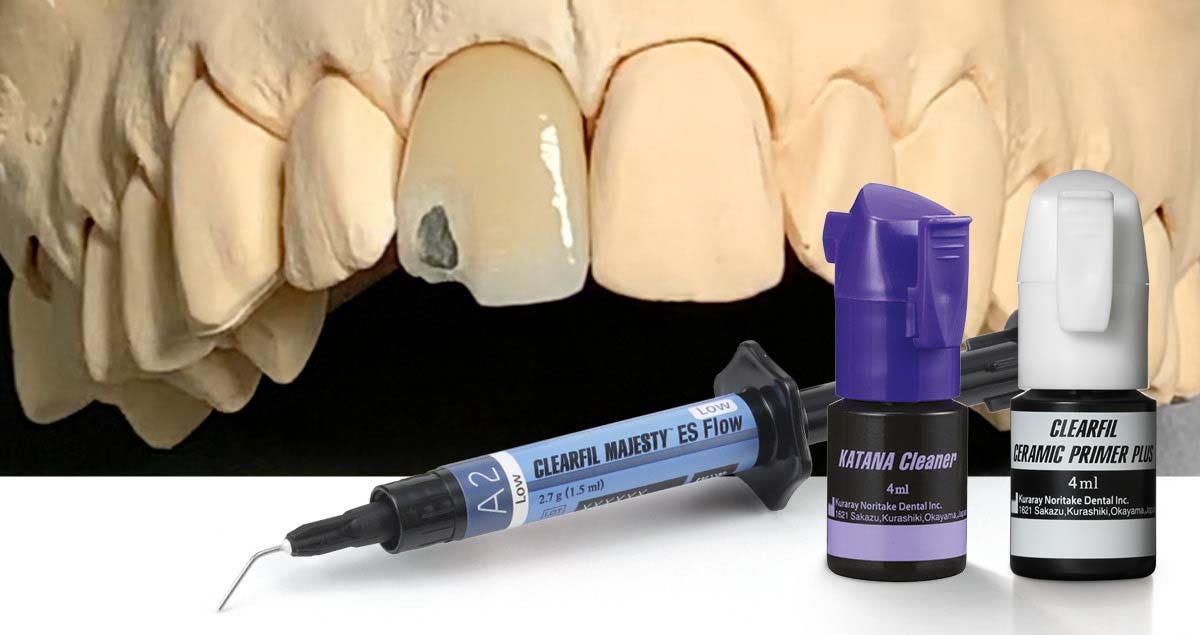
An adequately performed adhesive cementing procedure, including a clean dentine surface, seems important for the success of the coronal restoration of endodontically treated teeth.** Remaining sealer after post-space preparation negatively influences the bondability of the root canal dentine. Tian et al. conducted a study comparing the effectiveness of different sealer cleaning methods prior to bonding procedures. They found KATANA™ Cleaner to be capable of restoring the bonding potential to sealer contaminated dentine.
Direct Composite Resin Core Build-Ups
Today, the use of direct composite resins for core build-ups has become popular. Their use permits the conservation of dentine and facilitates adhesive bonding to the radicular and root dentine. The continuous development of (self-adhesive) resins, both cement and build-up materials, has provided greater applicability to endodontically treated tooth restoration. With proper tooth preparation, adhesive techniques and protocols, direct composite resin can provide predictable and long lasting results.
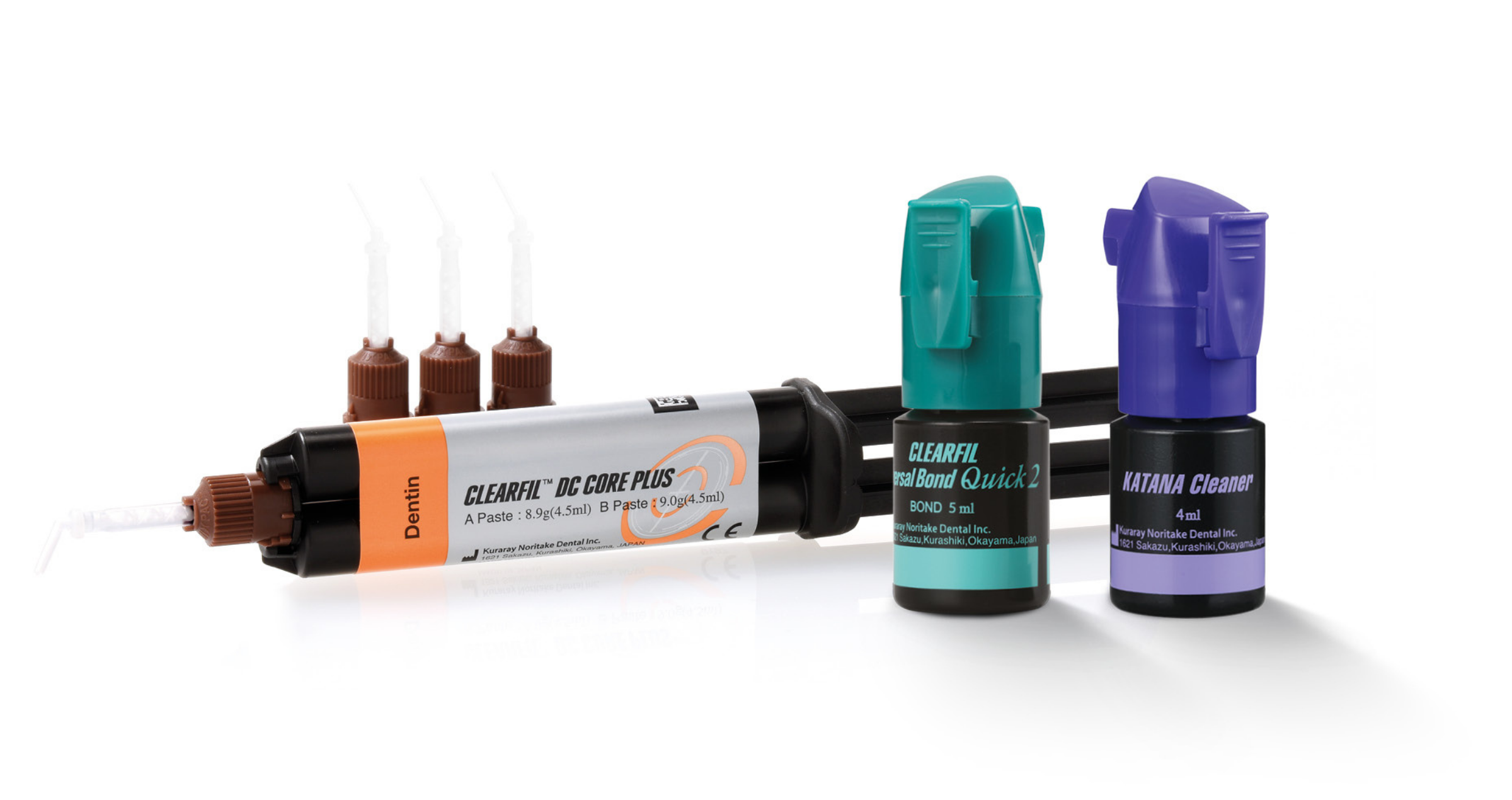
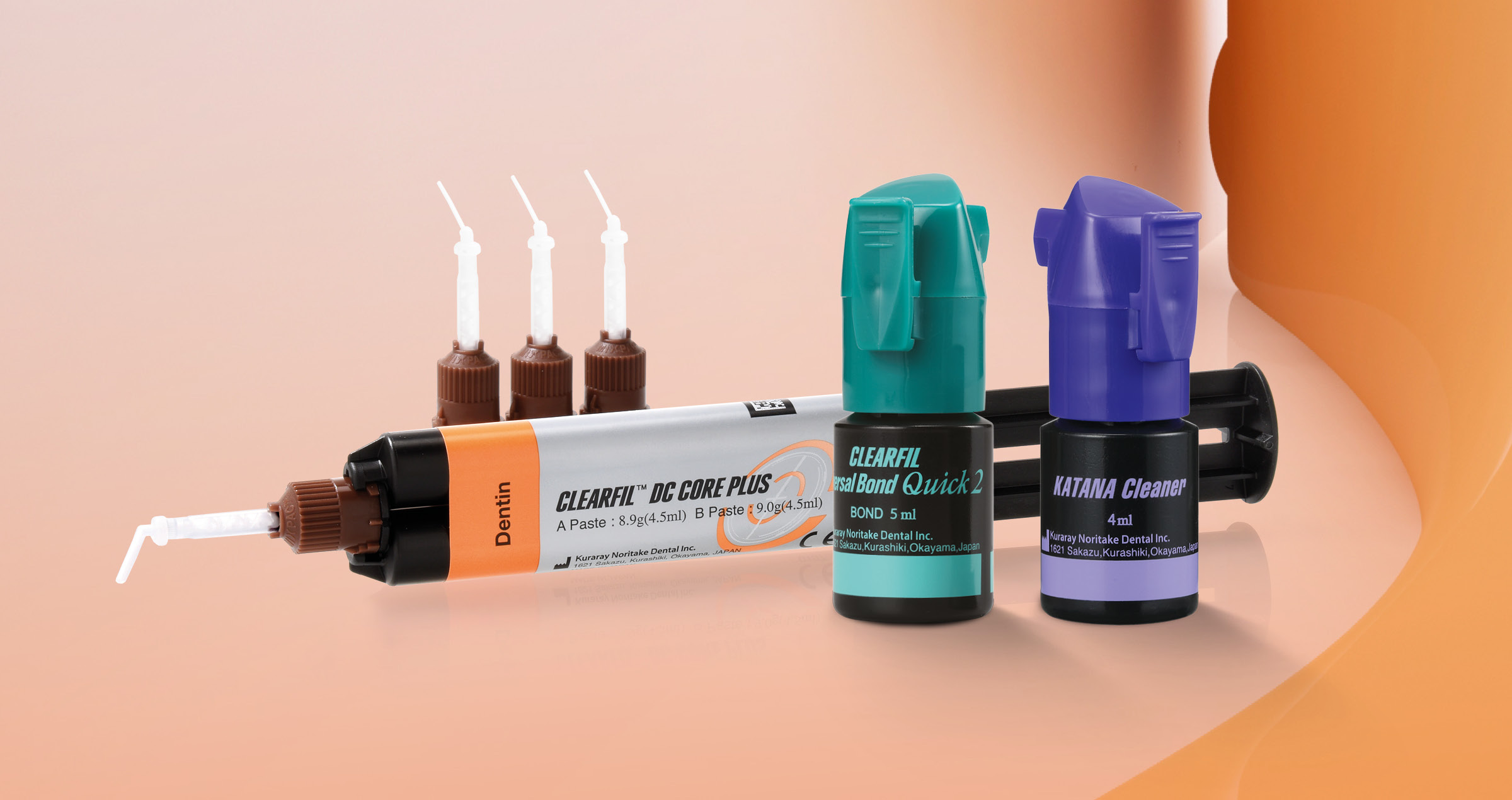
CLEARFIL Universal Bond Quick 2 and CLEARFIL DC CORE PLUS
Using adhesives in core build-ups and post & core restorations can be challenging because of the need for adequate energy from the curing light to polymerise the adhesive properly. To overcome curing problems in deeper root canal regions, manufacturers have developed self-cure promoters that can be added to light-curable adhesives. These, however, can lead to pooling of the adhesive in the apical area of post preparations, hampering the insertion of the post to the desired depth and also limit the working time. Kuraray Noritake Dental Inc. addressed this clinical issue with an advanced and improved single-component self-etch adhesive, CLEARFIL™ Universal Bond Quick 2, when combined with CLEARFIL™ DC CORE PLUS dual-cure core build-up resin composite. New initiators have been added to the adhesive and core build-up resin as an alternative to using a self-cure promoter, causing CLEARFIL Universal Bond Quick 2 to set when CLEARFIL DC CORE PLUS contacts the adhesive.
Improved properties
Kuraray Noritake Dental Inc. has improved their dual-cure core build-up resin, CLEARFIL DC CORE PLUS, to offer better flow during dispensing and stability afterwards of the uncured resin core material. The filler technology has been modified in a way that the paste became thixotropic. This "non-slumping formula" enables easy dispensing and allows the creation of a build-up without the need for a matrix. The improved flow also permits its use, combined with CLEARFIL Universal Bond Quick 2, for the cementation of posts, resulting in a product that is suitable for post cementation as well as the build-up.
Core composite or adhesive cement?
In clinical situations where a post is included, the post-cementing process can be covered with either CLEARFIL DC CORE PLUS or PANAVIA™ SA Cement Universal. The latter one can be used with or without CLEARFIL Universal Bond Quick 2. Choosing between the two products is, for a large part, dependent on the space between the post and the canal wall:
- Tight-fit: So-called tight-fit situations, meaning the post snugs tightly to the canal, might benefit from using a highly bondable resin cement of low thickness (PANAVIA SA Cement Universal).
- Loose-fit: Loose-fit cases need a larger amount of resin-based material and are better off using a material that has better physical properties for use as a filling material (CLEARFIL DC CORE PLUS) instead of cement.
CONCLUSION
The general prerequisite in modern dentistry is to preserve as much tooth structure as possible. Based on the premises identified in this article, the choice for the placement of a post and the use of the restorative materials can be decided based on the case in front of the clinician. The stability of core build-ups is no longer dependent on the support by a post. After analyzing the remaining tissue and keeping in mind the success factors for a strong bond, patients can be offered highly aesthetic and sustainable restorations without large interventions.
*This flowchart has been put together with the greatest care. The “workflows” shown in this article only intended as a brief indication of the actual procedure to follow. This procedure is for general information purposes only and no rights may be derived from it. Always follow the instructions for use (IFU) that come with the product(s). Please note that only a selection of treatment options have been explored. Our main focus is on the use of a core build-up composite and fibre post placement.
The following sources of information were used in writing this article:
• Zenthofer, A., Bermejo, J. L., Bomicke, W., Frese, C., Gulmez, R., Rammelsberg, P., & Ohlmann, B. (2022). Early failures when using three different adhesively retained core build-up materials-a randomized controlled trial. Clin Oral Investig, 26(2), 1927-1936. doi:10.1007/s00784-021-04170-6
• Tian, F., Jett, K., Flaugher, R., Arora, S., Bergeron, B., Shen, Y., & Tay, F. (2021). Effects of dentine surface cleaning on bonding of a self-etch adhesive to root canal sealer-contaminated dentine. J Dent, 112, 103766. doi:10.1016/j.jdent.2021.103766
• Bhuva, B., Giovarruscio, M., Rahim, N., Bitter, K., & Mannocci, F. (2021). The restoration of root filled teeth: a review of the clinical literature. Int Endod J, 54(4), 509-535. doi:10.1111/iej.13438
• Ozcan, M., & Volpato, C. A.M. (2020). Current perspectives on dental adhesion: (3) Adhesion to intraradicular dentine: Concepts and applications. Jpn Dent Sci Rev, 56(1), 216-223. doi:10.1016/j.jdsr.2020.08.002
• Lazari, P. C., de Carvalho, M. A., Del Bel Cury, A. A., & Magne, P. (2018). Survival of extensively damaged endodontically treated incisors restored with different types of posts-and-core foundation restoration material. J Prosthet Dent, 119(5), 769-776. doi:10.1016/j.prosdent.2017.05.012
• Carvalho, M. A., Lazari, P. C., Gresnigt, M., Del Bel Cury, A. A., & Magne, P. (2018). Current options concerning the endodontically-treated teeth restoration with the adhesive approach. Braz Oral Res, 32(suppl 1), e74. doi:10.1590/1807-3107bor-2018.vol32.0074
• Magne, P., Lazari, P. C., Carvalho, M. A., Johnson, T., & Del Bel Cury, A. A. (2017). Ferrule-Effect Dominates Over Use of a Fiber Post When Restoring Endodontically Treated Incisors: An In Vitro Study. Oper Dent, 42(4), 396-406. doi:10.2341/16-243-L
• Scotti, N., Rota, R., Scansetti, M., Migliaretti, G., Pasqualini, D., & Berutti, E. (2012). Fiber post adhesion to radicular dentine: The use of acid etching prior to a one-step self-etching adhesive. Quintessence Int, 43(7), 615-623. Retrieved from https://www.ncbi.nlm.nih.gov/pubmed/22670257
• Ferrari, M., Vichi, A., Fadda, G. M., Cagidiaco, M. C., Tay, F. R., Breschi, L., Goracci, C. (2012). A randomized controlled trial of endodontically treated and restored premolars. J Dent Res, 91(7 Suppl), 72S-78S. doi:10.1177/0022034512447949
• Breschi, L., Mazzoni, A., De Stefano Dorigo, E., & Ferrari, M. (2009). Adhesion to Intraradicular
• Dentine: A Review. Journal of Adhesion Science and Technology, 23(7-8), 1053-1083. doi:10.1163/156856109X440957
• Watzke, R., Blunck, U., Frankenberger, R., & Naumann, M. (2008). Interface homogeneity of adhesively luted glass fiber posts. Dent Mater, 24(11), 1512-1517.doi:10.1016/j.dental.2008.03.022
• Fokkinga, W. A., Kreulen, C. M., Bronkhorst, E. M., & Creugers, N. H. (2007). Up to 17-year controlled clinical study on post-and-cores and covering crowns. J Dent, 35(10), 778-786. doi:10.1016/j.jdent.2007.07.006
• Fokkinga W.A. Post it? Reconstruction of the endodontically treated tooth. Thesis. ISBN: 978-90-9021726-0
• Fokkinga, W. A., Kreulen, C. M., & Creugers, N. H. (2006). [In vitro fracture behaviour of composite crowns with and without posts]. Ned Tijdschr Tandheelkd, 113(8), 313-318. Retrieved from https://www.ncbi.nlm.nih.gov/pubmed/16933594