Optimizing intraoral and extraoral substrates for maximal adhesive potential

Article by Dr. Clarence Tam HBSc, DDS, FIADFE, AAACD


A NOVEL MDP-BASED SURFACTANT SOLUTION

The everyday practice of adhesive restorative dentistry, whether utilizing direct or indirect restorations, is fraught with the need for ideal environmental conditions to generate an optimal prognosis. The bonding of composite resin is the foundation of direct and indirect restoratives, as it provides the link between restoration and tooth. As dentistry strives to be minimally invasive, the treatment of the bonding interface is reflected in this philosophy by the use of self-etching multi-substrate acidic monomers such as 10-methacryloyloxyldecyl dihydrogen phosphate (10-MDP). There are myriad opportunities for both intaglio and fitting surfaces to be contaminated with varying agents to the detriment of restoration prognosis.


Some of the contaminants to be considered are of course, moisture from exhalation, ambient humidity in the oral cavity, blood, saliva and artificial sources such as provisional cement during a two-stage indirect delivery technique. Moisture is an agent which is only welcomed via a controlled approach during the dentin penetration phase of priming the substrate for adhesion, however if excessive in quantity will compromise the hybridization of the interface. Blood and saliva are ubiquitous in restorative dentistry, and best controlled via the application of rubber dam as part of an absolute isolation philosophy. Contamination of the prepared surface can also occur through artificial cements or lubrication agents. Hemostatic agents such as ferric sulfate and aluminum chloride have the ability to deposit insoluble precipitates on the surface of the tooth in a manner that 33% orthophosphoric acid can only partially remove. Also considered is the particulate deposition of dentin and enamel as part of standard tooth preparation. This smear layer is residual on the dentin surface, often occludes dentinal tubules, and is an obstacle that must be overcome in order to bond to the hydroxyapatite and collagen fibrils of the surface.


Overall, the risks to adhesive compromise and at worst, adhesive failure are high. This report details the use of a novel solution for debriding both indirect restorative and tooth intaglio with a 10-MDP salt-based solution that has the flexibility to be used both extraorally and intraorally.


ENDEMIC CONTAMINANTS: MOISTURE, BLOOD AND SALIVA

Moisture is a critical component to maximize the adhesive bond strength of certain modern universal adhesives. The presence of moisture allows for increased penetration of bonding solutions into dentinal tubules and between collagen fibrils, ultimately bolstering the resilience of the hybrid layer1. During the cementation of an indirect restoration, both salivary and blood contamination of the mating surfaces have been shown to have a deleterious effect on bond strengths, with blood contamination faring the worst in all conditions2. Van Meerbeck et al reported on technique sensitivity with one-step contemporary universal adhesives3. The basis of his findings note that these adhesives require water as an ionization medium for the self-etching reaction, with the need to evaporate water from the interfacial surfaces in order to maximize bond strengths. Despite this, these interfaces are considered semi-permeable which predisposes the hybrid layer to an increased risk of hydrolytic degradation in adhesive solutions that are not 2-hydroxyethyl methacrylate-free (HEMA-free), which has a greater affinity for water.


Periera et al tested varying degrees of wetness of dentin substrate controlled with variables such as short vs. long air blasts, wet vs. dry cotton pellets, microbrush use and an intentionally over-wet surface. In all groups, the “wettest” dentin intaglio surface resulted in the lowest shear bond strength4.


The influence of saliva and blood contamination is clearly negative in situations where the bonding interface was contaminated before or after adhesive application. For saliva, this reduction is due to the deposition of salivary glycoprotein on the surface, and relative to blood, macromolecules such as fibrinogen and platelets block access to the tubules for effective bonding. Blood contamination was found consistently to be more profoundly deleterious on bond strength relative to saliva2.


In general, on smear layer-affected dentin, chlorhexidine was consistently superior to other agents such as ethanol, EDTA, aloe vera in establishing the highest shear bond strength to dentin. On dentin that had previously been etched and contaminated with blood and saliva, the agent subsequently applied that showed the highest recovery of shear bond strength was 37.5% phosphoric acid5. A study on the nanomechanical and nanoroughness of etched dentin and self-etching adhesive treated dentin both contaminated with saliva revealed that KATANA™ Cleaner was capable of restoring control values of complex modulus and nanoroughness relative to control6.


SYNTHETIC WORKFLOW CONTAMINANTS: DENTAL STONE, HEMOSTATIC AGENTS, ROOT CANAL SEALERS AND PROVISIONAL CEMENTS

A 2020 study by Marfenko et al demonstrated that salivary contamination showed significantly lower bond strengths relative to intaglio contamination by dental stone from laboratory processes. The application of a silane coupling agent to the intaglio surface has a protective effect on the bond strength7. The caveat is that lithium disilicate-based restorations are often requested pre-etched with hydrofluoric acid from the laboratory. Often, the case is returned to the clinician on the secondary or primary model. If already treated with hydrofluoric acid, the surface can now be considered recontaminated with the stone or resin model or simply skin oils from handling. The unprotected surface needs to be decontaminated in any case following the try-in procedure, which now may feature elements of dental stone, blood and saliva, not to mention hemostatic agents such as aluminum chloride and ferric sulphate. If silane coupling agents are applied prior to try-in, the question of whether the intaglio surface was truly contaminant-free after removal from the model.


Aluminum chloride is a hemostatic agent that leaves an insoluble precipitate on the surface of the dentin, that is only partially removed when treated with phosphoric acid, resulting only in a partial recovery of shear bond strength relative to control. The application of ethylene diacetyl tetrasodium acetate (EDTA) returned the bond strengths to the level of normal dentin8. The bonding of polycrystalline ceramic restorations and metal alloys is contaminated with saliva upon try-in. This can be removed via steam cleaning and air particle abrasion set at 2.5 bar for 15 seconds9. Phosphoric acid is often mistakenly applied as a cleaning agent to the intaglio surface. In polycrystalline ceramics such as tetragonal zirconia polycrystal, this is disastrous, as phosphates will bond firmly to the free sites that the 10-MDP monomer normally bonds to as part of the APC protocol of zirconia bonding, significantly compromising bond strength (Blatz, 2016)10. A study of modern surface cleaners demonstrated successful debridement of the surface using KATANA™ Cleaner for both blood and saliva-contaminated substrates11, 12.


Provisional cements are thought to have a deleterious effect on the shear bond strength of adhesively-bonded indirect ceramic restorations. Ding et al (2022) uncovered that resin-based and non-eugenol cement use in the provisional phase decreased the bond strength relative to control, whilst the use of calcium hydroxide and polycarboxylate cements exhibited acceptable metrics. Debridement of the prepared surface with air particle abrasion (APA) resulted in recovery of decreased bond values to that of control13. Equally useful was the application of Immediate Dentin Sealing (IDS)14, a technique characterized ideally by APA before adhesive bonding and the application of a resin coat, occluding both the dentin tubules as well as the oxygen inhibition layer, allowing the resin-dentin bond to mature and strengthen in the absence of stresses. This approach is effective in minimizing post-operative hypersensitivity and bacterial ingress, as well as optimizing the shear bond strength particularly when indirect ceramics are concerned15. Hardan et al found that the shear bond strength was highest when IDS was completed using a three-step etch and rinse adhesive protocol14.


Hemostatic agents used in clinical dentistry exhibit a pH of 1.1 to 3.0 and are as acidic as self-etching primers16. Chaibutyr and Kois found that dentin when contaminated with 25% aluminum chloride or 13% ferric sulphate demonstrated a significantly lower shear bond strength to dentin, which was significantly recovered using the etch-and-rinse approach17. This approach albeit successful was only able to achieve partial reversal of shear bond strength deficits relative to control, with a pre-etching application of EDTA required in order for full recovery8. KATANA™ Cleaner was found to have a positive effect on the cleaning of dentin contaminated with both aluminum chloride and ferric sulphate.


The bonding of dentin substrate contaminated with root canal sealers is a concern for the integrity of core buildups post-endodontic treatment. The use of  KATANA™ Cleaner was found to be generally superior to the ethanol test subgroup in the removal of zinc-oxide eugenol-based sealer with equal performance to 70% ethanol for the epoxy resin-based sealer18.


CLINICAL CASE DEMONSTRATION

A 35 year old ASA 1 female patient presented to the practice with multiple failing composite restorations in the second quadrant that were planned for replacement. Prior to the delivery of topical and local anaesthesia, it is common procedure in the practice to ascertain shade specifics of planned restoratives before potential dehydration can affect the optical properties of the natural tooth. Smart monochromatic composites (Fig. 1) are a class of direct restoratives that leverages the ability of its nanofiller composition and refractive index to mimic the structural color of the surrounding enamel and dentin19. This typically enables a clinician to have a simplified selection of shades on hand.


Two carpules of 2% Lignocaine with 1:100,000 epinephrine were delivered via buccal infiltration before absolute isolation was achieved using a non-latex rubber dam (Isodam HD Heavy, 4D Rubber, UK) (Fig. 2). The old restorations were excavated along with caries (Fig. 3), and the dentin structure assessed for residual decay with a detector dye (Caries Detector, Kuraray Noritake Dental Inc.). The preparation cavosurface margins were gently bevelled before surface treatment with air particle abrasion (30psi, 29 micron aluminum oxide in a 17.5% ethanol carrier, Aquacare UK) (Fig. 4). The enamel margins were etched with 33% orthophosphoric acid and rinsed (Fig. 5). The preparation surfaces were decontaminated further of any residual smear or powder residue using a MDP-based surfactant (KATANA™ Cleaner, Kuraray Noritake Dental Inc.) (Fig. 6). A single step self-etching universal adhesive was applied to the preparation as per manufacturer instructions and air thinned before light curing (Fig. 7).


Fig. 1


Fig. 2


Fig. 3


Fig. 4


Fig. 5


Fig. 6


Fig. 7


A matrix-in-matrix approach was utilized for the second bicuspid as the first step to allow for simultaneous anatomic construction of the mesial and distal marginal ridges. This technique does not require the use of a wedge as the outer circumferential Tofflemire matrix (Omnimatrix, Ultradent Products) tightens cervically around the inner anatomically-curved sectional matrix (Garrison Firm Band, Garrison Dental Solutions) allowing for a hermetic gingival seal (Fig. 8). If required, the setup may be further modified by the use of Teflon inserted between the two matrices to provide better proximofaciolingual adaptation. As a result, finishing and contour creation post-band removal is kept to a minimum. Following this, a traditional sectional matrix system may be employed to close contacts and build marginal ridges in the conventional manner (Fig. 9).


Following marginal ridge construction, the matrix assembly was removed and with the Class II lesions converted into a Class I situation, microlayering proceeded with a high flexural strength flowable liner (CLEARFIL MAJESTY™ Flow, Kuraray Noritake Dental Inc.) prior to the application of a monochromatic composite resin (CLEARFIL MAJESTY™ ES-2 Universal U shade, Kuraray Noritake Dental Inc.). The buccal cusps were constructed first as the author considers this essential to establishing restoration lobe proportions (Fig. 10). Subsequent layers were completed in a lobe-by-lobe approach to finish the occlusal anatomy (Fig. 11 and 12). The restoration was checked for occlusal functional conformativity, finished and polished to high shine (Fig. 13).


Fig. 8


Fig. 9


Fig. 10


Fig. 11


Fig. 12


Fig. 13


DISCUSSION

Dental substrates are often contaminated in both direct and indirect restorative processes. Historically, etch-and-rinse approaches have been successful for at least the partial recovery of bond strength however it is not practical in situations where selective or self-etching is the adhesive strategy. The restorative dentist in these cases can use the 10-MDP monomer in self-etching systems to target non-demineralized dentin such as CLEARFIL™ Universal Bond Quick to establish an acid base resistance zone (ABRZ) otherwise known as Super Dentin20. The presence of the operative smear layer impedes full access of the self-etching primer to the dentin substrate in some cases. In such cases, without KATANA™ Cleaner, APA is required to transform the substrate back to control bonding potential. APA as a modality is only utilized by a subset of dental practitioners often due to financial constraints or lack of technique experience. KATANA™ Cleaner thus represents a versatile tool for the decontamination and  optimization of substrate surfaces for adhesive bonding both in intraoral and extraoral applications. Its ability to re-establish ideal bonding values in areas that are not effectively reached by APA such as endodontic canal anatomy in a non-invasive manner literally cements it as a truly indispensable tool for the modern restorative dentist.


Disclaimer: Some indications are not described in the product’s Instructions for Use and are based on published research and/or the author’s experience. Before using each product, read carefully the Instructions for Use supplied with the product for full details and workflows.


Dentist:

CLARENCE TAM


References

1. Sugimura R, Tsujimoto A, Hosoya Y, Fischer NG, Barkmeier WW, Takamizawa T, Latta MA, Miyazaki M. Surface moisture influence on etch-and-rinse universal adhesive bonding. Am J Dent. 2019 Feb;32(1):33-38. PMID: 30834729.
2. Taneja S, Kumari M, Bansal S. Effect of saliva and blood contamination on the shear bond strength of fifth-, seventh-, and eighth-generation bonding agents: An in vitro study. J Conserv Dent. 2017 May-Jun;20(3):157-160. doi: 10.4103/0972-0707.218310. PMID: 29279617; PMCID: PMC5706314.
3. Van Meerbeek B, Van Landuyt K, De Munck J, Hashimoto M, Peumans M, Lambrechts P, Yoshida Y, Inoue S, Suzuki K. Technique-sensitivity of contemporary adhesives. Dent Mater J. 2005 Mar;24(1):1-13. doi: 10.4012/dmj.24.1. PMID: 15881200.
4. Pereira GD, Paulillo LA, De Goes MF, Dias CT. How wet should dentin be? Comparison of methods to remove excess water during moist bonding. J Adhes Dent. 2001 Fall;3(3):257-64. PMID: 11803713.
5. Haralur SB, Alharthi SM, Abohasel SA, Alqahtani KM. Effect of Decontamination Treatments on Micro-Shear Bond Strength between Blood-Saliva-Contaminated Post-Etched Dentin Substrate and Composite Resin. Healthcare (Basel). 2019 Nov 1;7(4):128. doi: 10.3390/healthcare7040128. PMID: 31683858; PMCID: PMC6956069.
6. Toledano M, Osorio E, Espigares J, González-Fernández JF, Osorio R. Effects of an MDP-based surface cleaner on dentin structure, morphology and nanomechanical properties. J Dent. 2023 Nov;138:104734. doi: 10.1016/ j.jdent.2023.104734. Epub 2023 Oct 2. PMID: 37793561.
7. Marfenko S, Özcan M, Attin T, Tauböck TT. Treatment of surface contamination of lithium disilicate ceramic before adhesive luting. Am J Dent. 2020 Feb;33(1):33-38. PMID: 32056413.
8. Ajami AA, Kahnamoii MA, Kimyai S, Oskoee SS, Pournaghi-Azar F, Bahari M, Firouzmandi M. Effect of three different contamination removal methods on bond strength of a self-etching adhesive to dentin contaminated with an aluminum chloride hemostatic agent. J Contemp Dent Pract. 2013 Jan 1;14(1):26-33. doi: 10.5005/jp-journals-10024-1264. PMID: 23579888.
9. Yang B, Lange-Jansen HC, Scharnberg M, Wolfart S, Ludwig K, Adelung R, Kern M. Influence of saliva contamination on zirconia ceramic bonding. Dent Mater. 2008 Apr;24(4):508-13. doi: 10.1016/j.dental.2007.04.013. Epub 2007 Aug 6. PMID: 17675146.
10. Blatz MB, Alvarez M, Sawyer K, Brindis M. How to Bond Zirconia: The APC Concept. Compend Contin Educ Dent. 2016 Oct;37(9):611-617; quiz 618. PMID: 27700128. (7)
11. Awad MM, Alhalabi F, Alzahrani KM, Almutiri M, Alqanawi F, Albdiri L, Alshehri A, Alrahlah A, Ahmed MH. 10-Methacryloyloxydecyl Dihydrogen Phosphate (10-MDP)-Containing Cleaner Improves Bond Strength to Contaminated Monolithic Zirconia: An In-Vitro Study. Materials (Basel). 2022 Jan 28;15(3):1023. doi: 10.3390/ma15031023. PMID: 35160968; PMCID: PMC8838745.
12. Tian F, Londono J, Villalobos V, Pan Y, Ho HX, Eshera R, Sidow SJ, Bergeron BE, Wang X, Tay FR. Effectiveness of different cleaning measures on the bonding of resin cement to saliva-contaminated or blood-contaminated zirconia. J Dent. 2022 May;120:104084. doi: 10.1016/j.jdent.2022.104084. Epub 2022 Mar 3. PMID: 35248674.
13. Ding J, Jin Y, Feng S, Chen H, Hou Y, Zhu S. Effect of temporary cements and their removal methods on the bond strength of indirect restoration: a systematic review and meta-analysis. Clin Oral Investig. 2023 Jan;27(1):1530. doi: 10.1007/s00784-022-04790-6. Epub 2022 Nov 24. PMID: 36422719; PMCID: PMC9877054.
14. Hardan L, Devoto W, Bourgi R, Cuevas-Suárez CE, Lukomska-Szymanska M, Fernández-Barrera MÁ, Cornejo Ríos E, Monteiro P, Zarow M, Jakubowicz N, Mancino D, Haikel Y, Kharouf N. Immediate Dentin Sealing for Adhesive Cementation of Indirect Restorations: A Systematic Review and Meta-Analysis. Gels. 2022 Mar 11;8(3):175. doi: 10.3390/gels8030175. PMID: 35323288; PMCID: PMC8955250.
15. Samartzi TK, Papalexopoulos D, Sarafianou A, Kourtis S. Immediate Dentin Sealing: A Literature Review. Clin Cosmet Investig Dent. 2021 Jun 21;13:233-256. doi: 10.2147/CCIDE.S307939. PMID: 34188553; PMCID: PMC8232880.
16. Woody RD, Miller A, Staffanou RS. Review of the pH of hemostatic agents used in tissue displacement. J Prosthet Dent. 1993 Aug;70(2):191-2. doi: 10.1016/0022-3913(93)90018-j. PMID: 8371184.
17. Chaiyabutr Y, Kois JC. The effect of tooth-preparation cleansing protocol on the bond strength of self-adhesive resin cement to dentin contaminated with a hemostatic agent. Oper Dent. 2011 Jan-Feb;36(1):18-26. doi: 10.2341/09-308-LR1. Epub 2011 Feb 21. PMID: 21488725.
18. Tian F, Jett K, Flaugher R, Arora S, Bergeron B, Shen Y, Tay F. Effects of dentine surface cleaning on bonding of a self-etch adhesive to root canal sealer-contaminated dentine. J Dent. 2021 Sep;112:103766. doi: 10.1016/j.jdent.2021.103766. Epub 2021 Aug 5. PMID: 34363888.
19. Ahmed MA, Jouhar R, Khurshid Z. Smart Monochromatic Composite: A Literature Review. Int J Dent. 2022 Nov 8;2022:2445394. doi: 10.1155/2022/2445394. PMID: 36398065; PMCID: PMC9666026.
20. Nikaido T, Weerasinghe DD, Waidyasekera K, Inoue G, Foxton RM, Tagami J. Assessment of the nanostructure of acid-base resistant zone by the application of all-in-one adhesive systems: Super dentin formation. Biomed Mater Eng. 2009;19(2-3):163-71. doi: 10.3233/BME-2009-0576. PMID: 19581710.


Simplifying esthetic composite reconstructions using CLEARFIL MAJESTY™ ES-2 Universal

Article by Dr. Clarence Tam HBSc, DDS, FIADFE, AAACD


A CHAMELEON SUPERCOMPOSITE


INTRODUCTION

The name of the game in modern-day esthetic and restorative dentistry is that of Responsible Esthetics. The goal of treatment typically strives to correct any structural and cosmetic shortfalls in both biologically-driven and trauma-affected teeth with the precise, artistic placement of various replacement layers, all whilst respecting and retaining a maximal volume of residual tooth structure. Anterior teeth can be affected by enamel and dentin dysplasia, caries and sclerotic conditions and are characterized by a laundry list of genetically-derived and environmentally-acquired conditions with an esthetic deficit that often threaten an individual’s functional and psychosocial integrity if not restored to the seamless picture of health.


Missing and defective tooth structure must be categorized into its attendant enamel and dentin components. Both substrates are distinctly different in composition, with enamel being highly inorganic in nature and dentin proportionately more collagenous in nature. The latter stratum is responsible for the refraction of light, the expression of the true color of the tooth, namely the hue and the endowment of fracture toughness or resilience in functional performance. The value and chroma are the other elements of color and are modified by the thickness of enamel. The replacement of enamel has been found to be best substituted from a biomechanical perspective by adhesively-bonded indirect porcelain restorations, and dentin using both composite resin and short fiber reinforced composite (SFRC), the latter imparting increased fracture toughness in large volume replacement restorations, especially those with pericervical structural deficits.


In adolescent patients, the gold standard of treatment involves direct composite resin, as often zero to minimal tooth structure preparation is required as a foundation to the bonded restorative. It would be impractical to use bonded indirect restorations when the development of the dentition in puberty is continuous, especially with the retraction of gingiva as one progresses to young adulthood. Resin composite allows prescience in the opportunity to predictably modify and/or add to the existing restoration if dental bleaching for the other teeth is desired or if a further traumatic incident is encountered. The ability to modify bonded porcelain is not predictable and frequent marginal failures occur due to a lower shear bond strength to bonded composite, especially after thermocycling. This is despite our ability to establish a chemical linkage via silane coupling agents from silicate ceramics to resin composite especially at a blended interface.


STATEMENT OF PROBLEM

Dental shades in clinical dentistry have long been classified using the VITA* Classical A1 – D4 shade guide. Despite being ubiquitous in dental practices, composite resin systems with corresponding shade systems do not satisfactorily match to their purported shade1. Floriani et al found that various mixtures of different shades in one system was required to achieve an acceptable color match with the VITA* Classical shades using the CIEDE2000 formula. Testing another composite resin, they found that none of the A1, A2 or A3 shades matched acceptably to the standard shade guide2. Indeed, even with indirect ceramic layering systems, a wide range of unacceptable discrepancy was noted between VITA* labeled porcelain shades and the actual shade guide3. The VITA* Classical shade guide became the standard in dental shade classification with the release of its A1-D4 shade guide in 1985. The majority of human-tested dental shades has been found to be in the A-family (78.5%), followed by C (13.2%), D (5.2%) and B (3.1%)1. As such, the shade accuracy of a given composite system must be important if they are to be visually naturomimetic.


CHAMELEON EFFECT DEVELOPMENT

There are myriad composite resin systems featuring a simplified shade Universal system that have acceptable chameleon effects due to their balance of translucency, light transmission, diffusion and refractive index properties. There is a concern over how these optical properties may change after both thermocycling and wet storage, potentially compromising the excellent initial esthetic blend4. Refractive index (RI) is best optimized when the RI of the inorganic fillers match closely with the RI of the cured organic matrix, typically in a range between 1.47 and 1.525. If the match is dissimilar, this drives up the opacity of the restoration due to heightened refraction and reflection at the filler/matrix interface6.


Layering of composite to mask an intraoral defect is complicated by the need to mask any linear defects such as fracture lines superimposed over the shadowing of the dark intraoral cavity in addition to regional color variations. It is confounded by the requirement to recreate natural maverick and translucent effects particularly in the incisal window region of upper and lower incisors and canines, giving the illusion of a virgin, healthy tooth. This has been historically difficult to accomplish in anterior teeth given the need to block out restorative interfaces with natural tooth structure and recreate a seamless internal structure and details. This detailed layer belies a well contoured enamel layer with realistic translucency, polishability and accurate primary and secondary anatomy.


Adding to the complexities described above, the histoanatomical approach to composite layering dictates that missing enamel is replaced by enamel shades, and dentin by the corresponding dentin shade in the appropriate shade. This shade must be selected at the very start of the appointment, as often even a minute of dehydration has a negative effect on both the perceptibility threshold and acceptability threshold of teeth7, resulting in the incorrect shade.


DEVELOPMENT

CLEARFIL MAJESTY™ ES-2 is a value-based super-nanofilled composite system that covers 15 VITA* shades in just 4 shade options with its Universal series. This Universal series provides a chameleon effect and has 4 variants: Universal (U), Universal Light (UL), Universal Dark (UD) and Universal White (UW). It is the VITA*-approved shading concept relative to color accuracy. Incorporating nano-fillers that consist of silanated barium glass fillers and slanted silica nanoclusters, its wear resistance is high and features minimal abrasiveness against the functional antagonist. The RI of both inorganic filler and organic matrix are well-matched, and the high refractive index of the composite mimics and is extremely similar to natural enamel (1.613) and dentin (1.540), thanks to an innovation labeled Light Diffusion Technology (LDT), which distorts light in a similar way dental tissue does8. There is comfort that the stability of refractive index and other optical transmission properties remains statistically stable even after artificial thermocycling and water-storage aging studies4. The color stability of CLEARFIL MAJESTY™ ES-2 has been proven over time, where a direct comparison to Filtek Ultimate showed CLEARFIL MAJESTY™ ES-2 to feature significantly less color variation from baseline and marginal functional wear over a three to four year period in teeth featuring amelogenesis imperfecta9. This color substantivity is important as dietary and environmental stressors applied over time should have as minimal effect on the restoration to ensure continued esthetic integration.


CLINICAL PROTOCOL

CLEARFIL MAJESTY™ ES-2 Universal is a monochromatic solution that covers the five key shades featured in the CLEARFIL MAJESTY™ ES-2 Premium. As such, it exhibits the most significant LDT relative to all five shades, as its ability is equal when blending to higher value translucent shades as it does to cervical chromatic shades. In a Class IV restoration with a defined fracture line, the challenge is to restore the tooth in a minimal volume of available space. The alchemy requires a complete visual occlusion of the fracture line position, and recreation of internal and external opaque and translucent anatomy along with maverick staining, craze lines and effects. In anterior teeth, the idiom of “the less you see, the less you notice” is not true, especially due to the presence of incisal edge window effects as above, however, materials with the best light diffusion and structure transference properties should be utilized to ensure the highest probability of success.


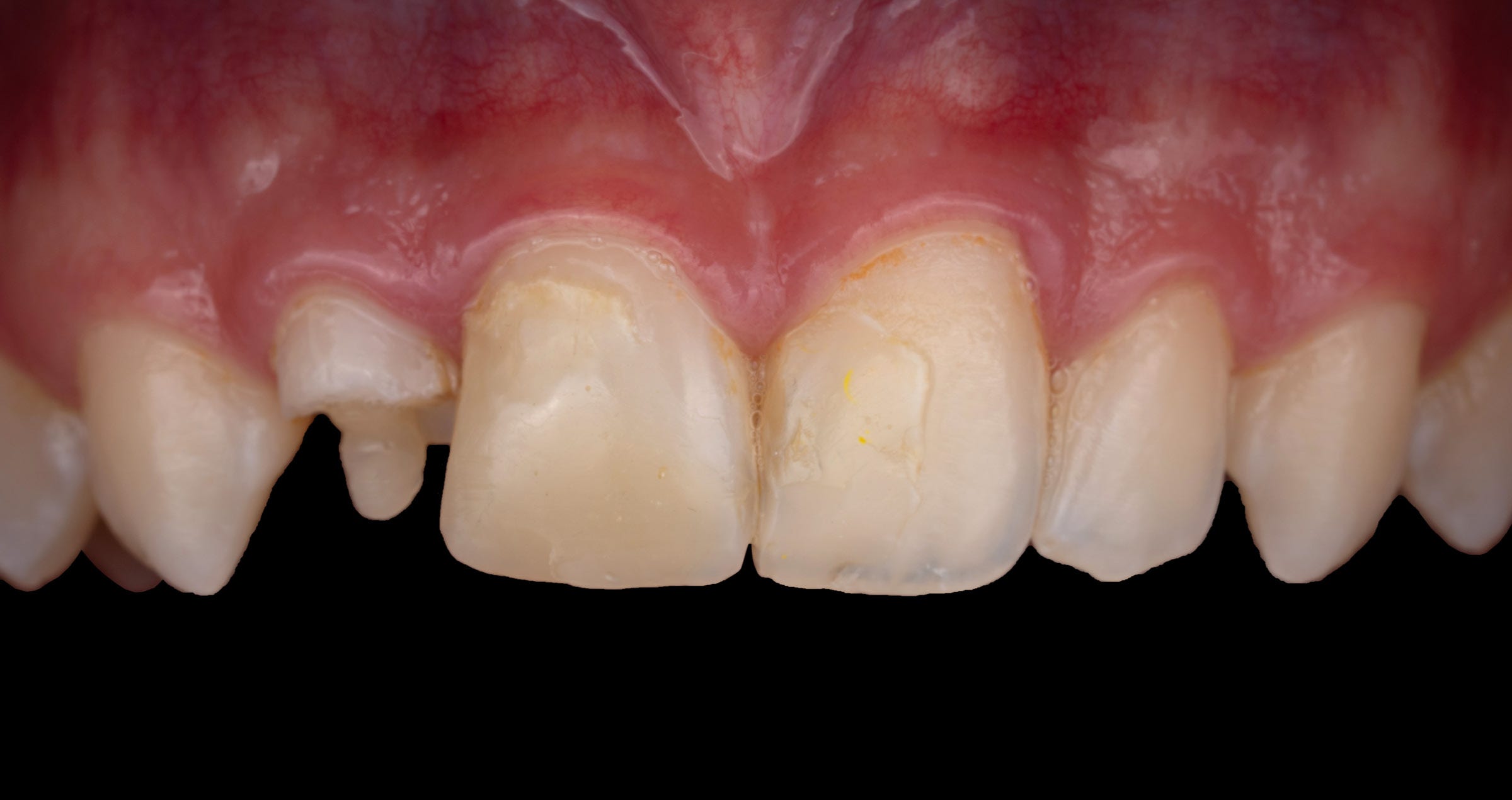
A 15 year old ASA I female presented to the practice exhibiting aged, chromatic composite restorations with poor marginal integration and gross axial overhangs; essentially a gross failure of primary anatomy and esthetics. She had been involved in a bike accident where she high-sided off braking sharply in a face-meets-concrete scenario, resulting in an uncomplicated moderate enamel-dentin fracture with blushing, affecting both the facial and palatal aspects of tooth 1.1 and a mild uncomplicated enamel dentin fracture affecting the distoincisobuccolingual aspect of tooth 2.1. The restoration overhangs were significant, extending into the proximal contour zone, thus obviating effective interdental cleaning. Vitality tests were confirmed along with radiographs to exclude the presence of apical pathology. The patient accepted the option of pre-prosthetic whitening, to improve the value characteristics of the adjacent teeth, allowing the selection of a brighter value shade combination. Intraoral digital scans were acquired and custom bleaching trays with a no reservoir, cervical seal-priority design were fabricated. The patient was instructed to bleach overnight for a 2 week period using a 10% carbamide peroxide solution (Opalesence, Ultradent Products, UT) until her maximal value was reached. Her baseline shade of the incisors was a 1M1/2M1 combination in the upper incisors and a 2M1 in the lower incisors. On final post-bleach assessment she exhibited a lightened shade of VITA* 0M3 in all incisors. The patient was instructed to use a fluoride-containing, amorphous calcium phosphate complex (ToothMousse Plus, GC America) during the following 2 weeks after cessation of whitening whilst the residual oxygen radical species dissipated from the teeth.


Fig. 1. Pre-operative unrestricted smile 1:2 ratio view, teeth 1.1 and 2.1 with old, defective composite restorations with excessive chroma.


On the day of the procedure, the pre-dehydrated shade was assessed using the supplied “real composite” shade guide tabs featured in the CLEARFIL MAJESTY™ ES-2 Premium system, with the enamel shade being WE (White Enamel) and the dentin shade WD (White Dentin). It was assessed that both white maverick effects as well as a moderate halo effect was desired along with moderate to strong translucency in the incisal window.


The patient was anesthetized using 1.5 carpules of 2% Lignocaine with 1:100,000 epinephrine (Septodont) before a rubber affixed with individual ties for the central incisors (NicTone Medium). Excavation of the old restorative material was undertaken, and the residual natural incisal edge was found to be undermined by a through-and-through fracture. Thus, the preparation was converted into a true Class IV design, with the facioincisal cavosurface margin subjected to an infinity bevel. The maxillary central incisors were isolated from the lateral incisors by way of a serrated metal strip (Komet) and the prepared surfaces subjected to micro particle abrasion using a 29 micron aluminum oxide powder in 17.5% ethanol carrier (Aquacare). The surfaces were subsequently treated with a calcium sodium phosphosilicate powder (Sylc, Aquacare) to increase the inorganic content of the prepared surface especially extending into the exposed tubules. The teeth were etched using a 33% orthophosphoric acid before a 1 minute 2% chlorhexidine scrub (Vista Products). The surface was reduced to a moist dentin surface before the bond applied, air thinned and cured.


A Mylar strip was pre-crimped in the palatoproximal line angles and positioned on the linguoaxial surface of both teeth 1.1 and 2.1. There is no shade guide for the CLEARFIL MAJESTY™ ES-2 Universal U shade, as it bears a significant chameleon effect however it does come in a light (L) and dark (D) variant. The UL shade was deemed the most suitable for the palatal or lingual shelf, with an average thickness of 0.3mm. This layer was applied in a freehand fashion with a focus on establishing the desired outline form of the tooth relative to the contralateral 2.1. The Mylar matrix setup was removed and a precurved metal matrix (Garrison Slickband, Garrison Dental) was oriented in a position perpendicular to its normal placement interproximally, and the end of the curved band tucked into the sulcus before being secured by a wedge. In this way, there is light separation of the central incisors and an intimate contact between the matrix band and the mesial edge of the freshly applied lingual shelf. A 0.5mm frame extending more than halfway through the contact point was created and cured. The process was repeated on tooth 2.1 with the goal of recreating both lingual and proximal walls of the restoration, leaving only the facial volume to be replaced.


Fig. 2. Pre-crimped Mylar matrix repeated on the DIBP aspect of tooth 2.1 to close the available space. CLEARFIL MAJESTY™ ES-2 Universal UL is used here.


Block-out of the composite extensions against the natural tooth structure was achieved by opacification using an opaque composite resin (WD, CLEARFIL MAJESTY™ ES-2 Premium, Kuraray Noritake Dental Inc.) layered in both horizontal and vertical increments. It is noted that the restorative join line must be completely obscured at the end of layering the dentin volume, otherwise the case will have almost certain esthetic failure. The internal dentin anatomy and its inherent variation was created to mirror that of the 2.1, which had minimal compromise of its incisal window with details intact. A super translucent composite resin (Clear, CLEARFIL MAJESTY™ ES-2 Premium, Kuraray Noritake Dental Inc.) was placed between the lobes of the dentin layers and cured. A 9:1 ratio of white: orange tint was mixed and placed on the incisal edge and proximoincisal corners to recreate the halo effect. A pure white tint was placed in gentle dentin mamelon-connecting spider legs up to the incisal edge to impart the realism. This was layered in a manner consistent with the appearance of the 2.1.


Fig. 3. Both horizontal and vertical dentin composite increments are demonstrated mimicking the contralateral tooth.


Fig. 4 & 5. Final immediate post-operative result after finishing and polishing.


DISCUSSION

The esthetic merit of this case is foundationally supported by composite resin technology on multiple levels. The color and physical stability over time needs to be proven in order for the clinician to have faith in its prognostication. Specifically, the material needs to have an excellent and well-matched refractive index, and one that is unaffected by both water and thermocycling stressors.


The palatal shelf was fabricated using a new-generation super nano-filled universal composite system that boasts a strong chameleon effect. If it is our intention to fool the eye, to obscure, then this first layer works well to start the blockout process of the darkness of the mouth behind the fracture line of the restored tooth. Following this, the chroma and value of the tooth are corrected using the dentin, simultaneous to its continued opacification of the fracture line and intraoral darkness. Both dentin and enamel layers are applied histoanatomically, that is, in a manner respecting the various thickness zones observed in nature.


Ultimately, esthetic success in direct composite resin is not dictated on the first day post-operatively. Factors are in play, from dehydration to occlusal wrinkles that need to be ironed out and corrected. The win depends on what material is used, along with how that material was developed to what standards, and why shade accuracy is so important in a world of variety. In a dental world with myriad composite options, we are looking for precision. Precision in technology leads to efficiency and physicoesthetic maintenance in clinical results. This ultimately results in a boost to clinician-patient confidence and an optimal prognosis.

Dentist:

CLARENCE TAM


*VITA is a trademark of VITA Zahnfabrik, Bad Sackingen, Germany


References


1. Elamin HO, Abubakr NH, Ibrahim YE. Identifying the tooth shade in group of patients using Vita Easyshade. Eur J Dent. 2015 Apr-Jun;9(2):213-217. doi: 10.4103/1305-7456.156828. PMID: 26038652; PMCID: PMC4439848.
2. Floriani F, Brandfon BA, Sawczuk NJ, Lopes GC, Rocha MG, Oliveira D. Color difference between the vita classical shade guide and composite veneers using the dual-layer technique. J Clin Exp Dent. 2022 Aug 1;14(8):e615-e620. doi: 10.4317/jced.59759. PMID: 36046166; PMCID: PMC9422970.
3. Gurrea J, Gurrea M, Bruguera A, Sampaio CS, Janal M, Bonfante E, Coelho PG, Hirata R. Evaluation of Dental Shade Guide Variability Using Cross-Polarized Photography. Int J Periodontics Restorative Dent. 2016 Sep-Oct;36(5):e76-81. doi: 10.11607/prd.2700. PMID: 27560681.
4. Almasabi W, Tichy A, Abdou A, Hosaka K, Nakajima M, Tagami J. Effect of water storage and thermocycling on light transmission properties, translucency and refractive index of nanofilled flowable composites. Dent Mater J. 2021 May 29;40(3):599-605. doi: 10.4012/dmj.2020-154. Epub 2020 Dec 24. PMID: 33361663.
5. Arai Y, Kurokawa H, Takamizawa T, et al.. Evaluation of structural coloration of experimental flowable resin composites. J Esthet Restor Dent. 2020;e12674.
6. Ota M, Ando S, Endo H, et al.. Influence of refractive index on optical parameters of experimental resin composites. Acta Odontol Scand. 2012;70(5):362–367.
7. Suliman S, Sulaiman TA, Olafsson VG, Delgado AJ, Donovan TE, Heymann HO. Effect of time on tooth dehydration and rehydration. J Esthet Restor Dent. 2019 Mar;31(2):118-123. doi: 10.1111/jerd.12461. Epub 2019 Feb 23. PMID: 30801926.
8. Meng Z, Yao XS, Yao H, Liang Y, Liu T, Li Y, Wang G, Lan S. Measurement of the refractive index of human teeth by optical coherence tomography. J Biomed Opt. 2009 May-Jun;14(3):034010. doi: 10.1117/1.3130322. PMID: 19566303.
9. Tekçe N, Demirci M, Sancak EI, Güder G, Tuncer S, Baydemir C. Clinical Performance of Direct Posterior Composite Restorations in Patients with Amelogenesis Imperfecta. Oper Dent. 2022 Nov 1;47(6):620-629. doi: 10.2341/21-106-C. PMID: 36281978.


Wishing you a wonderful Holiday Season!

2025 MARKS THE YEAR OF THE SNAKE

We wish you a successful New Year and hope you will join us on our journey in 2025.


WISHING YOU AN INNOVATIVE YEAR!


Individualisation of monolithic zirconia restorations

Article by Dr. Florian Zwiener


Modern multi-layered zirconia such as KATANA™ Zirconia STML (Kuraray Noritake Dental Inc.) already meets high aesthetic demands due to its natural colour gradient and high translucency. To achieve further characterisation and optical adjustment to the adjacent teeth, there are essentially two options: veneering with feldspathic ceramic or glazing and individualisation with ceramic stains.


While there are still many indications for veneering, especially in the anterior area, more and more cases can now be solved with monolithic restorations. This allows for a time-efficient chairside workflow with same-day treatment, eliminating the need for temporary restorations. Additionally, the absence of a porcelain layer reduces the wall thickness of the restoration and thus the space required, allowing for less invasive preparation. This also reduces the risk of endodontic complications induced by tooth preparation (grinding trauma). Another advantage is a significant reduction in the chipping risk.


Below are the essential steps for individualisation using ceramic stains, demonstrated through the example of a molar crown.


PREPARATION

The restoration is designed in full contour as usual, ideally dry-milled, and then sintered. After sintering, the restoration is first sandblasted (aluminium oxide 50 μm, 1 to 1.5 bar pressure). This microscopic roughening of the ceramic surface enables an optimal bond with the glaze. Subsequently, the restoration should be cleaned using a steam cleaner or an ultrasonic cleaner to remove all blasting residue.


The functional restoration surfaces must then be polished to avoid the risk of excessive abrasion on the enamel of the opposing dentition, as zirconia is harder than enamel. Following this, optional glazing and characterization with ceramic stains can be performed. However, for areas not in the aesthetic zone, such as the palatal surfaces of maxillary anterior teeth, this is not necessarily required.


PREPARATION: STEPS AT A GLANCE

  1. Sandblasting of the sintered restoration (Al2O3 50 μm, 1-1.5 bar)
  2. Cleaning (steam cleaner or ultrasonic cleaner)
  3. Polishing the occlusal/palatal contact areas


Fig. 1. Sintered and sandblasted zirconia crown.


Fig. 2. Occlusal high-gloss polish.


Fig. 3. TWIST™ DIA for Zirconia (Kuraray Noritake Dental Inc.) enables efficient polishing of zirconia in three steps.


STAINING AND GLAZING

The shades A+, B+, C+, and D+ of the paste-like ceramic stain CERABIEN™ ZR FC Paste Stain (Kuraray Noritake Dental Inc.) enhance the chroma in the cervical area when applied in the respective tooth shade. They are used to strengthen the multicolour effect of the zirconia or to darken the restoration overall. By mixing the stains with glaze or clear glaze in different ratios, the intensity can be adjusted.


Cervical 1 and 2 are suitable for replicating exposed cervical areas or discolouration. Cervical 1 is also useful for marking fissures, as it gives the crown depth and structure without appearing overly dark. Patients typically reject excessively pronounced fissure effects. Since fissure areas in multi-layered materials generally lie in the lightest part of the block (in the enamel layer), it may make sense to darken them slightly with A+, while white hypermineralisations can be replicated on the cusp tips. A narrow band of Grayish Blue below the cusp tips creates an optical translucency effect. In cases where this translucency appears too dark blue or greyish, mixing Grayish Blue with Dark Grey can modify the appearance.


By mixing various colours, numerous different tones can be created. For instance, by adding Yellow to A+, its slightly brownish colour can be adjusted to a warmer, more yellowish tooth shade. It is generally advisable to capture the patient‘s tooth shade with a photo and a custom-made colour ring of the corresponding material before preparation. This can serve as a reference during production, especially in the laboratory, where lighting conditions may differ.


For pronounced characterisations or fine details, it may be necessary to carry out multiple firings to avoid unwanted running effects between the colours and the glaze. This is particularly recommended when replicating anatomical details with high sharpness, such as enamel cracks or local discolourations. For this, a glaze and base shade are first applied and fired, and finer structures are added in a second firing. Alternatively, a fixative firing of the stains without glaze can be performed first, with only a glaze layer fired in the second step. A benefit of CERABIEN™ ZR FC Paste Stain is that its appearance during application closely matches the final firing result. In thick consistency, glaze can also be used to easily rebuild missing proximal contacts.


STAINING AND GLAZING: STEPS AT A GLANCE

  1. Glaze with Glaze/Clear Glaze
  2. Increase chroma (in the cervical area or over large areas) with A+, B+, C+, or D+
    - Adjust intensity by mixing with Glaze/Clear Glaze
    - Create a warmer tone by mixing with Yellow
  3. Replicate discolouration/exposed cervical areas: Cervical 1 and 2
  4. Customise fissure areas
    - Darken with A+, B+, C+, or D+
    - Accentuate fissures with Cervical 1
  5. Customise cusp tips
    - Replicate hypermineralisations with White
    - Create a band below with Grayish Blue (translucency effect)
    - Adjust translucency effect below cusp tips by mixing with Dark Grey
  6. Firing


Alternatives:

  1. First firing: Glaze plus base shade, second firing: Finer structures
  2. First firing: Fixative stain firing without glaze, second firing: Glaze firing


Fig. 4. CERABIEN™ ZR FC Paste Stain assortment for the practice laboratory.


Fig. 5. Discoloured fissures can be accurately replicated with an ISO10 endodontic file.


Fig. 6 and 7. Glazing and staining in one firing.


Fig. 8. Shade determination using a custom-made KATANA™ Zirconia STML colour ring (A3.5).


Fig. 9. Bridge made from KATANA™ Zirconia STML, sandblasted and occlusally polished.


Fig. 10. Finished glazed and characterised restoration.


Fig. 11. Bridge 14-16 in place.


FINAL SITUATION

Fig. 11. Bridge 14-16 in place.


Dentist:

FLORIAN ZWIENER


Flowable Injection Technique: Hvordan unngå luftblærer i kompositt-restaureringer?

Article by Dr. Michał Jaczewski


Komposittrestaureringer er den vanligste prosedyren som tannleger utfører. Det er mange teknikker og materialer som brukes innen restaurerende tannbehandling. Uavhengig av hvilke materialer og teknikker som brukes, er luftblærer inne i- eller på overflaten av komposittlagene et vanlig problem. Komposittrestaureringen bør være homogen for å sikre at fyllingen er tett og holdbar. Reparasjon av luftblærer er omstendelig og ofte kreves det at hele eller deler av fyllingen erstattes. Avhengig av type kompositt (flow eller vanlig) og/eller teknikken ved legging, vil antall defekter variere, men det er flere årsaksfaktorer.


Ved Flowable Injection Technique bruker vi flytende kompositt. Denne flyter selvfølgelig lett, men er også følsom for feilaktig applisering. Den første årsaken til at luftblærer oppstår, ligger i selve materialet. Blærer kan inkorporeres i sprøyten under fremstillingen eller ved appliseringen. Ved å bruke førsteklasses produkter kan vi være trygge på at både materialet og sprøyten er av en slik kvalitet at dannelsen av luftblærer inne i materialet reduseres så mye som mulig.


CLEARFIL MAJESTY™ ES Flow kompositt er designet for å forhindre dannelse av luftblærer under appliseringen. Den spesielle utformingen av sprøyte og stempel begrenser faren for drypping eller tilbakestrømming av materiale under eller etter applisering.


En unik sikkerhetsdetalj er den spesielle o-ringen inne i sprøyten som forhindrer at materialet fortsetter å komme ut etter at trykket på stempelet opphører og samtidig hindrer for stor tilbaketrekking  av stempel og materiale.


En annen årsak til luftblærer er at luft suges inn i sprøyten fordi stempelet trekkes tilbake av operatøren etter at materialet er applisert. Dette vil ganske sikkert suge luft inn i sprøyten slik at det vil dannes luftblærer ved neste gangs bruk.


Til Flowable Injection Technique bruker vi en silikonindeks som vi sprøyter komposittmaterialet inn i. Indeksen skal passe nøyaktig til tannen, og skal ikke kunne bevege seg under injeksjonen. Hvis den gjør dette, kan det dukke opp luftblærer. Å trykke og så slippe indeksen vil gi en sugeeffekt og trekke kompositten bort fra både indeksen og tannen. For å unngå defekter, må indeksen utsettes for konstant trykk fra det øyeblikket kompositten injiseres til den er ferdig polymerisert.


Forskjellige modifikasjoner av silikonindeksen kan brukes for å redusere mobiliteten og risikoen for ukontrollert press mot tannen. Et eksempel er en indeks som er laget på en modell hvor annenhver tann er vokset opp. Denne har en høy grad av stabilitet.


En annen grunn til at man får luft inn i restaureringen, er størrelsen på injeksjonskanalen. Hvis hullet er for trangt, vil indeksen kunne bevege seg når spissen på sprøyten settes inn eller under injeksjonen. For å unngå dette, må kanalen utvides så mye at spissen kan føres inn og beveges litt under injeksjonen. En videre kanal tillater også at luft kan unnslippe under appliseringen av kompositt. Viktigst er det imidlertid å injisere med jevnt trykk og å unngå å trekke ut og sette inn spissen under injeksjonen. Dette kan resultere i et komposittlag som ikke er ensartet.


Dentist:

MICHAL JACZEWSKI


Michał Jaczewski ble uteksaminert ved Wroclaw Medical University i 2006 driver i dag sin egen privatpraksis i byen Legnica, Polen. Han har minimal invasiv tannbehandling og digital tannbehandling som spesialfelt, og er grunnlegger av Biofunctional School of Occlusion. Her foreleser han og holder arbeidskurs med fokus på totalbehandling av pasienter.


When a product is as good as it claims to be

CLEARFIL MAJESTY™ ES FLOW RECEIVES “NIOM TESTED” QUALITY SEAL

Before being allowed to market a dental composite filling material, it must, among other things, meet the set standards within ISO 4049:2019 Dentistry - Polymer-based restorative materials. Prompted by the tremendous positive response Kuraray Noritake Dental Inc. received from users of the CLEARFIL MAJESTY™ ES Flow series, we asked the Nordic Institute of Dental Materials (NIOM), an independent research institute, to test this product line on key aspects within the said ISO standard.


While it was not mandatory for us to have the CLEARFIL MAJESTY™ ES Flow series tested, our confidence in the quality of our product prompted us to do so. NIOM thoroughly evaluated CLEARFIL MAJESTY™ ES Flow in all three different levels of flowability: High, Low, and Super Low (Fig. 1). Among the properties assessed were depth of cure, flexural strength, water sorption and solubility, and colour stability after irradiation and water sorption. NIOM found that regarding all properties, the three flowabilities and different shades proved to comply with the requirements.


We are pleased to have gone the extra mile and proud that an independent party verified that our product meets the stringent ISO standards.


Fig. 1. CLEARFIL MAJESTY™ ES Flow in its three different levels of flowability.


IMPLICATIONS FOR CLINICAL USE

These test results are an external proof for users of the popular flowable composite series that they safely can be used as specified by Kuraray Noritake Dental Inc. in the product’s instructions for use. The NIOM test results obtained regarding the depth of cure imply that, when applied to the recommended layer thickness, the composite will polymerise adequately – which is essential for a great long-term performance. In addition, all three flowabilities offer sufficient strength and water sorption/solubility behaviour even to be suitable for restorations, including the occlusal surface of molars and pre-molars. This means that the materials are very well suited for a wide range of indications, including restoring all cavity classes and repairing existing restorations and cementing (Fig. 2).


Fig. 2. Three variants of CLEARFIL MAJESTY™ ES Flow and the suggested use areas.


GREAT AESTHETICS AND HANDLING

On top of these well-balanced mechanical properties, CLEARFIL MAJESTY™ ES Flow in its innovative syringe handles well due to an easy dispensing, bubble-free application, easy sculpting facilitated by its non-sticky formulation, and easy polishing behaviour. Coming in a variety of shades (Fig. 3) and equipped with proprietary Light Diffusion Technology, the material in its three different levels of flowability blends nicely and effortlessly with the surrounding tooth structure, creating a natural overall look. Both handling and aesthetics have been rated very good to excellent by dental advisor consultants in the context of a clinical evaluation.


Fig. 3. Overview of shades available per flowability.


NIOM also provides proof of the positive aesthetic properties: the institute's tests to evaluate colour stability after irradiation and water sorption reveal that CLEARFIL MAJESTY™ ES Flow is expected to remain stable over time. This feature is important for the long-term aesthetics of the restorations created with the materials.


Choose a reliable, high-quality, flowable, direct restorative material that withstands rigorous testing.


Universal resin cement: Har du noen gang tenkt på en tredje appliseringsmåte?

Artikkel av prof. Lorenzo Breschi


Færre flasker, flere valgmuligheter- dette er antagelig den enkleste måten å beskrive universal resinsementer på. Fordi de er selvadhesive, muliggjør disse dualherdende, resinbaserte sementene en én-komponent arbeidsoperasjon uten behov for separate primere hverken for tann eller restaurering. I mange tilfeller vil bindingsstyrken man da oppnår være tilstrekkelig høy. Den er imidlertid noe lavere enn den som oppnås med konvensjonelle resinsement-systemer som består av flere komponenter (typisk tannprimer, resinsement og primer for restaureringen). 


Bortsett fra den selvadhesive bruksmåten, kan  universal-resinsementer kombineres med tilleggskomponenter for å øke bindingsstyrken til respektive tannvev og restaureringsmaterialer. Dette åpner opp for nye muligheter for bruk av materialene. Hvis økt bindingsstyrke er nødvendig eller ønskelig, kan universal-resinsementen brukes alene eller i kombinasjon med primer for tann eller restaurering, eller begge deler. I tillegg er hybridkonsepter gjennomførbare slik som det forklares i denne artikkelen hvor PANAVIA™ SA Cement Universal (Kuraray Noritake Dental Inc.) er brukt som eksempel


Selvadhesiv sementering: For mange indikasjoner

PANAVIA™ SA Cement Universal er en dual-herdende universal resinsement som er indisert for et bredt bruksområde når den brukes i selvadhesiv modus. Bindingen som etableres til restaureringsmaterialer (inkludert silikatkeramer) er sterk selv uten bruk av separat primer eller silan. Dette skyldes to forskjellige adhesive monomerer som inngår i materialet, original MDP og LCSi Monomer (en silankoblende forbindelse med lang karbonkjede som binder sterkt til silikatkeramikk). Derfor er det mulig å bruke resinsementen uten noen ekstra komponenter for binding til restaureringen, også i kasus med dårlig retensjon og derav følgende høye krav til bindingsstyrken.

En sterk binding til emalje og dentin oppnås også i selvadhesiv modus. I noen situasjoner kan det likevel være nyttig å øke bindingsstyrken til tannsubstans ytterligere ved bruk av en tann-primer.


Adhesiv sementering: For utfordrende kasus.

Tannprimeren som anbefales for PANAVIA™ SA Cement  Universal er CLEARFIL™ Universal Bond Quick (Kuraray Noritake Dental Inc.). Denne brukes når behandler føler behov for en ekstra sterk kjemisk binding , f.eks. ved dårlig retensjon.Effekten av dette har blitt bekreftet i in vitro studier utført i Japan hvor 24 timer micro tensile bond strength til dentin øker vesentlig ved bruk av denne tannprimeren. Imidlertid øker kravet til et fullstendig tørt arbeidsfelt når primer brukes. Årsaken er at toleransen for fukt er høyere for resinsementer enn for bondinger. Derfor er kofferdam sterkt anbefalt.


Selektiv adhesiv sementering: For korte pillarer og subgingivale prepareringsgrenser.

For de tilfellene da det er vanskelig å få på kofferdam, er en tredje bruksmodus tilgjengelig og anbefalt av en gruppe italienske forskere: nemlig Selektiv Adhesiv Sementering. I dette tilfellet appliseres CLEARFIL™ Universal Bond Quick bare på de deler av preparert tann hvor det er mulig å kontrollere fuktigheten, mens man stoler på adhesiviteten til PANAVIA™ SA Cement Universal i de områder hvor det er vanskelig å oppnå et tørt arbeidsområde. Eksempler på dette kan være subgingivale prepareringsgrenser eller svært korte pillarer hvor det er vanskelig å bruke kofferdam.

Effektiviteten av selektiv adhesiv sementering  har blitt verifisert i en in vitro studie som sammenlignet de tre strategiene selvadhesiv, fulladhesiv og selektiv adhesiv sementering. Resultatet av testen viser at det er mulig å øke bindingsstyrken for PANAVIA™ SA Cement Universal til emalje og dentin ved å applisere adhesiv (i denne studien CLEARFIL™ Universal Bond Quick), til bare deler av tannoverflaten. I denne studien ble resultatet noenlunde likt for fulladhesiv og selektiv adhesiv tilnærming.


For situasjoner hvor skikkelig isolasjon av arbeidsfeltet med kofferdam er vanskelig, kan man benytte en tredje behandlingsvariant som anbefales av en gruppe italienske forskere, nemlig Selektiv Adhesiv Sementering.


ANBEFALTE TRINN FOR SELEKTIV ADHESIV SEMENTERING

Fig. 1: Preparering av tennene.


Fig. 2: Selektiv ets av emalje med fosforsyre.


Fig. 3: Applisering av adhesiv og lufttørring.


Fig. 4. Plassering av kroner etter at de er fylt med resinsement.


Fig. 5. Kortvarig herding (tack-cure).


Fig. 6. Fjerning av overskudd og endelig lysherding.


Fig. 7. Behandlingsresultat ved recall etter 1


Fordeler med selektiv adhesiv sementering

Bortsett fra den økte  (langtids) bindingsstyrken som oppnås ved å applisere en separat adhesiv til deler av den preparerte tannflaten, har teknikken i tillegg andre fordeler. Sammenlignet med multi-step  sementerings-systemer, er protokollen forenklet siden det ikke er nødvendig med noen separat primer for restaureringen. Lysherding av adhesiven er unødvendig så lenge man holder seg til det anbefalte systemet. Dessuten er det ikke nødvendig med kofferdam. Slik sparer man stol-tid, og det er mer komfortabelt for pasienten.


Konklusjon

Avhengig av indikasjon, kliniske variabler og individuelle preferanser, kan brukere av universale resinsementer som PANAVIA™ SA Cement Universal, velge den teknikken som sannsynligvis vil gi det beste kliniske resultatet. Det er denne fleksibiliteten og det brede indikasjonsområdet som gjør denne innovative produktetkategorien universell. Med færre komponenter gir universalmaterialer en strømlinjeformet og standardisert klinisk prosedyre. Og færre flasker å lagre og holde styr på, gjør det lettere å ha kontroll over lagerbeholdningen, også.


Dentist:

LORENZO BRESCHI


Prof. Lorenzo Breschi is Professor er Restorative Dentistry and Dental Materials ved University of Bologna. Han er aktiv innern forskning på ultrastrukturelle aspekter ved emalje og dentin. Han er Past-President i Academy of Dental Materials (ADM), President-Elect i European Federation of Conservative Dentistry (EFCD), President-Elect i Dental Materials Group IADR, President-Elect i Italian Academy of Conservative Dentistry (AIC), President-Elect i International Academy of Adhesive Dentistry (IAAD). 


References

1. Cowen M, Cunha S, Powers JM. Novel Cement Bond Strength to Multiple Substrates. DENTAL ADVISOR Biomaterials Research Center, Biomaterials Research Report, Number 132 – June 16, 2020.
2. Patel N, Anadioti E, Conejo J, Ozer F, Mante F, Blatz M. Bond Strength of Different Self-Adhesive Resin Cements to Zirconia” (2021). Dental Theses. 62. https://repository.upenn.edu/dental_theses/62.
3. Yoshihara K, Nagaoka N, Maruo Y, Nishigawa G, Yoshida Y, Van Meerbeek B. Silane-coupling effect of a silane-containing self-adhesive composite cement. Dent Mater. 2020 Jul;36(7):914-926.
4. Irie M, Tokunaga E, Maruo Y, Nishigawa G, Yoshihara K, Nagaoka N, Minagi S, Matsumoto T. Shear bond strength of a resin cement to CAD/CAM Blocks for molars. P-2, 37th Annual Meeting of the Japanese Society of Adhesive Dentistry 2018.
5. Ohara N. Bonding strength of resin cement containing silane coupling agent to dentin or core resin. Results presented at the 150th meeting of the Japanese Society of Conservative Dentistry.
6. Breschi L, Josic U, Maravic T, et al. Selective adhesive luting: A novel technique for improving adhesion achieved by universal resin cements. J Esthet Restor Dent. 2023;1-9. doi:10.1111/jerd.13037.


Bonding in minimally invasive repair procedures: tips and tricks

Article by Dr. Michał Jaczewski


Resin composites are wonderful restorative materials: They allow for minimally invasive, defect oriented tooth preparation, may be modelled as desired, and can be modified and repaired whenever necessary. To achieve all of this, however, a strong and long-lasting bond is an absolute requirement. The bond needs to be established either between enamel and dentin on one side and the resin composite on the other, or between the existing and the newly applied composite material.


UNIVERSAL ADHESIVE

Committed to keeping clinical procedures as simple as possible, I use an 8th-generation bonding agent – CLEARFIL™ Universal Bond Quick (Kuraray Noritake Dental Inc.) in my dental office. Containing Rapid Bond Technology, it allows for a particularly easy and straightforward use without the need for extensive rubbing or long waiting times. At the same time, it bonds well to various substrates including enamel, dentin and resin composite as it contains the original MDP monomer.


Its composition and resulting versatility make CLEARFIL™ Universal Bond Quick the first choice for many indications including non- to minimally-invasive repair procedures. As it works extraordinarily well in situations where we want to bond to dentin, enamel or old composite (Fig.1), it is usually not necessary to remove the whole existing restoration that needs to be repaired or modified. Instead, preparation may be limited to the composite part, so that no additional tooth structure needs to be removed.


Fig. 1. CLEARFIL™ Universal Bond Quick establishes a strong bond to dentin, enamel or old composite.


CLINICAL PROTOCOL

Depending on the condition of the existing restoration surface, the repair protocol may be slightly different. The basic steps are as follows:


PROTOCOL 1: OXYGEN INHIBITION LAYER STILL ON THE SURFACE

- No surface treatment required, rinse with water in case of contamination with blood or saliva, followed by air-drying and (optionally) adhesive application

- Apply new layer of composite immediately


PROTOCOL 2: OXYGEN INHIBITION LAYER ALREADY REMOVED FROM THE COMPOSITE SURFACE

- Remove the composite around the defect and create a bevel at the cavity margin with rotating instruments

- Sandblast the surface with aluminium oxide particles

- Fresh composite surface: Clean the surface with KATANA™ Cleaner (Kuraray Noritake Dental Inc.) or etch with phosphoric acid etchant

- Composite surface older than two weeks: Etch with phosphoric acid etchant

- Apply the universal adhesive (which contains silane)

- Apply a new layer of composite


CLINICAL RECOMMENDATIONS

1. STAY IN THE COMPOSITE DURING PREPARATION

When an old composite restoration needs to be replaced – e.g. because the existing restoration shows discolouration or the patient asks for a brighter shade – it is possible to remove only a part of the composite and leave the rest in place to save the underlying healthy tooth structure. Accurate control over the amount of material removed and the amount of material left in place is offered by the use of UV light. Under UV light, the composite is perfectly visible (Fig. 2). Hence, a highly conservative structure removal is supported (Fig. 3).


Fig. 2. Controlling structure removal with UV light, which nicely reveals the old composite.


Fig. 3. Tooth preparation with rotating instruments.


2. INCREASE ADHESION BY SANDBLASTING

Creating a clean, micro-retentive composite surface ideal for bonding: This is the aim of sandblasting the affected composite area with aluminium oxide particles (Fig. 4). The particle size I prefer is 27 μm. Residual particles, may be removed with 37% orthophosphoric acid, which needs to be rinsed off thoroughly before air-drying the surface (Figs. 5a and 5b).


Fig. 4. Air-abrasion with 27 μm aluminium oxide particles.


Fig. 5a. Phosphoric acid etching. Adjacent teeth are protected with PTFE tape.


Fig. 5b. Thorough rinsing to remove the etchant from the surface.


3. USE A UNIVERSAL ADHESIVE THAT CONTAINS SILANE

When bonding to old composite, silanisation of the surface is recommended to increase the bond strength. On dentin, a separate silane shows no positive effect. Hence, it is recommended to apply a separate silane to the composite surface only, a challenging task in situations with a surface consisting of tooth structure and composite. As CLEARFIL™ Universal Bond Quick contains silane, the separate silane application step may be skipped, which clearly simplifies the procedure (Figs. 6a and 6b).


Fig. 6a. Application of CLEARFIL™ Universal Bond Quick to the prepared surface.


Fig. 6b. Solvent evaporation with a gentle stream of air.


4. IF IN DOUBT, USE A UNIVERSAL ADHESIVE DURING REPAIR PROCEDURES

Whenever detected during restoration, defects in the composite layer or air bubbles can be repaired or eliminated right away. As long as the oxygen inhibition layer is still present, another layer of composite may be applied immediately without any prior steps. However, if the surface has been contaminated by saliva or blood (Figs. 7a and 7b) or it is unclear whether we are bonding to dentin, enamel or composite, CLEARFIL™ Universal Bond Quick may be applied (Fig. 8). On top, a new layer of composite is placed to restore the defect (Fig. 9).


Fig. 7a. Composite surface with a defect near the margin with blood contaminating the affected area.


Fig. 7b. Composite surface with a defect near the margin after thorough rinsing and drying.


Fig. 8. Application of the universal adhesive.


Fig. 9. Application of composite material to restore the defect.


5. IF AVAILABLE, PLACE A SILICONE INDEX TO SIMPLIFY ANATOMICAL SHAPING

If the defect is small, it is possible to apply the flowable composite directly and remove the excesses (Fig. 10). The obtaining of a natural shape and smooth transition between old and new composite, however, is simplified by the use of a silicone index or matrix (Fig. 11), which might still be present from the original restoration procedure. A possible outcome of this type of repair is shown in Figure 12; both images were taken prior to finishing and polishing.


Fig. 10. Flowable composite spreading and excess removal.


Fig. 11. Silicone index placed over the teeth including the tooth with the defect.


Fig. 12. Outcome of the flowable injection procedure.


CONCLUSION

Elimination of bubbles or defects in a freshly created restoration, changes in the colour of an existing filling or a shape correction due to wear processes: Modifying composite restorations can be easy – provided that appropriate materials and techniques are used. One of the key elements on the path to success is the selection of a suitable adhesive system, preferably a universal single-bottle adhesive like CLEARFIL™ Universal Bond Quick, which allows for streamlined procedures and supports excellent outcomes. By respecting the provided tips, it is possible to create the desired outcomes in a minimally invasive, straightforward way, laying the foundation for long-lasting aesthetics and function.


Dentist:

MICHAŁ JACZEWSKI


Michał Jaczewski graduated from Wroclaw Medical University in 2006 and today runs his private practice in the city of Legnica, Poland. He specializes in minimally invasive dentistry and digital dentistry and is the founder of the Biofunctional School of Occlusion. Here he lectures and runs workshops with focus on full comprehensive patient treatments.


Don't take your work with you

Leaving work at work, unplugging your mind from the dental office is not rocket science - provided that high-quality dental materials are used. Ideally, they are well-adapted to operator, case, and patient-specific needs. When it comes to restoring cavities with composite, Kuraray Noritake Dental Inc. has got the right products for any dental professional.


The CLEARFIL MAJESTY ES family of dental composites is composed of different product lines designed to meet specific needs. Altogether, the line-up offers a solution for every technique and handling preference, clinical situation and patient requirement.


UNIVERSAL SOLUTION FOR UTMOST SIMPLICITY


When utmost simplicity is desired, a highly innovative universal solution such as CLEARFIL MAJESTY ES-2 Universal is an excellent choice. This paste-type composite system includes only four shades: Universal, Universal Light, Universal Dark, and Universal White.


The Universal shade has the highest translucency and is, therefore, most suitable in cases where several cavity walls are still present, such as in Class I or II cavities and the cervical area. In cavities where light easily passes through, the lower-translucency variants Universal Light (for teeth with shades up to A3) and Universal Dark (for teeth darker than A3) are the best options. Universal White is the go-to solution for young patients and whitened teeth. Consequently, there is usually no need for a shade guide, and the optical properties allow application without an opaquer or blocker in most of cases. Both features greatly simplify the clinical procedure.


CLASSIC AND PREMIUM OPTIONS FOR SINGLE- AND DUAL-SHADE LAYERING

Clinicians who prefer classical single-shade layering according to a shade guide and a greater number of shades available may prefer CLEARFIL MAJESTY ES-2 Classic. With a line-up of 18 shades, it supports straightforward procedures and leads to aesthetic results.


Whenever the aesthetic needs are very high, such as in the context of restoring a large cavity in the aesthetic anterior region, CLEARFIL MAJESTY ES-2 Premium may be the best option. Designed for simplified multi-shade layering, it comes with fixed shade combinations of dentin and enamel opacity, that greatly support predictable outcomes.


MECHANICAL PROPERTIES

All the CLEARFIL MAJESTY ES paste-type composite systems offer a well-balanced viscosity and excellent mechanical properties, including

  • a high flexural strength of 118 MPa
  • a filler load of 78 wt%
  • a compressive strength of 347 MPa
  • a low volumetric shrinkage of 1.9 %
  • a curing depth of 2.0 mm and
  • a long working time under ambient light of 4.5 minutes

VERSATILITY POWERHOUSE IN THREE VISCOSITIES>

A flowable composite completes the portfolio. As the ideal level of viscosity depends on individual preferences and on the specific indication, CLEARFIL MAJESTY ES Flow comes in three different flowabilities: high, low and super low.


They have:

  • a high flexural strength of 145, 151 and 152 MPa, respectively
  • a filler load of 71, 75 and 78 wt%, respectively
  • a compressive strength of 358, 373 and 374 MPa, respectively and
  • a working time under ambient light of 100 seconds.

In addition, they are well-received for their easy application, fast polishing and high polish retention. All these features make the product a true versatility powerhouse. Moreover, it is offered in an innovative syringe designed for bubble-free application of the desired amount of composite and easy modelling.


THE IDEAL PORTFOLIO FOR PEACE OF MIND

The CLEARFIL MAJESTY ES portfolio offers highly suitable products for many clinical situations, demands and treatment techniques. As they support predictable outcomes and long-lasting success, using them gives dental practitioners the peace of mind needed to leave work at work and truly enjoy their free time—in the evening at home, on weekends or on holiday.


For more information about Kuraray Noritake Dental Inc.’s composite solutions visit the website.


Universal adhesive in the context of different repair procedures

Article by Dr. Michał Jaczewski


When working with composite, one of the most important aspects is to understand the mechanisms of adhesion. Choosing the right composite is one thing, but choosing a suitable bonding system and using it correctly is an equally important aspect affecting the long-term performance of a direct restoration.


There are many bonding products on the market - two-bottle (primer and bond) but also single-bottle systems. For anyone trying to select an ideal adhesive for a specific clinical case, the sheer number of available products can be challenging. The temptation to use them all, in slightly different ways, has the potential to create errors. In my dental practice, I am committed to simplifying procedures.


This is why I started looking for a bonding system that would offer a sense of security in terms of adhesion, but also ease of use in different clinical situations. I have opted for the 8th-generation bonding agent with the desired features - CLEARFIL™ Universal Bond Quick (Kuraray Noritake Dental Inc.). The single-bottle universal adhesive is ideal for a broad variety of bonding procedures carried out in the dental office.


IMPRESSIVE FEATURES

CLEARFIL™ Universal Bond Quick can be used in the total-etch as well as the selective enamel etching technique in combination with an etching gel such as K-ETCHANT Syringe (Kuraray Noritake Dental Inc.). It is also a self-etching adhesive. Used in combination with the dual-cure build-up material CLEARFIL™ DC CORE PLUS or the dual-cure universal resin cement PANAVIA™ SA Cement Universal (both Kuraray Noritake Dental Inc.), it is also an ideal choice for cementation in the root canal and for cementing inlays or crowns made of a variety of different restorative materials – from metal to zirconia or lithium disilicate. Efficient clinical procedures are supported by the incorporated Rapid Bond Technology, which eliminates the need for extensive rubbing or waiting for the adhesive to penetrate the substrate and the solvent to evaporate. Among the key components of this technology are hydrophilic amide monomers, which allow the adhesive solution to penetrate moist dentin extraordinarily quickly, while also having a high curing ability. In addition, the original MDP monomer is included in the formulation. Together with the amide monomers, it provides for a high bond strength to enamel and dentin – achievable in a simple procedure of application, air-drying and light-curing.


The described properties turn CLEARFIL™ Universal Bond Quick into one of the most versatile and easy-to-use adhesive bonding solutions in the dental office. Operator sensitivity is low, as is its technique sensitivity, since the three-step procedure is always the same. The following case examples illustrate its use in the context of different repair procedures.


REPAIR OF COMPOSITE RESTORATIONS

One of the major benefits of using composite as a restorative material lies in the fact that it may be modified and repaired at any time. Regardless of whether an air bubble is detected on the surface, the shade needs to be adjusted, a fracture occurs or materials need to be added as a result of wear, modification or repair is easily accomplished without needing to sacrifice additional amounts of healthy tooth structure. Whenever a silicone index has been produced for the initial treatment and is still available, and the user knows which composite has been utilized for the original restoration, the Flowable Injection Technique may be selected as a particularly easy and efficient way of repairing a restoration. However the recommended protocol is slightly different depending on the state of the restoration surface.


CASE EXAMPLE 1: IMMEDIATE REPAIR PROCEDURE

When a restoration has been damaged or an air bubble has appeared during injection of a flowable composite, the procedure is slightly different. In this case, the oxygen inhibition layer is usually still present on the surface of the restoration. Therefore, it is possible to simply apply an additional portion of composite (Figs. 1a to 1d). Even after contamination of the composite surface with water, saliva or blood, this measure is possible. The surface merely needs to be rinsed thoroughly and dried before applying the new portion of composite. For maximum safety, a universal adhesive may be used as well.


Fig. 1a. Repair procedure applicable for defect within a composite restoration whenever the oxygen inhibition layer has not yet been removed: Air bubble detected in the interproximal region.


Fig. 1b. Application of a new portion of composite after rinsing and drying. The adjacent surface is protected with PTFE tape.


Fig. 1c. Repositioned silicone index used to give the restoration the originally planned shape.


Fig. 1d. Final restoration.


CASE EXAMPLE 2: REPAIR PROCEDURE AFTER POLISHING

If a similar defect is detected during finishing and polishing, i.e. when the oxygen inhibition layer has already been removed (Fig. 2), a roughening of the surface is strictly necessary. With a bevelled preparation of the area with the air bubble, optimal conditions are created for another layer of composite that blends in well with the surrounding material (Fig. 3). After bevelling, the surface needs to be sandblasted and cleaned either with KATANA™ Cleaner (Kuraray Noritake Dental Inc.) (Fig. 4a) or with 37 % orthophosphoric acid (Fig. 4b). After thorough rinsing and drying, an additional portion of composite may be applied to the surface (Figs. 5a to 5c). As the defect is small, the composite may be applied instead of injected and the silicone index repositioned afterwards.


Fig. 2. Void on the surface, detected during finishing.


Fig. 3.  Removed void and bevelled area around the defect.


Fig. 4a. Option 1: Cleaning of the surface with KATANA™ Cleaner.


Fig. 4b. Option 2: Etching with K-ETCHANT Syringe.


Fig. 5a. Application of composite (CLEARFIL MAJESTY™ ES Flow Low).


Fig. 5b. Repositioning of the original silicone index to obtain the desired shape.


Fig. 5c. Final restoration with a nice blend-in of the different layers of composite.


CASE EXAMPLE 3: REPAIR PROCEDURE AFTER TWO OR MORE WEEKS

For damaged restorations which have been in place for more than two weeks, an ideal composite-composite interface needs to be created by bevelling and roughening of the surface. A perfect example is presented in Figure 6. The most important step influencing the success of the procedure is proper preparation of the composite surface. To lay the foundation for a strong bond between the new and the old composite as well as for aesthetic outcomes, a bevel needs to be created (Figs 7a and 7b) to facilitate a smooth transition between the two layers. Once the bevel is completed, the surface should be sandblasted with alumina particles sized 27 μm (Fig. 8). The following recommended steps are etching of the composite with 37 % orthophosphoric acid (Fig. 9) and finally application of CLEARFIL™ Universal Bond Quick (Fig. 10). As the universal adhesive contains a silane coupling agent, separate silane application is not necessary. Instead, the new layer of composite may be applied immediately e.g. using the flowable injection technique with an existing matrix (Fig. 11).


Fig. 6. Fractured anterior composite restoration benefitting hugely from repair – the remaining composite is in a great state regarding colour and shape.


Fig. 7a.  Bevelling with dedicated instruments.


Fig. 7b.  Ideal bevel created to provide for a strong bond and great optical blend-in.


Fig. 8. Sandblasting of the surface with alumina particles.


Fig. 9.  Phosphoric acid etching.


Fig. 10. Application of the universal adhesive.


Fig. 11. Composite applied using the flowable injection technique.


Fig. 12. Treatment outcome.


CONCLUSION

The three described repair protocols are straightforward and work well – provided that a strong bond is established at the composite-composite interface. The way it is established may be slightly different depending on whether the oxygen inhibition layer is still present or has already been removed. Using a universal adhesive like CLEARFIL™ Universal Bond Quick, the procedure is simplified owing to elimination of steps such as the separate application of silane.


Dentist:

MICHAŁ JACZEWSKI


Michał Jaczewski graduated from Wroclaw Medical University in 2006 and today runs his private practice in the city of Legnica, Poland. He specializes in minimally invasive dentistry and digital dentistry and is the founder of the Biofunctional School of Occlusion. Here he lectures and runs workshops with focus on full comprehensive patient treatments.