

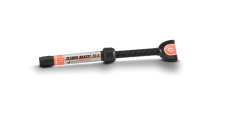
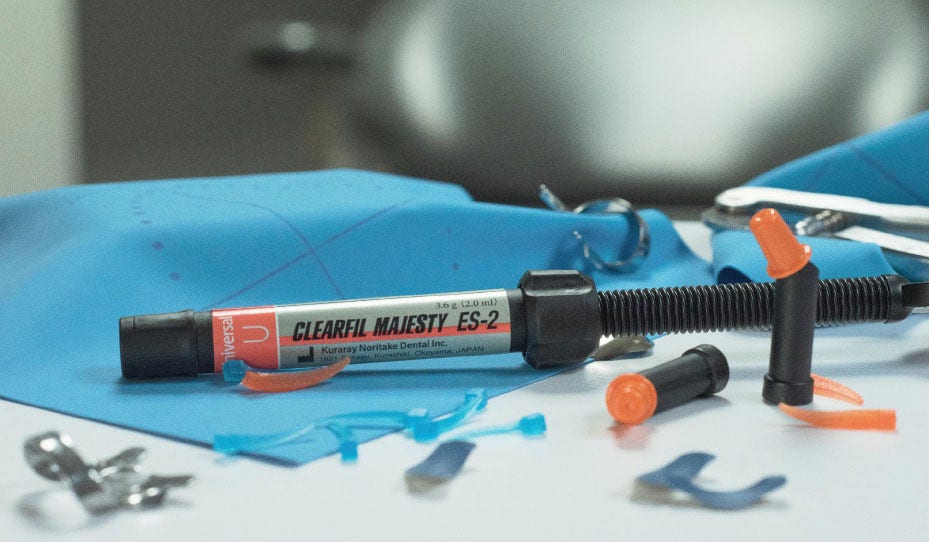
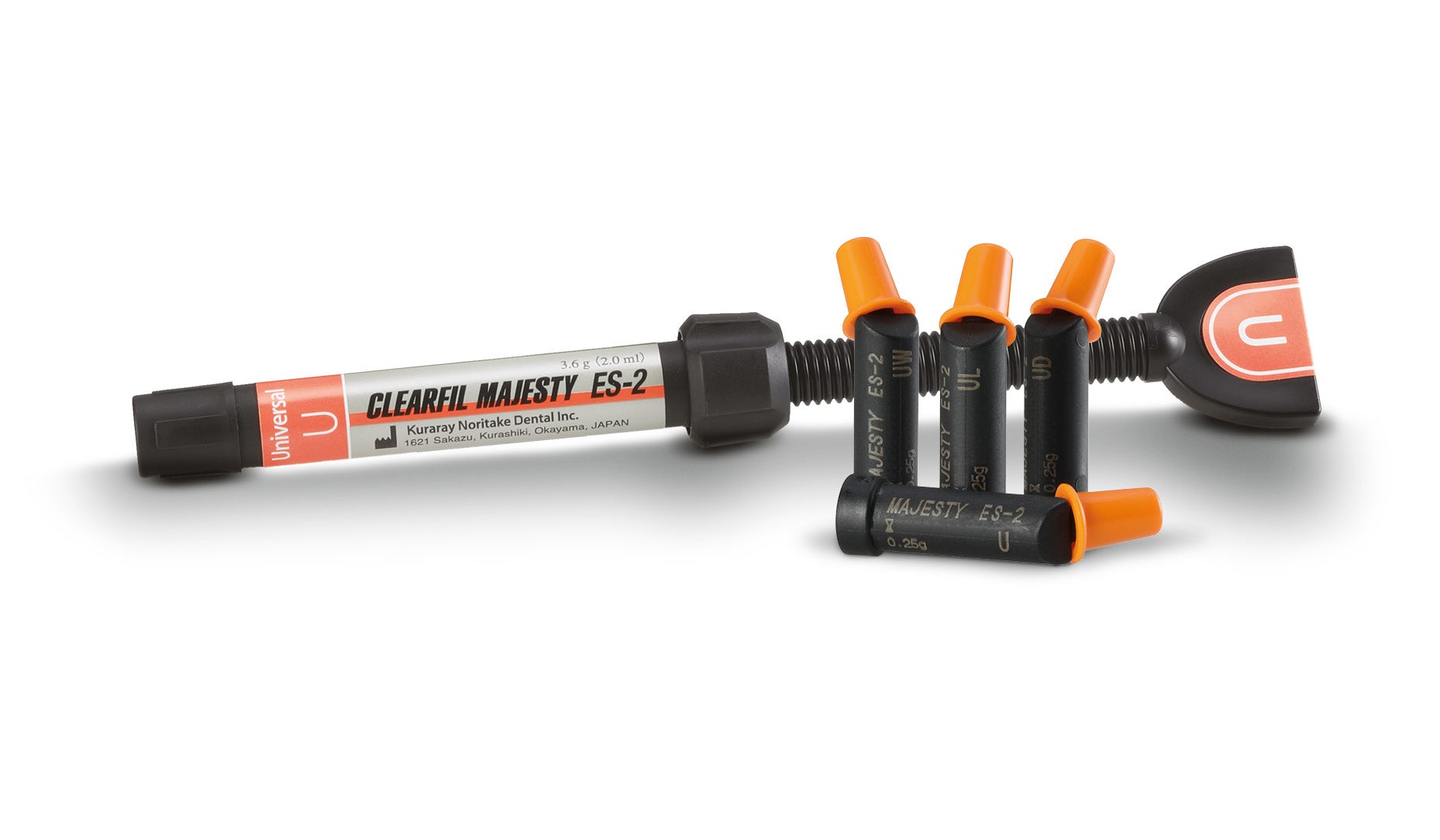
CLEARFIL MAJESTY ES-2 Universal
1 syringe U: 2ml (3.6g)
Je certifie être un professionnel de la santé bucco-dentaire et être autorisé à accéder à cet espace.
CLEARFIL MAJESTY ES-2 Universal | un composite vraiment universel


1 syringe U: 2ml (3.6g)
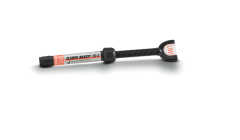
1 syringe UW: 2ml (3.6g)
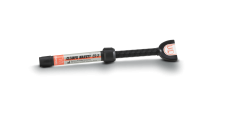
1 syringe UL: 2ml (3.6g)
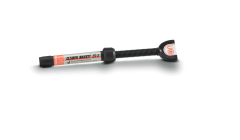
1 syringe UD: 2ml (3.6g)
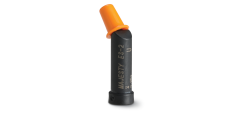
20 PLT U: 0.25g
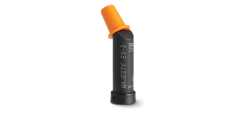
20 PLT UW: 0.25g
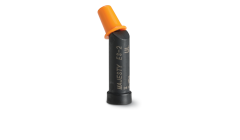
20 PLT UL: 0.25g
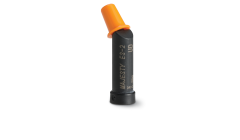
20 PLT UD: 0.25g
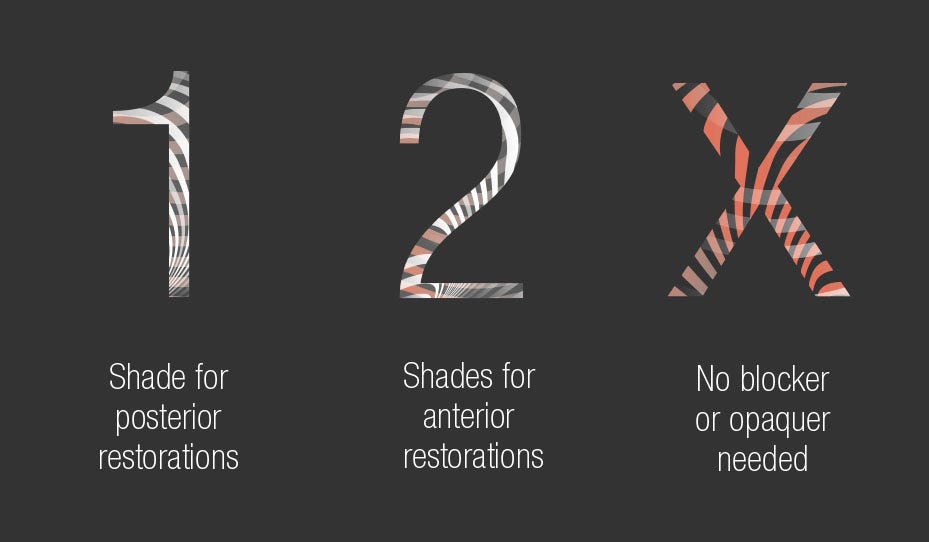
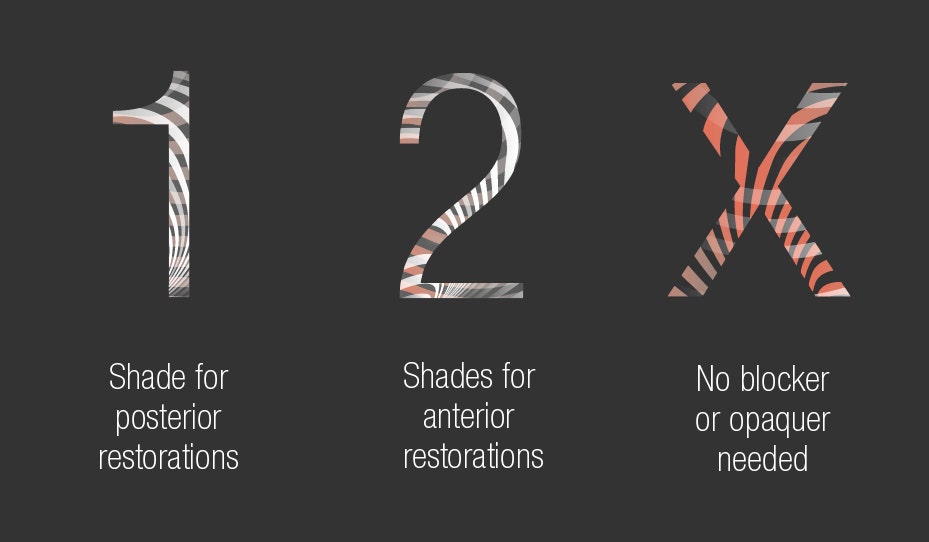
Le concept de teintes CLEARFIL MAJESTY™ ES-2 Universal propose une gamme optimisée de teintes pour chaque région de la bouche, assurant un résultat hautement esthétique. Une teinte unique pour toutes les restaurations postérieures. Deux teintes dédiées aux restaurations antérieures esthétiques. Une teinte spéciale (blanc universel) pour les cas cliniques nécessitant une haute luminosité/valeur dans la région antérieure.


)
Une teinte universelle, pensée pour toutes les restaurations postérieures, quelle que soit la couleur de la structure des dents adjacentes ou sous-jacentes.
)
Dans la région antérieure, plus exigeante sur le plan esthétique, deux teintes au choix sont disponibles.
)
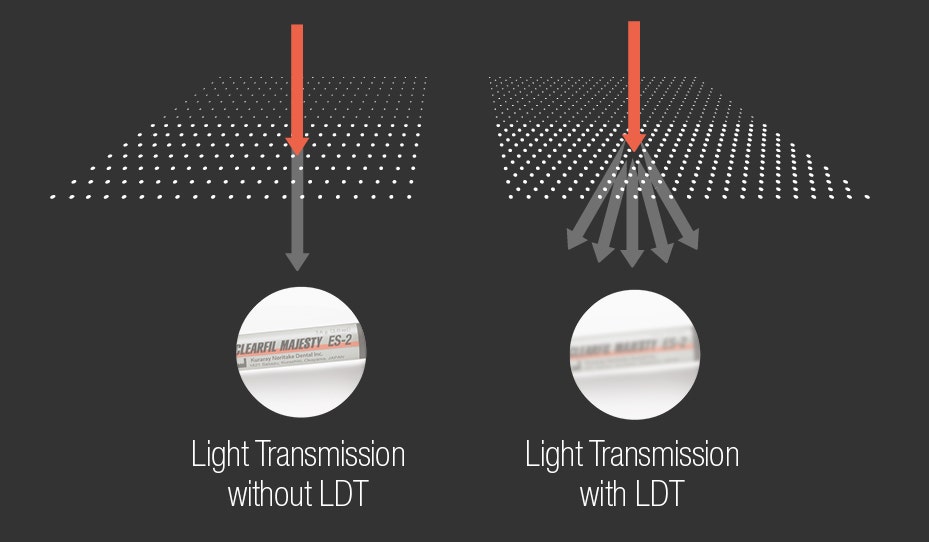
Grâce à une technologie avancée de diffusion de la lumière, le composite imite le comportement optique du tissu dentaire naturel. Il se fond facilement et harmonieusement dans la structure dentaire environnante.
Vous cherchez un système intelligent et facile à utiliser qui couvre la majorité de vos cas cliniques au quotidien ?
Avec le concept de teintes CLEARFIL MAJESTY™ ES-2 Universal, seules quelques teintes suffisent.
Résultats prévisibles, avec un stock minimal
Excellente esthétique
Manipulation facile
Faible usure, brillance élevée
Durabilité

Simplicité d’utilisation: 1 teinte postérieure, 2 teintes antérieures, aucun agent bloquant requis.
Un système intelligent qui assure des résultats prévisibles dans toutes les régions de la bouche (postérieures et antérieures), avec un stock minimal.
Un brillant naturel et durable après un polissage facile.
Des résultats visibles et durables.
Une esthétique exceptionnelle, des patients satisfaits.
Facile à sculpter, composite non collant et travaillable longtemps.
Une manipulation facile et un temps confortable pour parfaire votre restauration.
Faible usure, faible retrait, sans affecter les dents antagonistes.
Des restaurations durables, qui conservent leur éclat dans le temps.
Un remodelage directement dans la bouche est possible si nécessaire.
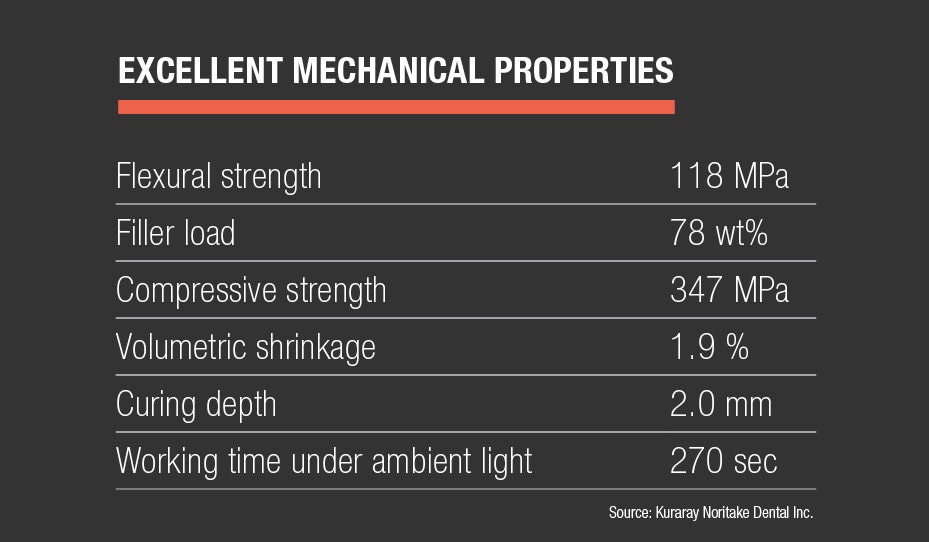
Résistance à la flexion 118 MPa
Teneur en charge 78 % en poids
Résistance à la compression 347 MPa
Contraction volumétrique 1,9 %
Profondeur de polymérisation 2,0 mm
Temps de travail sous lumière ambiante 270 s

Mesures en MPa

CLEARFIL MAJESTY™ ES-2 Universal (rouge) affiche un taux de retrait à la polymérisation inférieur à celui d’Omnichroma (Tokuyama) et de Filtek Universal Restorative (3M).
Conditions du test : échantillons polymérisés pendant 20 s avec Pencure 2000 (Morita) et retrait à la polymérisation mesuré avec un micro-extensomètre (Shimadzu). * Il ne s’agit pas d’une marque de commerce de Kuraray Noritake Dental Inc. Source des graphiques : Kuraray Noritake Dental Inc.
Grâce à la formulation équilibrée de CLEARFIL MAJESTY™ ES-2 Universal et à ses propriétés de résistance à l’usure, ce composite maintient une occlusion stable dans le temps, sans affecter les dents antagonistes. Le faible retrait à la polymérisation du matériau contribue à prévenir la décoloration marginale et les microfuites, limitant ainsi les caries secondaires.
Mesures en mm3

CLEARFIL MAJESTY™ ES-2 Universal (orange) démontre une usure de l’émail antagoniste inférieure aux principaux matériaux concurrents testés.
L’usure de CLEARFIL MAJESTY™ ES-2 Universal (orange) est inférieure à celle d’Omnichroma (Tokuyama) et de Filtek Universal Restorative (3M).
Conditions du test : Test d’usure de Leinfelder dans l’eau à température ambiante. Charge : 7,9 kg/cm², 400 000 cycles. Antagoniste : émail bovin poli avec du papier 3000 grains. Matériau : poli avec du papier 3000 grains. * Il ne s’agit pas d’une marque de commerce de Kuraray Noritake Dental Inc. Source des données : Kuraray Noritake Dental Inc.
L'aptitude au polissage et la rétention de la brillance sont deux critères essentiels pour des résultats esthétiques durables. CLEARFIL MAJESTY™ ES-2 Universal excelle sur ces deux points comparé à d'autres matériaux à teinte simplifiée. Il offre une meilleure aptitude au polissage pour un aspect final naturel et proche de l’émail, et une brillance élevée même après abrasion par brossage, pour des résultats esthétiques constants dans le temps. Les propriétés mécaniques démontrées sur la teinte postérieure s’appliquent également aux teintes destinées aux restaurations antérieures.
Mesures en %

CLEARFIL MAJESTY™ ES-2 Universal offre une meilleure aptitude au polissage comparé à d’autres matériaux comme Admira fusion x-tra (VOCO) et des valeurs de brillance supérieures.
Conditions du test : polymérisation de l’échantillon rugueux (papier abrasif 600 grains), poli par un polissoir en silicone pendant 5 à 15 s à 10 000 tr/min dans l’eau, brillance mesurée par un réflectivimètre. * Il ne s’agit pas d’une marque de commerce de Kuraray Noritake Dental.Source : Kuraray Noritake Dental Inc.
Une partie essentielle de la gamme Universal Excellence

Chez Kuraray Noritake Dental Inc., nous comprenons parfaitement les besoins des cabinets dentaires modernes. Gérer les procédures complexes, les délais serrés et les soins aux patients n’est pas chose aisée. C’est pourquoi nous avons passé des années à perfectionner nos matériaux – afin de vous permettre de vous concentrer sur l’essentiel : vos patients. Nos produits Universal simplifient vos procédures, en mettant des matériaux et des outils de qualité au service de votre expertise.
Notre technologie brevetée de diffusion de la lumière CLEARFIL MAJESTY™ ES-2 Universal permet une intégration parfaite à la structure dentaire environnante. L’équilibre précis entre les matériaux d’obturation submicroniques, la charge, la matrice de résine et la technologie silane brevetée produit un composite qui combine propriétés mécaniques et optiques. Une aide vraiment universelle pour votre pratique quotidienne.

Une réduction du nombre de teintes est possible grâce à l’intégration de la technologie de diffusion de la lumière (TDL) de Kuraray Noritake Dental. Cette technologie permet aux restaurations de reproduire la manière dont la lumière interagit avec le tissu dentaire naturel. Par conséquent, le matériau s’intègre facilement et harmonieusement à la structure dentaire environnante. Les résultats sont esthétiquement durables, malgré une simplification de vos procédures.

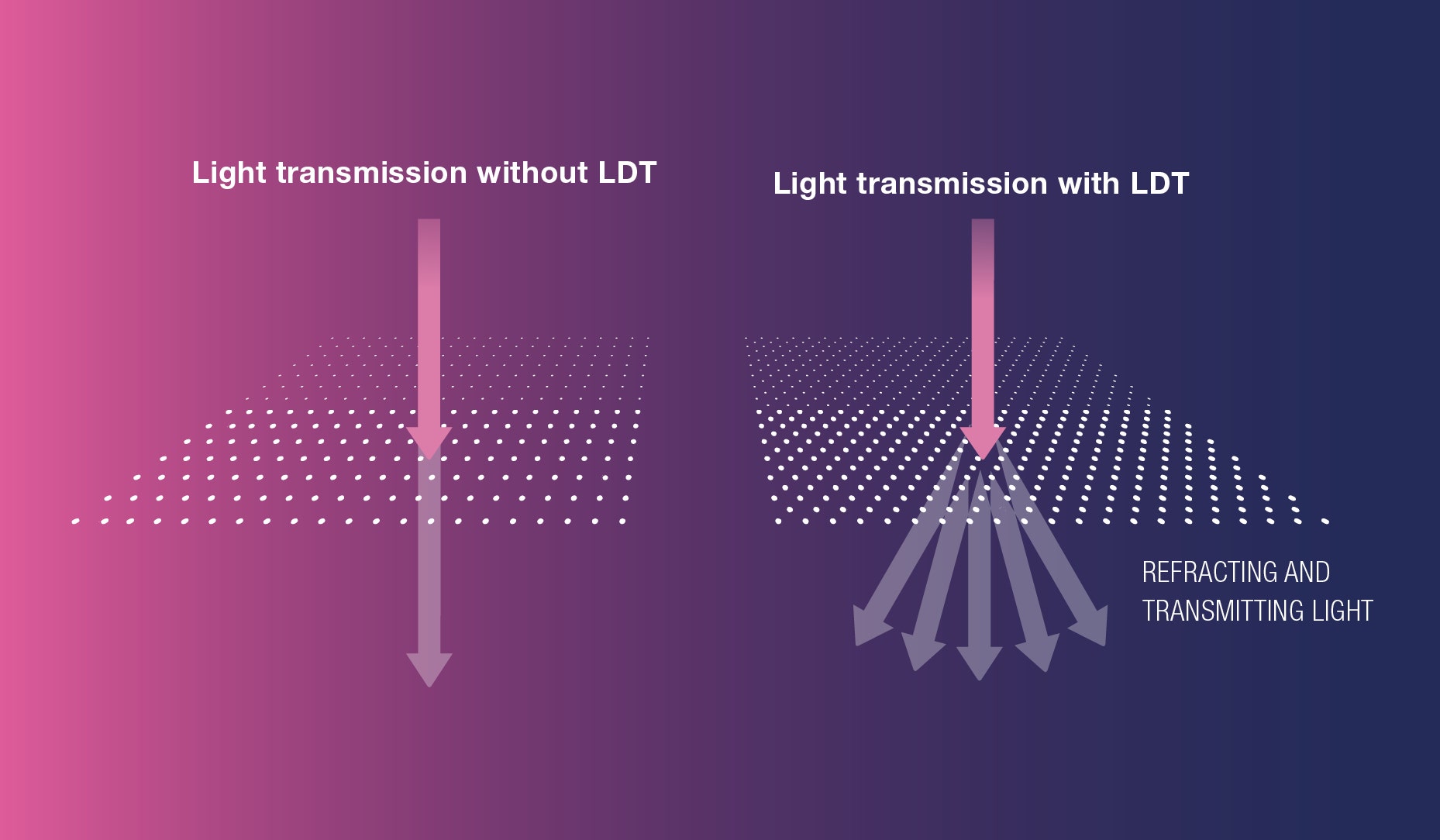
Transmission de la lumière sans TDL
Transmission de la lumière avec TDL
Une même teinte Universal (U) appliquée dans les cavités A1 et A3,5.

Voir les produits en action

CLEARFIL MAJESTY ES Composite Family

Cliquez sur le signe « PDF » pour zoomer ou télécharger le document.
CLEARFIL MAJESTY ES-2 Universal
Cliquez sur le signe « PDF » pour zoomer ou télécharger le document.
Universal Excellence

Cliquez sur le signe « PDF » pour zoomer ou télécharger le document.
CLEARFIL MAJESTY ES Composite Family
CLEARFIL MAJESTY ES-2 Universal
Cliquez sur le signe « PDF » pour zoomer ou télécharger le document.
CLEARFIL MAJESTY ES-2 Universal
Cliquez sur le signe « PDF » pour zoomer ou télécharger le document.
Une multitude de cas, une solution universelle

Compact, time-saving and aesthetic
How many different shades of composite do you need to create appealing restorations in virtually every clinical situation? If you opt for “CLEARFIL MAJESTY™ ES-2” Universal shade concept, a few shades will do the trick.
With wonderful support of our internationally recognized key opinion leaders, we have prepared a Clinical Case brochure of “CLEARFIL MAJESTY™ ES-2” Universal for you. The brochure highlights a variety of clinical cases in the anterior and posterior region to show the all about excellent properties of our latest composite. Let the pictures speak for themselves!
Click here to view. Enjoy!
Start Reading: Special MAJESTY ES-2 Universal - Clinical Cases Brochure
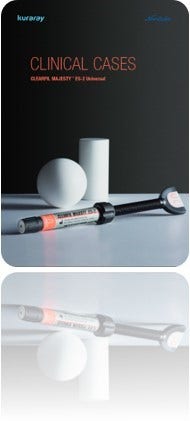
de CLEARFIL MAJESTY™ ES-2 Universal

Would you like to skip shade matching in direct posterior restorative procedures? You can, with CLEARFIL MAJESTY™ ES-2 Universal.
See what the REALITY Evaluators have to say about the innovative product with a single posterior shade!
Read the report to learn more!
Content Highlights:
Start Reading: REALITY | RATINGS & REVIEWS | CLEARFIL MAJESTY™ ES-2 Universal

avec CLEARFIL MAJESTY ES-2 Universal
avec CLEARFIL MAJESTY™ ES-2 Universal

Cas réalisé par le Dr. Clarence P. Tam, HBSC, DDS, AAACD, FIADFE
Contexte clinique
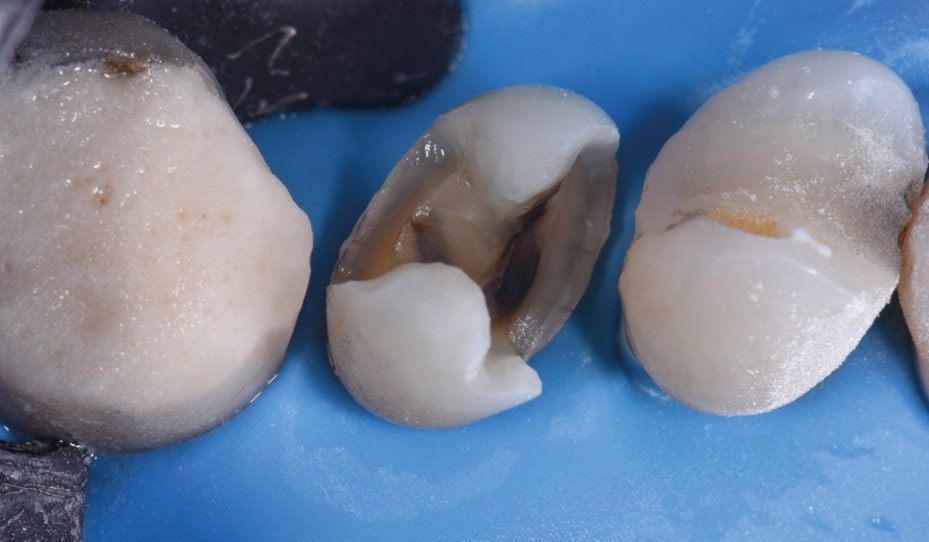
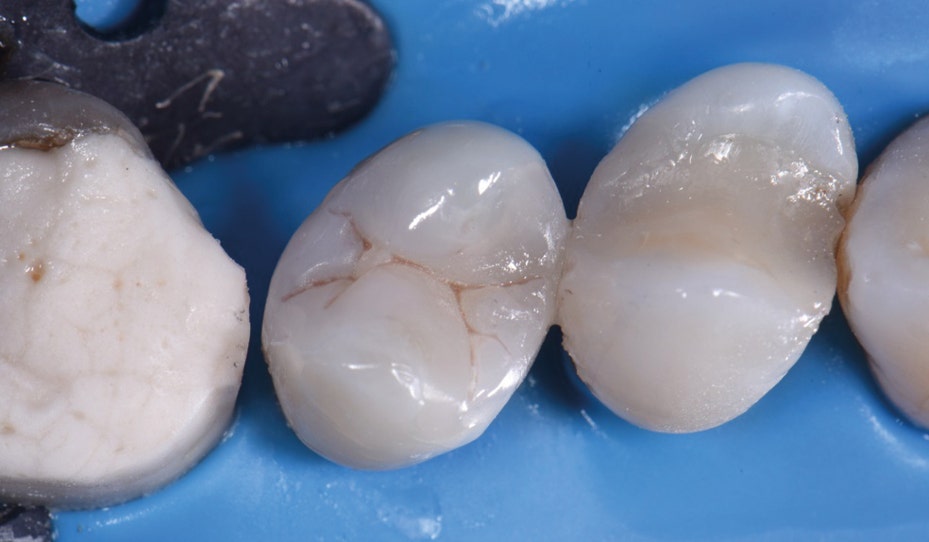
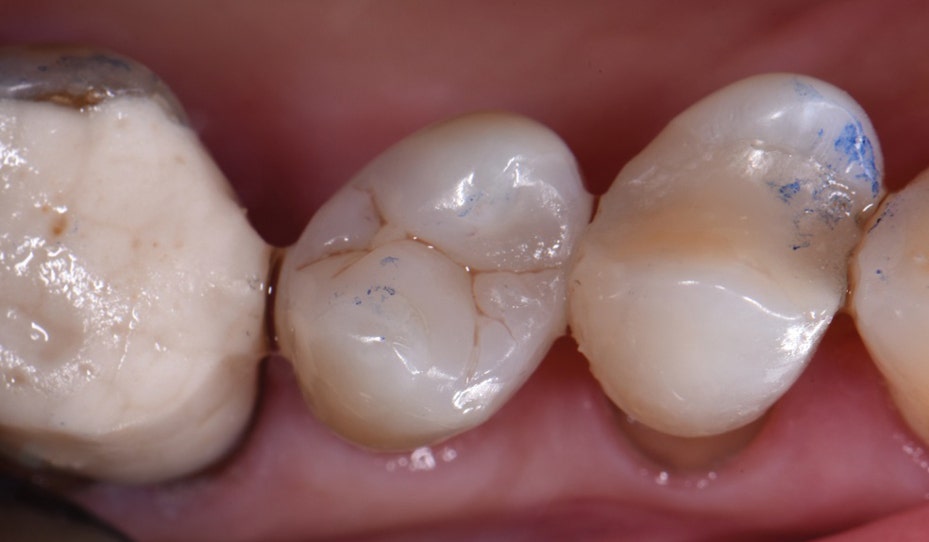
Une patiente de 65 ans, ASA 2 stable, s’est présentée au cabinet pour des soins restaurateurs. Ses antécédents médicaux incluaient un déficit en immunoglobulines non spécifique, pour lequel elle reçoit des perfusions régulières. Elle ne rapporte aucune allergie médicamenteuse connue. À l’examen clinique, une fracture périphérique occlusale créant un piège alimentaire a été diagnostiquée sur la dent 14 (notation FDI). La dent 15 présentait un amalgame étendu, très proche de la crête marginale distale, laquelle montrait des fractures axiales verticales distales résultant de cycles répétés d’expansion et de contraction au fil du temps. L’objectif restaurateur consistait à réaliser une dentisterie directe minimalement invasive. Toutefois, la présence probable d’un substrat dentinaire sombre sous l’amalgame compliquait la situation. Un matériau offrant à la fois un excellent effet caméléon et des propriétés mécaniques élevées a donc été recherché afin d’optimiser le pronostic des restaurations directes dans cette zone.
Procédure restauratrice
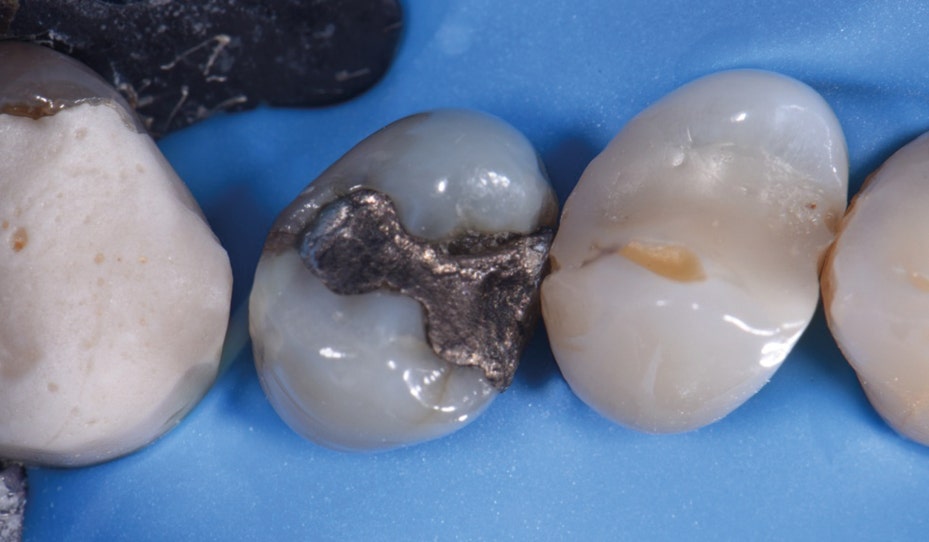
Suite à une technique de mordançage total, un nettoyage à la chlorhexidine à 2 % a été réalisé pendant 30 secondes, puis la dentine a été séchée délicatement par tamponnement afin de conserver une surface légèrement humide. Un adhésif de 5ᵉ génération a ensuite été appliqué, affiné par soufflage d’air puis photopolymérisé conformément aux instructions du fabricant. Les microcouches jouent un rôle essentiel durant les cinq premières minutes, phase délicate de formation de la couche hybride. Elles ont été réalisées à l’aide d’incréments de 0,25 mm de CLEARFIL MAJESTY™ Flow de Kuraray Noritake Dental Inc..
Cette technique permet d’augmenter significativement la résistance au cisaillement de l’adhésion à la dentine.¹˒²
Justification du choix des matériaux
Dentiste :

DR CLARENCE P. TAM, HBSC, DDS, AAACD, FIADFE
Références
1. Bertschinger C, Paul SJ, Luthy H, Scharer P. Dual application of dentin bonding agents: effect on bond strength. Am J Dent. 1996;9(3):115-119.
2. Magne P, Kim TH, Cassione D, Donovan TE. Immediate dentin sealing improves bond strengths of indirect restorations. J Prosthet Dent. 2005;94(6):511-519.
3. Nikolaenko SA, Lohbauer U, Roggendorf M, Petschelt A, Dasch W, Franenberberger R. Influence of C-Factor and layering technique on microtensile bond strength to dentin. Dental Mater. 2004;20(6):579-585.
Une multitude de cas, une solution universelle

The introduction of universal composites, which are not only universal in terms of application range but also in terms of shade adaptation, effectively marks the dawn of a new type of composite. This prompts a reinterpretation of the term "universal composite."
CLEARFIL MAJESTY™ ES-2 is a nanohybrid composite family. Nowadays, nanohybrid composites are commonly used as universal composites. They have a high filler content, they are strong, and they have exceptionally good polishability characteristics1.
The newest variant in the CLEARFIL MAJESTY™ ES-2 range is CLEARFIL MAJESTY™ ES-2 Universal shade concept. For this composite; we expand the definition of universal and include shade coverage.
Posteriorly, a single material in a single shade is sufficient to cover the entire VITA™ range. This means that no shade determination is required. For the anterior zone, we offer two shade variants: a lighter and a darker variant (UL and UD). The lighter variant is used in the A1-A2 range and the darker for shades from A3 onwards. There is sufficient overlap between UL and UD ensuring no specific shade determination is necessary.
Finally, for situations that require extra lightness and brightness, an additional UW shade is available.
What makes CLEARFIL MAJESTY™ ES-2 Universal unique in comparison to other universal or single-shade composites?
The difference with CLEARFIL MAJESTY™ ES-2 Universal, is that without using an additional opaque composite, sometimes called a blocker, a successful, superbly matching restoration can be constructed. Not only with smaller cavities, but also with larger class I and II restorations. And, when used anteriorly, even an extensive Class IV restoration can be successfully constructed using CLEARFIL MAJESTY™ ES-2 Universal. So, it is not only for those small class III or V lesions.
Why Kuraray Noritake Dental Inc. can do this where others cannot, is to a large extent, thanks to optimized light diffusion technology (LDT). By using this technology in composites with the right translucency, the light is scattered and reflected in such a way that the composite blends in with the surrounding tooth structure.
Where others use the widely-employed chameleon effect, Kuraray Noritake Dental Inc. adds an extra dimension in the form of LDT. With the chameleon effect, light passes through the material and is reflected off the walls of the cavity. The perceived shade of the restoration is therefore the shade of the cavity walls. If the cavity is too large, thus requiring a larger amount of filling material, the light has to travel further and a large proportion of the light is absorbed. With this, the brightness of the restoration is reduced and the shade of the cavity walls no longer accurately reflected.
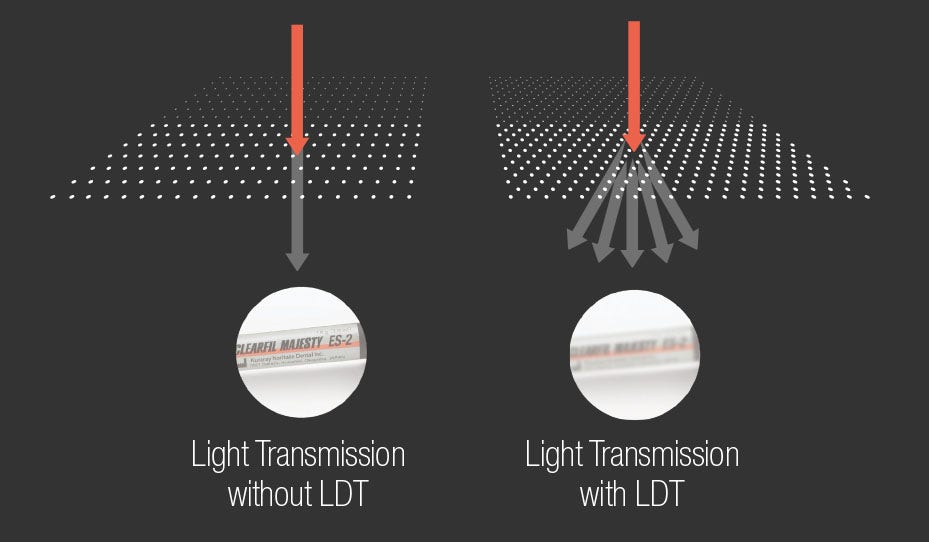
Our LDT allows light to be scattered within the composite itself, in addition to being reflected off the cavity walls. As a result, CLEARFIL MAJESTYTM ES-2 Universal is a particularly forgiving composite. This feature will be familiar to those who have used CLEARFIL MAJESTY™ ES-2 family products before.
CLEARFIL MAJESTY™ ES-2 Universal is the result of sophisticated filler, matrix and silane technology. It offers a solution for all your routine composite work. A consistently superb restoration where shade determination is a thing of the past.
Reference
1 Ilie, N., & Hickel, R. (2011). Resin composite restorative materials. Aust Dent J, 56 Suppl 1, 59-66. doi:10.1111/j.1834-7819.2010.01296.x
en utilisant CLEARFIL MAJESTY™ ES-2 Universal

Article réalisé par le Dr. Clarence Tam HBSc, DDS, FIADFE, AAACD
La dentisterie esthétique et restauratrice moderne repose sur le concept d’esthétique responsable. L’objectif du traitement est généralement de corriger les déficits structurels et esthétiques des dents, qu’ils soient d’origine biologique ou traumatique, par la mise en place précise et artistique de différentes couches de remplacement, tout en respectant et en préservant un volume maximal de structure dentaire résiduelle. Les dents antérieures peuvent être affectées par des dysplasies de l’émail et de la dentine, des caries ou des conditions sclérosantes. Elles présentent une multitude d’affections d’origine génétique ou environnementale, générant un déficit esthétique pouvant compromettre l’intégrité fonctionnelle et psychosociale de l’individu s’il n’est pas corrigé pour restaurer une apparence harmonieuse et saine.
La structure dentaire manquante ou altérée doit être analysée en distinguant ses composants émail et dentine. Ces deux tissus sont fondamentalement différents : l’émail est hautement minéralisé, tandis que la dentine est plus riche en collagène. Cette dernière joue un rôle essentiel dans la réfraction de la lumière, l’expression de la couleur réelle de la dent (teinte et chroma), ainsi que dans la résistance à la fracture et la performance fonctionnelle. La valeur et la chroma sont principalement influencées par l’épaisseur de l’émail. Le remplacement de l’émail est idéalement réalisé par des restaurations indirectes collées en céramique, tandis que la dentine peut être efficacement substituée par des résines composites ou des composites renforcés par fibres courtes (SFRC), ces derniers améliorant la résistance à la fracture dans les restaurations volumineuses, notamment en zone cervicale critique.
Chez les patients adolescents, le standard de référence reste la résine composite directe, car elle nécessite peu ou pas de préparation tissulaire. L’utilisation de restaurations indirectes serait peu adaptée durant la croissance dentaire et gingivale. De plus, le composite permet une adaptation et une modification ultérieure, notamment en cas d'éclaircissement dentaire ou de traumatisme supplémentaire. Les restaurations en céramique, bien qu'esthétiques, présentent une moindre prévisibilité de modification et un risque accru de défaillance marginale après thermocyclage, malgré l’utilisation d’agents de silanisation.
Les teintes dentaires en dentisterie sont traditionnellement classées selon le guide VITA* Classical A1–D4. Malgré son usage universel, les systèmes de composites ne correspondent pas toujours fidèlement à ces teintes de référence. Des études ont montré qu’un mélange de plusieurs teintes est souvent nécessaire pour obtenir une correspondance acceptable. Même les systèmes céramiques indirects présentent des écarts significatifs par rapport aux teintes du guide VITA*. La majorité des dents humaines se situe dans la famille A (78,5 %), suivie des familles C, D et B. Ainsi, la précision chromatique d’un système composite est essentielle pour garantir une intégration esthétique naturelle.
De nombreux composites dits « universels » présentent un effet caméléon acceptable grâce à l’équilibre entre translucidité, diffusion lumineuse, indice de réfraction et propriétés optiques. Toutefois, ces propriétés peuvent évoluer après thermocyclage et stockage humide, pouvant altérer l’intégration esthétique initiale. L’indice de réfraction est optimal lorsque celui des charges inorganiques est proche de celui de la matrice polymérisée (environ 1,47 à 1,52). Un déséquilibre entraîne une augmentation de l’opacité par réflexion et réfraction accrue à l’interface charge-matrice. La stratification du composite est complexe, notamment pour masquer les défauts internes, les lignes de fracture et les variations chromatiques, tout en recréant les effets optiques naturels (translucidité incisale, halos, mamelons). Une approche histoanatomique impose de remplacer l’émail par des matériaux à teinte émail et la dentine par des teintes dentinaires adaptées. Cette sélection doit être réalisée en début de séance, car la déshydratation - même légère - modifie significativement la perception des teintes.
CLEARFIL™ MAJESTY™ ES-2 est un composite super-nanofillé basé sur une approche simplifiée couvrant 15 teintes VITA* en seulement 4 options universelles. La gamme Universal propose quatre variantes : Universal (U), Universal Light (UL), Universal Dark (UD) et Universal White (UW), offrant un concept de correspondance chromatique optimisé. Le matériau contient des nanocharges de verre de baryum silanisé et des nanoclusters de silice, offrant une excellente résistance à l’usure et une faible abrasion antagoniste. L’indice de réfraction des charges et de la matrice est optimisé afin de reproduire le comportement optique de l’émail et de la dentine, grâce à la technologie de diffusion de la lumière (LDT). Des études montrent une stabilité des propriétés optiques après vieillissement artificiel et thermocyclage, ainsi qu’une stabilité colorimétrique supérieure à certains composites de référence sur plusieurs années. Cette stabilité est essentielle pour maintenir l’intégration esthétique face aux agressions alimentaires et environnementales.
Une patiente de 15 ans (ASA I) s’est présentée avec des restaurations composites anciennes, présentant une mauvaise intégration marginale et des excès volumétriques importants, entraînant une défaillance esthétique et fonctionnelle. Elle avait subi un traumatisme lors d’une chute à vélo, entraînant une fracture émail-dentine non compliquée des dents 11 et 21. Les restaurations existantes présentaient des surcontours importants compromettant l’hygiène interdentaire. Les tests de vitalité et les radiographies ont confirmé l’absence de pathologie apicale. Un éclaircissement pré-prothétique a été accepté afin d’augmenter la valeur des dents adjacentes. Des gouttières de blanchiment personnalisées ont été réalisées et un protocole au peroxyde de carbamide 10 % a été suivi pendant deux semaines. La teinte initiale (1M1/2M1 et 2M1) a été améliorée jusqu’à 0M3. Après traitement, un protocole de reminéralisation avec un complexe fluoré contenant de l’ACP (Tooth Mousse Plus, GC) a été prescrit afin de stabiliser les tissus après éclaircissement.

Fig. 1. Vue préopératoire du sourire en ratio 1:2, montrant les dents 11 et 21 présentant d’anciennes restaurations composites défectueuses avec une chromaticité excessive.
Le jour de l’intervention, la teinte pré-déshydratée a été évaluée à l’aide des clés de teinte « composite réel » fournies dans le système CLEARFIL™ MAJESTY™ ES-2 Premium, la teinte émail retenue étant WE (White Enamel) et la teinte dentine WD (White Dentin). Il a été déterminé que des effets blancs « maverick » ainsi qu’un effet halo modéré étaient souhaités, associés à une translucidité modérée à forte au niveau de la fenêtre incisale.
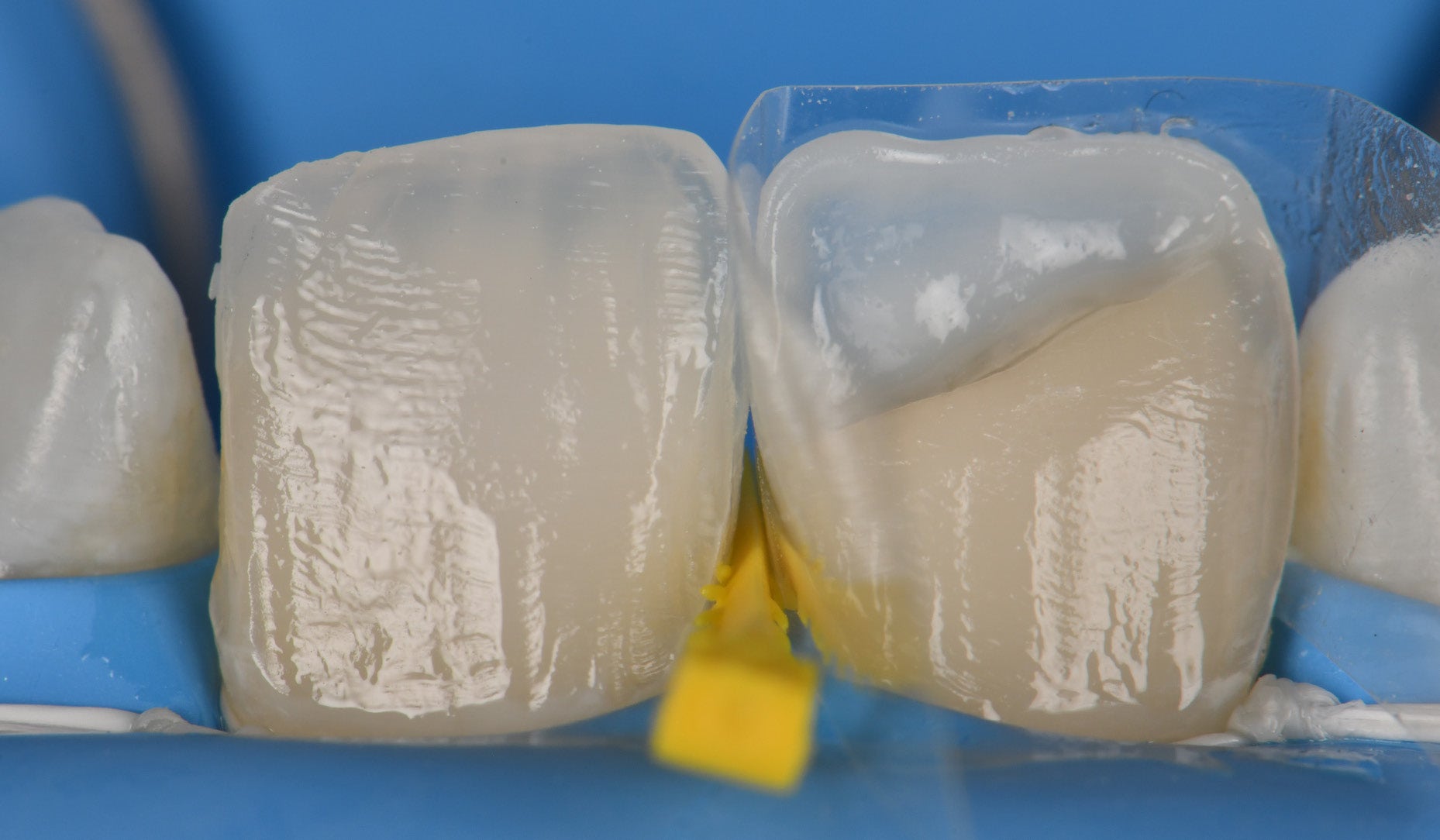
Fig. 2. Une matrice Mylar pré-crimpée a été à nouveau utilisée au niveau de la face DIBP de la dent 21 afin de fermer l’espace disponible. CLEARFIL™ MAJESTY™ ES-2 Universal UL a été utilisé dans cette étape.
Le blocage des extensions de composite contre la structure dentaire naturelle a été réalisé par opacification à l’aide d’une résine composite opaque (WD, CLEARFIL™ MAJESTY™ ES-2 Premium, Kuraray Noritake Dental Inc.), appliquée en couches horizontales et verticales successives. Il est à noter que la ligne de jonction de la restauration doit être totalement masquée à la fin de la stratification du volume dentinaire, faute de quoi le cas présente un risque quasi certain d’échec esthétique. L’anatomie dentinaire interne et ses variations inhérentes ont été reproduites en miroir de la dent 21, laquelle présentait une fenêtre incisale peu altérée avec des détails encore intacts. Un composite hautement translucide (Clear, CLEARFIL™ MAJESTY™ ES-2 Premium, Kuraray Noritake Dental Inc.) a été appliqué entre les lobes des couches dentinaires puis photopolymérisé. Un mélange de teintes composé de 9 parts de blanc pour 1 part d’orange a été placé au niveau du bord incisif et des angles proximoincisifs afin de recréer l’effet halo. Un pigment blanc pur a été délicatement appliqué sous forme de fines ramifications évoquant des « pattes d’araignée » reliant les mamelons dentinaires jusqu’au bord incisif afin d’apporter du réalisme. L’ensemble a été stratifié en respectant fidèlement l’anatomie et l’apparence de la dent 21.
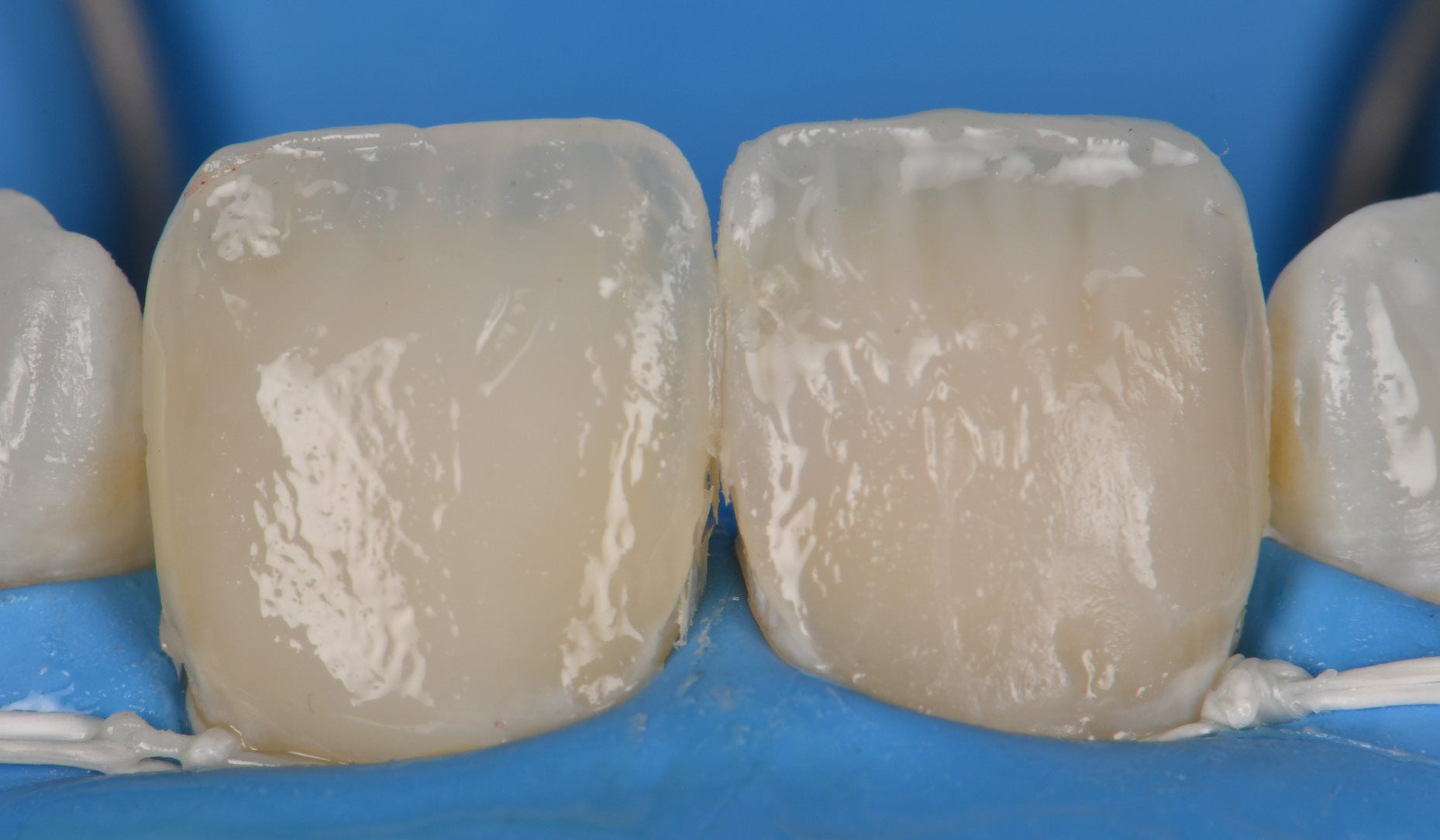
Fig. 3. Des incréments de composite dentinaire horizontaux et verticaux ont été réalisés, en reproduisant fidèlement l’anatomie de la dent controlatérale.
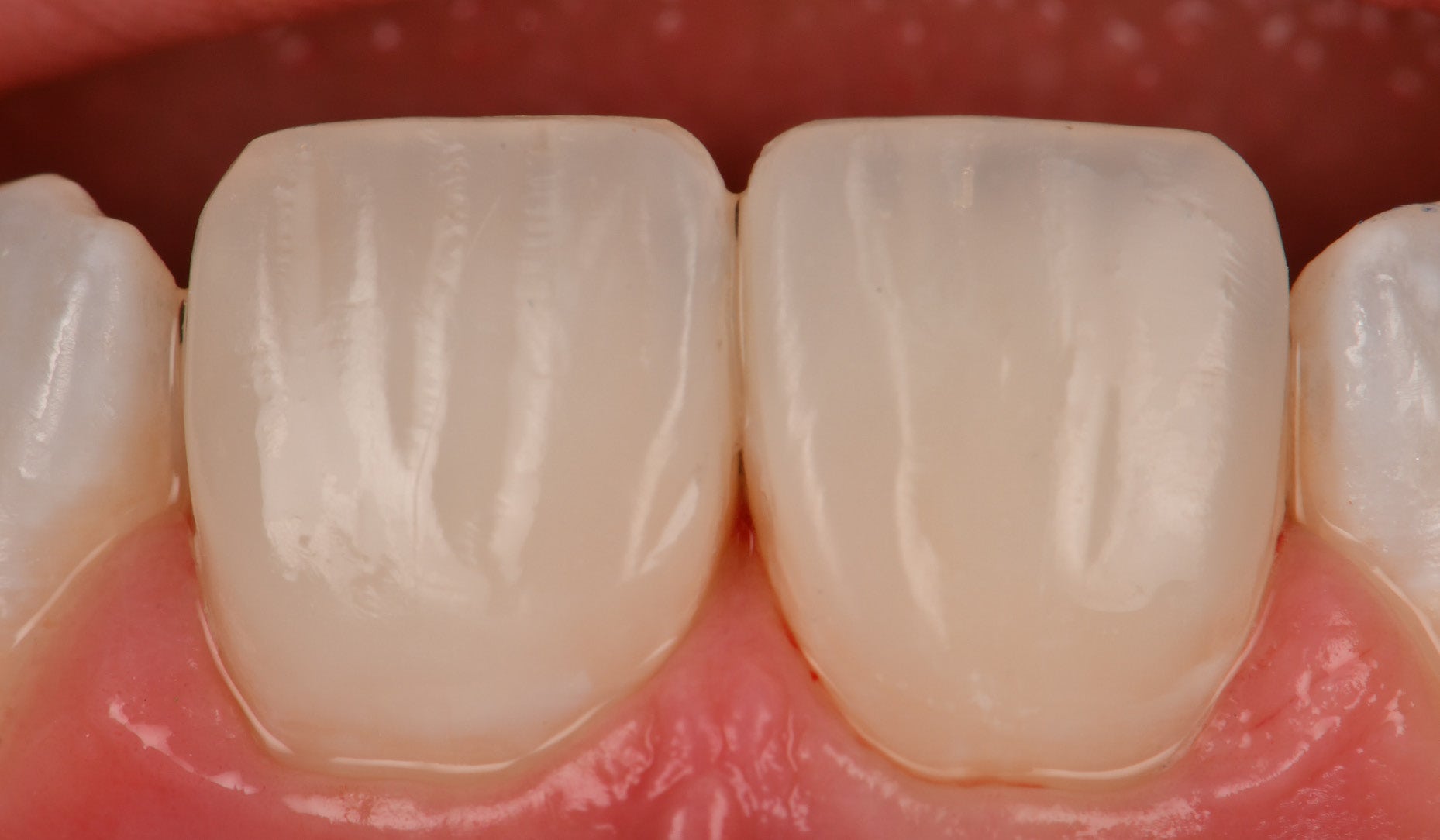
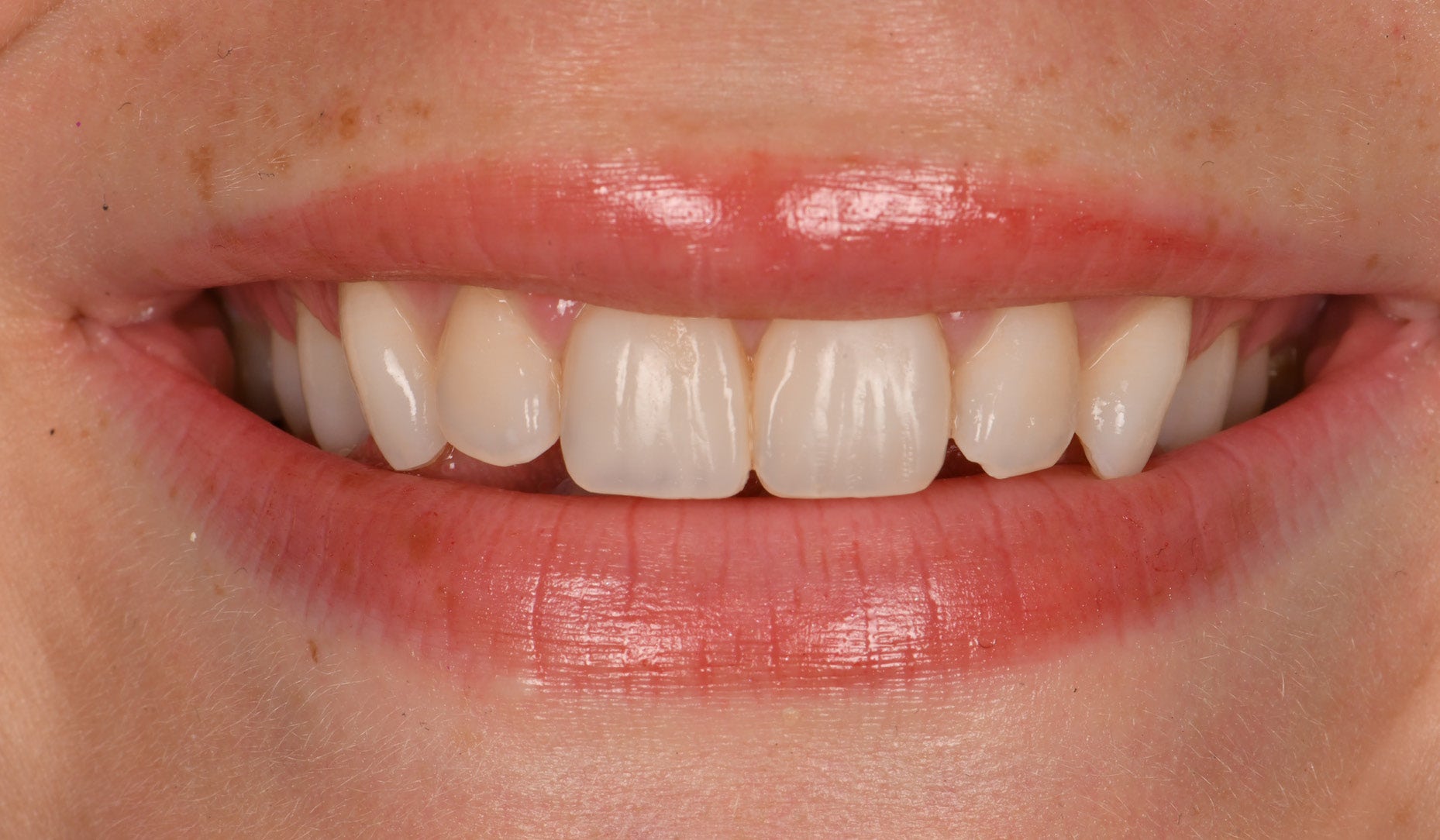
Fig. 4 & 5. Résultat postopératoire immédiat après finition et polissage.
La valeur esthétique de ce cas repose fondamentalement sur la technologie des résines composites à plusieurs niveaux. La stabilité des couleurs et des propriétés physiques dans le temps doit être démontrée afin de permettre au clinicien d’avoir confiance dans le pronostic du traitement. Plus précisément, le matériau doit présenter un indice de réfraction parfaitement adapté, ainsi qu’une stabilité face à l’eau et aux contraintes liées au thermocyclage, sans altération de ses propriétés optiques ou mécaniques. La paroi palatine a été réalisée à l’aide d’un système de composite universel super nanochargé de nouvelle génération présentant un fort effet caméléon. Lorsqu’il s’agit de tromper l’œil et de masquer, cette première couche constitue une base efficace pour débuter le masquage de la zone sombre de la cavité buccale en arrière de la ligne de fracture de la dent restaurée.
*VITA is a trademark of VITA Zahnfabrik, Bad Sackingen, Germany
Dentiste :

CLARENCE TAM
Clarence est originaire de Toronto, au Canada, où elle a obtenu son Doctorat en chirurgie dentaire (DDS) ainsi que son internat en pratique générale à l’Université de Western Ontario et à l’Université de Toronto, respectivement. La pratique de Clarence est limitée à la dentisterie esthétique et restauratrice. Elle est largement publiée dans la presse dentaire locale et internationale, rédigeant des articles, assurant des revues scientifiques et participant au développement de produits prototypes ainsi que de techniques en dentisterie clinique. Elle intervient également très régulièrement en tant que conférencière internationale. Clarence est l’ancienne présidente immédiate de la New Zealand Academy of Cosmetic Dentistry. Elle fait actuellement partie des deux seuls praticiens en Australasie à détenir le statut de membre accrédité et certifié par le board de l’American Academy of Cosmetic Dentistry.
Clarence est Opinion Leader pour plusieurs entreprises dentaires multinationales, notamment Kuraray Noritake, J Morita Corp, Henry Schein NZ, Ivoclar Vivadent, Dentsply Sirona, 3M, Kerr, GC Australasia, SDI et Coltene. Elle est également la seule Voco Fellow en Australie et en Nouvelle-Zélande. Elle est titulaire du statut de Fellow au sein de l’International Academy for DentoFacial Esthetics et est une personne passionnée et accessible, engagée dans une approche interactive avec les patients dans l’ensemble de ses cas afin de maximiser la prédictibilité des traitements.
1. Elamin HO, Abubakr NH, Ibrahim YE. Identifying the tooth shade in group of patients using Vita Easyshade. Eur J Dent. 2015 Apr-Jun;9(2):213-217. doi: 10.4103/1305-7456.156828. PMID: 26038652; PMCID: PMC4439848.
2. Floriani F, Brandfon BA, Sawczuk NJ, Lopes GC, Rocha MG, Oliveira D. Color difference between the vita classical shade guide and composite veneers using the dual-layer technique. J Clin Exp Dent. 2022 Aug 1;14(8):e615-e620. doi: 10.4317/jced.59759. PMID: 36046166; PMCID: PMC9422970.
3. Gurrea J, Gurrea M, Bruguera A, Sampaio CS, Janal M, Bonfante E, Coelho PG, Hirata R. Evaluation of Dental Shade Guide Variability Using Cross-Polarized Photography. Int J Periodontics Restorative Dent. 2016 Sep-Oct;36(5):e76-81. doi: 10.11607/prd.2700. PMID: 27560681.
4. Almasabi W, Tichy A, Abdou A, Hosaka K, Nakajima M, Tagami J. Effect of water storage and thermocycling on light transmission properties, translucency and refractive index of nanofilled flowable composites. Dent Mater J. 2021 May 29;40(3):599-605. doi: 10.4012/dmj.2020-154. Epub 2020 Dec 24. PMID: 33361663.
5. Arai Y, Kurokawa H, Takamizawa T, et al.. Evaluation of structural coloration of experimental flowable resin composites. J Esthet Restor Dent. 2020;e12674.
6. Ota M, Ando S, Endo H, et al.. Influence of refractive index on optical parameters of experimental resin composites. Acta Odontol Scand. 2012;70(5):362–367.
7. Suliman S, Sulaiman TA, Olafsson VG, Delgado AJ, Donovan TE, Heymann HO. Effect of time on tooth dehydration and rehydration. J Esthet Restor Dent. 2019 Mar;31(2):118-123. doi: 10.1111/jerd.12461. Epub 2019 Feb 23. PMID: 30801926.
8. Meng Z, Yao XS, Yao H, Liang Y, Liu T, Li Y, Wang G, Lan S. Measurement of the refractive index of human teeth by optical coherence tomography. J Biomed Opt. 2009 May-Jun;14(3):034010. doi: 10.1117/1.3130322. PMID: 19566303.
9. Tekçe N, Demirci M, Sancak EI, Güder G, Tuncer S, Baydemir C. Clinical Performance of Direct Posterior Composite Restorations in Patients with Amelogenesis Imperfecta. Oper Dent. 2022 Nov 1;47(6):620-629. doi: 10.2341/21-106-C. PMID: 36281978.
CLEARFIL MAJESTY™ ES-2 Universal

In this interview, Dr Adham Elsayed, certified specialist in dental prosthodontics and implants and clinical and scientific manager at Kuraray Noritake Dental, details the benefits of the company’s new CLEARFIL MAJESTY™ ES-2 Universal composite and explains its application in the daily dental workflow.
Though dentists are becoming increasingly specialised, there’s a growing demand for products that can be used for all indications. How does CLEARFIL MAJESTY™ ES-2 Universal fit this model?
First, we need to explain the meaning of the term ‘universal’ in this context. Previously, there have been two types of composites that differ according to the area of application: anterior composites, used in Class III, IV and V restorations where the aesthetic outcome is the priority, and posterior composites, in which the mechanical properties like strength and wear rate are more important. Universal composites, then, are those that can be used for all types of restorations in the anterior as well as the posterior region.
Another way in which ‘universal’ can be considered is in relation to shade. In this case, the term is used to describe a restorative composite system that exists in fewer shades, one that can adapt to the tooth structure independent of the colour of the tooth. A major benefit of this type of composites is that it offers a simplified workflow.
CLEARFIL MAJESTY™ ES-2 Universal is essentially universal in both meanings: it is one system that can be used for posterior and anterior restorations, and it is also provided in only three shades—one for posterior, and two for anterior.
Universal products, whether they are luting cements, bonding agents or composites, are attractive to dentists as long as they offer simplification of the treatment procedure without compromising quality and durability.
How does CLEARFIL MAJESTY™ ES-2 Universal build upon the success of the CLEARFIL MAJESTY™ range?
The CLEARFIL MAJESTY™ family is very well established at this stage. It includes such products as CLEARFIL MAJESTY™ Posterior, one of the most popular posterior composites owing to its superior mechanical properties and minimal polymerisation shrinkage. CLEARFIL MAJESTY™ ES-2 is an extensive system that is highly beneficial thanks to its outstanding optical properties and ability to produce high-end aesthetics in the anterior region using Kuraray Noritake Dental’s multilayering technique. The three flowable alternatives of CLEARFIL MAJESTY™ ES Flow, with different consistencies, are also other successful members of the family.
Kuraray Noritake Dental now continues the success story of CLEARFIL MAJESTY™ with the latest innovative product that can change the definition of the universal composite. CLEARFIL MAJESTY™ ES-2 Universal incorporates several attributes from the well-established ES-2 and ES Flow, including Kuraray Noritake Dental’s light diffusion technology (LDT).
Speaking of LDT—how does this technology benefit the composite?
LDT allows the material to scatter and reflect light rays at many different angles, which, in turn, allows the composite restoration to diffuse light in a similar way to the surrounding tooth structure. Hence, it eliminates aesthetic problems like the visibility of restoration and preparation borders. Thanks to innovative LDT, optimal particle fillers and opacity, CLEARFIL MAJESTY™ ES-2 Universal blends seamlessly with the surrounding tooth structure and emulates natural teeth, eliminating the need for shade selection.
As you mentioned, CLEARFIL MAJESTY™ ES-2 Universal comes with one shade for posterior restorations and two for anterior restorations. Can such a reduced shade range still truly deliver aesthetic restorations?
CLEARFIL MAJESTY™ ES-2 Universal is not the first composite on the market with a reduced shade system. However, we can safely say that it is the first to focus on aesthetics and not just on reducing the number of shades.
We know from experience that using one-shade composite systems in the anterior region mostly leads to unsatisfying aesthetic results, even with the use of an opaquer composite to reduce shade-matching interference. This is due to the fact that trying to provide one shade for all posterior and anterior restorations, and for all tooth shades, compromises the aesthetic to a high extent. In other words, using a highly translucent material to try to match all restorations and shades will result in the interference of other objects in the mouth, such as the tongue, gingivae and so on.
Kuraray Noritake understood this fact well and solved the problem by introducing three shades with translucencies designed to match specific indications. It is important to note the simplicity of the workflow, since only one syringe per restoration is required. This makes CLEARFIL Majesty™ ES-2 Universal a true game-changer, as it provides the perfect match between simplicity and aesthetics.
What other advantages does this new composite deliver?
Other advantages include the superior mechanical properties for which the CLEARFIL MAJESTY™ family is already known, such as favourable wear properties, low shrinkage stress and high strength. It can be polished easily and retains its gloss. Moreover, the handling of the material is a huge advantage: this includes a long working time of about 270 seconds under ambient light. It is non-sticky and can be sculpted easily.
Which dental professionals would benefit most from this product?
The perfect match between simplicity and aesthetics offers the clinician several benefits. It delivers a very straightforward time-saving procedure without compromising aesthetic results. There is no need for exact shade selection, thereby excluding visible errors of non-matching shades, and there is also a reduced amount of material stock needed. Therefore, in my opinion, this should be the product of choice for most cases in everyday practice.
Advances and developments in dental materials are rapidly accelerating, and clinicians should integrate these innovations and make their daily practice more efficient with simplified workflows, time-saving procedures, fewer material selections and, accordingly, less technique sensitivity and less need for dental practice personnel to become acquainted with an abundance of materials.
avec CLEARFIL MAJESTY™ ES-2 Universal
en utilisant CLEARFIL MAJESTY™ ES-2 Universal
Interview de Takehiro Kameya

Interview with Takehiro Kameya
Manager of the Technology Division of Kuraray Noritake Dental Inc.
How did you identify the need for a universal flowable restorative?
Packable composites with a universal shade concept are becoming increasingly popular worldwide. This fact made us assume that there is a demand for the flowable type as well. Users will also benefit from simplified procedures and a reduced number of shades to be stocked, with a positive impact on inventory management. Accordingly, we introduced the universal flowable composite in Japan, where it already holds a significant market share. Users have been utilizing it for various cases with excellent feedback. As it turned out to be very well received in Japan, we approached the European team to extend the release area to Europe, and the decision was made to launch it. We pushed forward with commercialization in an ultra-short period of about one year.
Does it really create added value to use a universal flowable composite in addition to the universal packable variant?
Yes, several benefits arise from the additional use of a modern flowable composite. This is because – unlike earlier products – the latest generation of flowable composites offers sufficient mechanical strength to be used for regular restorations. The advantages of using a flowable composite include the ability to flow into even the narrowest parts of a (sometimes complex) cavity, which provides for easy and quick filling procedures, and to an intimate adaptation at the adhesive interface leading to a tight seal.
What are the differences between CLEARFIL MAJESTY™ ES Flow and CLEARFIL MAJESTY™ ES Flow Universal?
CLEARFIL MAJESTY™ ES Flow Universal maintains the distinctive features of CLEARFIL MAJESTY™ ES Flow, such as convenient dispensing, handling and sculpting, extremely easy and quick polishing, long-lasting gloss and great mechanical properties. Due to their high strength, both products can be used not only as liners, but also for regular direct restoration procedures. The difference lies in the shade concept. CLEARFIL MAJESTY™ ES Flow Universal introduces a universal shade system, allowing it to adapt to a wide range of colour tones with fewer shade variations.
Please describe the shade concept behind CLEARFIL MAJESTY™ ES Flow Universal. How many shades are available and how are they selected?
The CLEARFIL MAJESTY™ ES Flow Universal line-up consists of two shades: Universal (U) and Universal Dark (UD). U is an excellent choice for all posterior restorations, independent of the target shade. In the anterior region and cervical area (Class III, IV and V cavities), U is best suited for restoring teeth of the shades A1 to A3 (including B1, B2, C1, C2, D2, D2, D3 and D4), while UD is the shade of choice to match the target shades A3.5 to A4 (including B3, B4, C3 and C4).
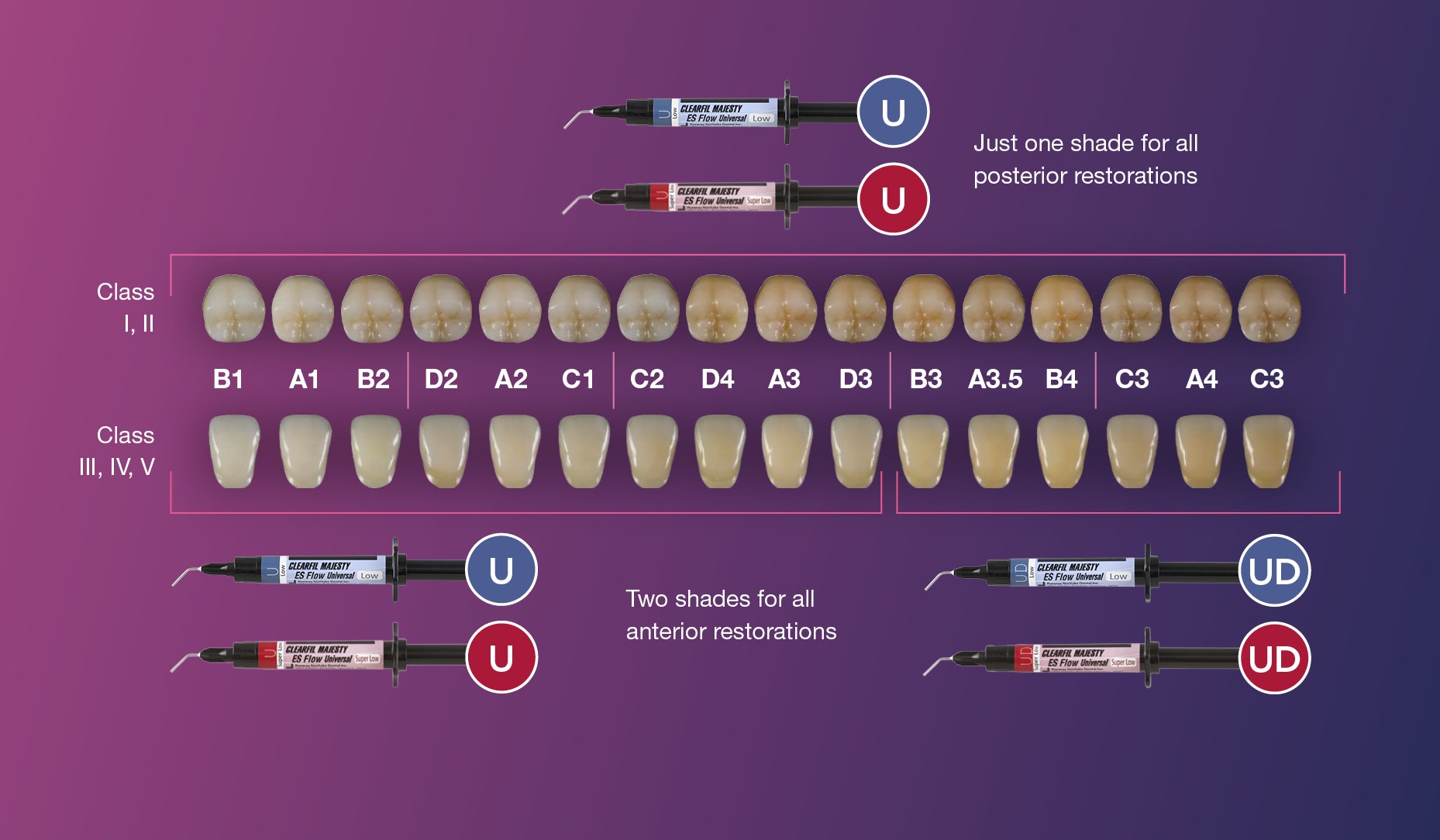
Color matching with anterior and posterior restorations.
Why do you offer an additional shade for the anterior region?
Universal-shade composites need to take on the colour of the surrounding tooth structure to deliver a perfect match for a great number of target shades. In the posterior area, large amounts of surrounding tooth structure are usually available with several cavity walls still present. This facilitates the taking on of the tooth colour compared to cavities in the anterior region. Here, light easily passes through, so that the colour of the composite itself is more likely to be reflected. This can lead to limitations in colour matching. In the case of CLEARFIL MAJESTY™ ES Flow Universal, the U shade that turned to be ideal for the posterior area showed some colour-matching limitations in anterior restorations of darker teeth. Hence, we decided to offer a second colour option specifically designed for these situations. With U and UD, CLEARFIL MAJESTY™ ES Flow Universal offers great colour adaptability from light to dark shades and hence addresses the need for precise colour matching especially in the anterior region.
Developing just two shades of composite to cover so many target tooth shades sounds challenging. How did you evaluate whether the available shades are appropriate in the clinical environment?
Indeed, it has been quite challenging to develop the U shade, which is able to match a wider range of tooth colours for both anterior and posterior teeth than the U shade of CLEARFIL MAJESTY™ ES-2 Universal. In order to evaluate and fine-tune the shades we developed, we repeatedly conducted filling tests using a wide range of experimental shades in artificial teeth and extracted teeth of various tooth colours. Additionally, the final selection of shades was visually evaluated by consulting dental practitioners who used the composite in the clinical setting.
What are the greatest challenges in the context of determining and selecting the right shade in the clinical environment?
The major drawback of classical shade determination is that it simply increases the chair time. For both, the dental practitioner and the patient, however, minimizing chair time is the ultimate goal, as it reduces costs and increases patient comfort. A true drawback in terms of time and comfort is a colour mismatch produced due to an error during shade determination: it may necessitate intra-oral adjustments or, in the worst case, the creating of a new restoration.
CLEARFIL MAJESTY™ ES Flow Universal is available in two viscosities – Low and Super Low. Why is this the case and what is the difference in use?
We decided to offer two types of flowability with different thixotropic properties to cater to users’ preferences in terms of handling. Basically, there is no difference in usage between Low and Super Low. However, users are encouraged to use composites with different thixotropic properties according to their preferences and the specific case. For example, Super Low is useful for shaping the occlusal surface of posterior teeth. Low can be widely used for applications such as lining and filling in the cervical area and on proximal surfaces.
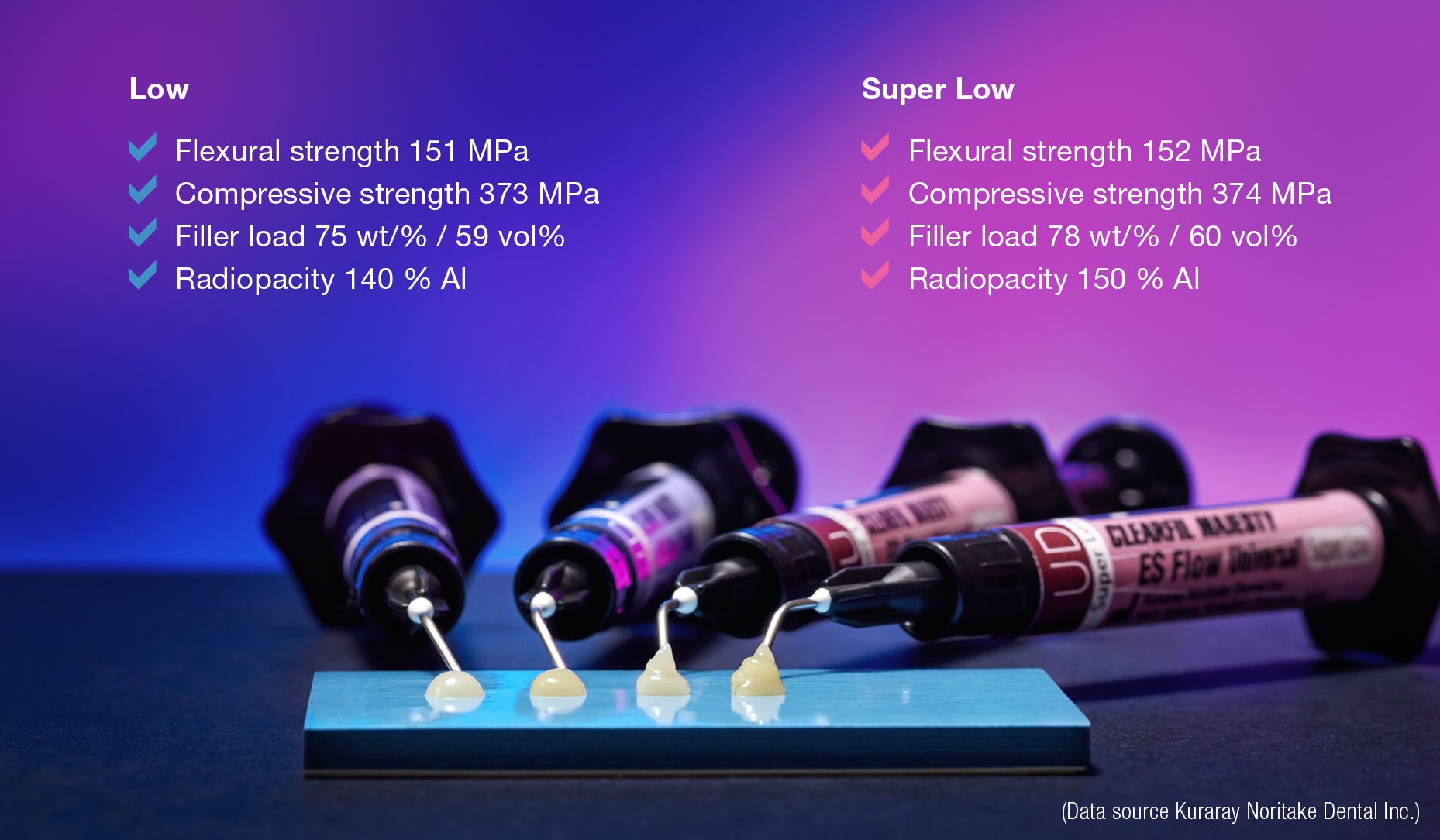
CLEARFIL MAJESTY™ ES Flow Universal – Great mechanical properties.
What are the technologies behind CLEARFIL MAJESTY™ ES Flow Universal that provide for a great blend-in?
The probably most popular technology used in this product is our proprietary Light Diffusion Technology. We determined the optimal light diffusion based on the observation that a strong diffuse reflection of incident light results in whitening, and weak light diffusion makes it easier to take on dark colours in the oral cavity, darkening the filling site. In addition, we focused on chroma adjustment: The universal shade concept is based on the ability to take on the colour of the surrounding tooth structure and blend with it. Therefore, we have set the chroma to be easily harmonized with a wide range of tooth shades. Finally, the translucency of the material was adjusted via its submicron fillers and silica clusters. Evaluation by key opinion leaders supported us in determining an appropriate level of translucency.
How to proceed in cases with discoloured tooth structure underneath – is there a need for masking with a blocker or opaquer?
The necessity depends on the degree of discolouration. Due to the light diffusion properties of CLEARFIL MAJESTY™ ES Flow Universal, it is generally believed that blocking is not required, and shading can be achieved. However, in cases of severe discolouration, it may be beneficial to fill the bottom of the cavity with A2D or A3D shades of CLEARFIL MAJESTY™ ES Flow, or to use CLEARFIL™ ST Opaquer.
What did you do to avoid void formation during application?
We have adopted the same packaging design used in CLEARFIL MAJESTY™ ES Flow to avoid void formation in this product as well. The innovative container design minimizes the gap between the needle tip and the syringe when the tip is attached.
Are there any recommendations of when to use CLEARFIL MAJESTY™ ES Flow and when to opt for CLEARFIL MAJESTY™ ES Flow Universal?
While the universal variant can be used for general lining and filling applications as described in the instruction for use, CLEARFIL MAJESTY™ ES Flow is recommended for those cases in which the tooth structure is covered and the colour of the entire tooth needs to be changed. Direct veneers are a perfect example. In those situations, the use of different shades and opacities is clearly beneficial.
What is the future of flowable composites?
As information on clinical performance and physical properties data continues to spread, the trust in flowable composites is expected to increase in Europe, leading to its expanded usage. Furthermore, an increased demand is anticipated due to the development of filling methods using flowable composites in conjunction with moulds or matrices.

TAKEHIRO KAMEYA
Il y a 4 teintes universelles CLEARFIL MAJESTY ES-2 disponibles. Il s'agit de U (Universal), UL (Universal Light), UD (Universal Dark) et UW (Universal White). Les teintes universelles CLEARFIL MAJESTY ES-2 sont utilisées en fonction de la classe de la cavité :
- Une seule teinte "U (Universal)" couvrira toutes les restaurations postérieures (classes I, II).
- Pour la zone antérieure (classes III, IV, V), 2 teintes sont disponibles : "UL (Universal Light)" (groupes A1, A2) et "UD (Universal Dark)" (groupes A3, A3.5, A4).
- En outre, "UW (Universal White)" est disponible pour les restaurations qui nécessitent une valeur/luminosité élevée.
Les séries Universal, Classic et Premium peuvent être utilisées pour tous les cas.
CLEARFIL MAJESTY ES-2 Universal est indiqué pour les applications restauratrices suivantes :
1. Restaurations directes pour toutes les classes de cavités dans les dents antérieures et postérieures.
2. Facettes directes
3. Correction de la position et de la forme de la dent (par exemple, fermeture du diastème, mésiodens, etc.)
4. Réparation intra-buccale de restaurations fracturées
PRODUIT NETTOYANT UNIVERSAL

ADHÉSIF TOUT-EN-UN

POUR UNE FINITION HAUTE BRILLANCE


1 syringe U: 2ml (3.6g)
1 syringe UW: 2ml (3.6g)
1 syringe UL: 2ml (3.6g)
1 syringe UD: 2ml (3.6g)
20 PLT U: 0.25g
20 PLT UW: 0.25g
20 PLT UL: 0.25g
20 PLT UD: 0.25g