
429 Too Many Requests

429 Too Many Requests


nginx

No Author Selected

Minimal ceramic layering on a "KATANA™ Zirconia" multi-layered micro-cutback restoration

By MDT Daniele Rondoni.


This clinical report reveals why you should start:

  • using fewer ceramic elements
  • choosing minimal ceramic layering
  • opting for micro-cutback solutions

without missing the quality and value of your restorations.


Advances in materials development and computer-aided processing allow for more streamlined workflows and an improved collaboration between the dental office and laboratory. In order to benefit from the new options, however, it is important that dental technicians embrace their new responsibilities: they need to keep track of the latest changes and need to acquire profound knowledge of how to leverage the materials’ and technologies’ full potential. Being open for new approaches and restoration techniques is part of this game. In return for their efforts, they will be able to achieve unparalleled aesthetic accuracy in a more efficient procedure.


The evolution of dental zirconia is an excellent example for advances in the field of dental materials: many modern zirconia discs have multi-layered structures and natural tranlucencies. Offering top-level performance and high versatility, these variants are increasingly often the materials of choice for the production of high-quality restorations.


The "KATANA™ Zirconia" multi-layered series, for example, is composed of four multi-layered materials: "KATANA™ Zirconia" HTML PLUS with the highest flexural strength (1,150 MPa) and lowest translucency, "KATANA™ Zirconia" STML with medium strength (748 MPa) and a high translucency, and "KATANA™ Zirconia" UTML with a strength above the level of glass ceramics (557 MPa) and ultra-high translucency. The latest add-on in “KATANA™ Zirconia” portfolio is YML - multi-layered zirconia disc that offers both flexural-strength and translucency gradation. With this portfolio, it is possible to select the right material for every specific need (e.g., high-strength variant for multi-unit restorations, high-translucency variant for anterior crowns). Using the zirconia with a monolithic or minimal vestibular cut-back design and a small layer of porcelain enables us to reduce the wall thickness of the restorations (as compared to a traditional framework design and full porcelain layer). As a consequence, a less invasive tooth preparation is required.


In addition, the design meets the functional needs in terms of low abrasiveness and high toughness, while a sophisticated aesthetic outcome is achieved using micro-layering with the materials contained in the 4.4.1. kit. These can be a winning alternative to traditional ceramic multi-layer solutions, as revealed using the following case example that illustrates the use of the 4.1. technique.


Fig. 1. Digital impression.


Fig. 2. Digital impression taken with the temporary in place.


Fig. 3. Digital model of the prepared teeth imported into the CAD software.


Fig. 4. Digital model of the teeth with temporary imported into the CAD software.


Fig. 5. Designing of four zirconia crowns: Transparent view.


Fig. 6. Designing of four vestibular enamel cutback zirconia crowns.


Dentin structure with internal anatomy


In the present case, "KATANA™ Zirconia" STML, in the shade A2, was selected based on the desired appearance of the final restorations, the colour of the abutment teeth and the space available. The selected design was a minimal vestibular cutback, while the palatal zirconia was left untouched. To replicate the natural aesthetics, we opted for vestibular micro-layering with single luster porcelain and specific internal design of the mamelons.


In order to achieve the best possible aesthetics, it is fundamental to incorporate the internal anatomy into the pre-sintered vestibular surface, and to precisely follow the recommended sintering protocol. Only a flawless sintering procedure will lead to the ideal translucency and correct shade appearance. Following sintering, the surface should be treated with a sandblasting unit (aluminium oxide, particle size 50 μm, pressure 1 to 2 bar).


Fig. 7. Cross-sectional view for a check of the correct thickness.


Fig. 8. Crown made of "KATANA™ Zirconia" STML after sintering.


Fig. 9. Checking the fit of the crowns on the printed working model.


Fig. 10. ILS technique: colour map.


Fig. 11. Application of "CERABIEN™ ZR" Internal Stains.


INTERNAL STAIN ADVANTAGES


  • Powder becomes gel and is always ready for use
  • The real colours are revealed already before baking
  • Optical effects are achieved simply and rapidly
  • Excellent adhesion to zirconia is ensured


To improve the mimicry effect, we use the internal light stain technique on the zirconia surface. Incisal Blue one is applied around the mamelons, Mamelon Orange 2 directly on the mamelons for a natural effect. For a calibrated chromaticity, A+ may be added in the cervical area.


Fig. 12. Appearance of the internal stains on the surface after firing.


Fig. 13. Light dynamics after firing.


Fig. 14. Luster layer: Colour map.


Fig. 15. "CERABIEN™ ZR" Luster Porcelain LT1 applied in a micro layer.


Fig. 16. Layering with LT1.


The vestibular body and incisal morphology are completed by adding a single ceramic micro layer of CZR Luster Porcelain LT1.


Before finalizing the restorations, the zirconia surface and texture were optimized with a stone and rubber polishers.


Polishing of the palatal surface was accomplished with Pearl Surface Z diamond paste before a final self-glaze step in the furnace.


Fig. 17. Appearance of the minimal ceramic layer after a single firing procedure.


Fig. 18. Light dynamics after firing.


Fig. 19. Final crowns after mechanical polishing.


Fig. 20. Check on the elements will be carried out on the printed digital model.


Fig. 21. Final situation after cementation.


Fig. 22. Palatal view of the final situation.


Conclusion


Considering aesthetic requirements and case difficulty, today it is possible to adopt different 4.4.1. approaches. In combination with the present generation of multi-layered zirconia, they allow the modern technician to make the best use of digital means to solve complex cases in an easy, effective, and successful manner.


The 4.4.1. system is recommended because it is a selection of materials used in a number of combinations, which help us achieve aesthetically sophisticated outcomes in a feasible, flexible and repeatable way.


For more information about the 4.4.1. system, click here.


Dentist:

DANIELE RONDONI, MDT


  • Graduating in 1979, Daniele Rondoni opened a laboratory in 1982, which is also the home of the AAT Community College he founded.
  • Teacher and counsellor for the “Italian School for Dental Technicians”at the University of Chieti, University of Sienna and University of Rome Tor Vergata.
  • EAED and IAED Active Member and a SICED Associate and O.L.
  • International Instructor for Kuraray Noritake Dental products.
  • Author of “Tecnica della Multistratificazione in ceramica” (Ceramic Multilayering Technique) and a lab manual about the use of composite materials, introducing his own method – the “Inverted Hardness Layering System”.
 

For bonding procedures of metal-free fixed dental prostheses

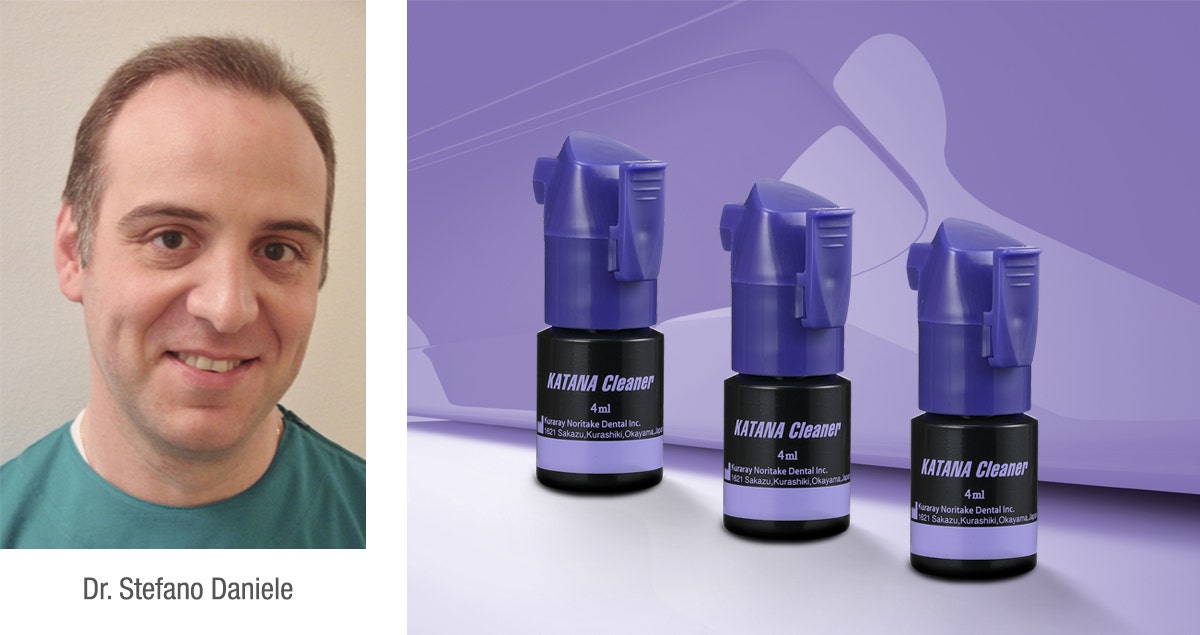
Article by Dr. Stefano Daniele.


During bonding procedures for metal-free fixed dental prostheses (FDPs), try-in with specific cement shade matching glycerine paste is necessary for choosing the correct shade of resin-based cement. During try-in, however, saliva and blood could contaminate the bonding surfaces of the ceramic and dental hard tissue. It is essential for the ceramic surface and dental hard-tissue surface to be perfectly clean of bacterial biofilm and other contaminants before adhesive application. Both the procedures ensure efficient bonding and long-term reliability of the adhesive fixed prosthetic intervention.


It is essential for the ceramic surface and dental hard-tissue surface to be perfectly clean.


Cleaning the ceramic bonding surface after try-in


Try-in of metal-free fixed dental prostheses (FDPs) is a key procedure for evaluating the fit of the finishing line of the dental preparation and, for very thin veneers, for matching the resin-based cement to be used to bond the ceramic restorations to the dental hard tissue. Aesthetic features—value in particular—of thin veneers depend on different factors, and one of the most important is the choice of shade of the resin-based cement used under the thin ceramic. To make this procedure easier and repeatable, many manufacturers provide glycerine pastes that have the same colours as those of the corresponding resin-based cements. This pre-bonding procedure of try-in of metal-free FDPs enables the selection of the most appropriate resin-based cement. Glycerine pastes are generally hydrophilic and can be rinsed from the ceramic bonding surface after try-in with an air–water spray, but some contaminants, such as saliva, blood and crevicular fluid, may remain on the surface, and this may affect the efficacy of the bond to the dental hard tissue. Sandblasting contaminated surfaces of metal-free FDPs may be the best choice for removing contaminants from bonding surfaces, but it is important to consider that not all dentists have sandblasting devices in their offices. To this end, Kuraray Noritake Dental launched KATANA™ Cleaner, a specific detergent for decontaminating the bonding surfaces of ceramics that is able to provide complete removal of contaminants from the bonding surfaces of metal-free FDPs after the try-in procedure. A perfectly clean ceramic bonding surface is important for obtaining an effective micromechanical interlocking between glass-ceramic and cement, as well as for allowing the chemical bond reaction between a 10-MDP-based primer and the zirconia bonding surface.


A perfectly clean ceramic bonding surface is important for obtaining an effective micromechanical interlocking between glass-ceramic and cement.


Cleaning the dental hard-tissue bonding surface when sandblasting is not recommended


The dental hard-tissue bonding surface must be clean before bonding metal-free FDPs, and this procedures can be done by sandblasting with a ‘soft’ powder such as erythritol. The focus of this procedure would not be to create an additive retention rate for the ceramic surface, but instead to remove the bacterial biofilm from the dental hard-tissue surface before bonding. Actually, metal-free FDPs are designed to have supra gingival finishing lines. Supra gingival preparation is also important for permitting perfect isolation with a rubber dam. In clinical practice, often the finishing line may be (partly) sub gingival for specific reasons, for example in veneer preparation designed to close diastemas and cervical black triangles between anterior teeth. In those clinical cases, dental dam application may be difficult, and sandblasting dental hard tissue may pose too high a risk of periodontal tissue bleeding. Tissue bleeding near the cervical margin of the preparation before adhesive bonding procedures for metal-free FDPs may affect the seal between the restorative and preparation. These clinical situations indicate the use of cleaning agents rather than sandblasting to clean surfaces before bonding.


Limitations of conventional agents used to clean bonding surfaces


Most conventional cleaning agents are not effective cleaners of ceramic, including zirconia, surfaces of metal-free FDPs and dental hard-tissue surfaces when sandblasting is contra-indicated as described. The following is a short list of the limitations and adverse effects of the main detergents used in clinical practice before bonding procedures:


  • Ethanol: It is not a very effective contaminant remover and is not able to remove saliva and blood proteins fully. Often ethanol fixates proteins rather than removing them.
  • Sodium hypochlorite: It has good efficacy as a cleaner, including removal of saliva and blood proteins, but may have an adverse impact on bonding procedures owing to its oxidisation properties (free radicals released from a sodium hypochlorite reaction could result in interference with autopolymerisation and light polymerisation of resin monomers).1
  • Hydrogen peroxide: It does not have any contaminantremoving properties and, to a greater extent than sodium hypochlorite, could result in interference with free-radical polymerisation of resin-based materials used for adhesive procedures.
  • Chlorhexidine: It does not have any adverse effect but also no capability of removing contaminants.


KATANA™ Cleaner and its specific features


KATANA™ Cleaner is a specific detergent solution for cleaning the surfaces of all kinds of prostheses, either metal based or metal free and for the adherent surfaces of dental hard tissue. KATANA™ Cleaner is for both extra-oral and intra-oral use. The chemical composition of KATANA™ Cleaner includes 10-MDP and a 10-MDP triethanolamine (TEA)-salt in an aqueous solution. 10-MDP-TEA is an emulsifier and surfactant compound able to solubilise many substances not soluble in water and to increase the wetting capacity of those. These chemical features of 10-MDP-TEA allow easier removal of contaminants from surfaces using water spray in order to obtain a clean surface. KATANA™ Cleaner is mainly targeting proteins; saliva, blood and the like. The 10-MDP-TEA-salt is amphiphilic. The non polair part enters the contamination forming micelles. the micelles are easy to rinse of with an air-water spray.


KATANA™ Cleaner is a powerful concentrated cleaner. It has a mild pH of 4,5 thus no adverse etching of the dental hard tissue. The presence of 10-MDP in the solution makes it compatible with all dental bonding agents. KATANA™ Cleaner is a purple-coloured solution, and this feature permits easy and accurate application on all surfaces to be cleaned. An easy flow chart follows that explains the use of KATANA™ Cleaner after try-in with glycerine paste before adhesive cementation of (metal-free) FDPs.


Fig. 1. Using KATANA™ Cleaner on the bonding surfaces of metal-free fixed dental prostheses and dental hard tissue after try-in and before bonding.


Fig. 2. Ceramic partial fixed dental prostheses (veneers) before the try-in.


Fig. 3. Glycerine paste used for the try-in.


Fig. 4. Veneer try-in.


Fig. 5. Use of KATANA™ Cleaner to remove remains of try-in gel and contaminants, such as saliva, from the bonding surfaces of the fixed dental prostheses.


CLINICAL CASE 1


Cleaning of "KATANA™ Zirconia" UTML FDPs after try-in using KATANA™ Cleaner


Fig. 6. "KATANA™ Zirconia" UTML fixed dental prostheses.


Fig. 7. Cleaning the fixed dental prostheses with KATANA™ Cleaner after the try-in.


Fig. 8. Tooth preparation cleaned with KATANA™ Cleaner before adhesive application and resin cementation.


Fig. 9. Fixed dental prostheses in situ at the recall appointment.


CLINICAL CASE 2


Tooth surface cleaning using KATANA™ Cleaner


Fig. 10. Ceramic partial fixed dental prostheses (veneers) before try-in and bonding procedures.


Fig. 11. Cleaning of the dental hard-tissue bonding surfaces in a clinical situation where sandblasting was not recommended owing to the high risk of periodontal soft-tissue bleeding.


Fig. 12. Bonded partial fixed dental prostheses at the recall appointment.


Fig. 13. Perioral aspect of the veneers during smiling.


Dentist:


DR STEFANO DANIELE


Dr Stefano Daniele received his dentistry degree from the University of Milan in Italy in 2001. He is in private practice in Milan and is an academic tutor in restorative dentistry in the Department of Biomedical, Surgical and Dental Sciences at the Faculty of Medicine of the University of Milan and is located at the San Paolo hospital in Milan. He was a visiting professor at the Università degli Studi del Piemonte Orientale “Amedeo Avogadro” in Novara in Italy, teaching restorative dentistry and dental materials until 2013.


Acknowledgements

Special thanks go to master dental technician Daniele Rondoni for the fabrication of the metal-free FDPs.


Reference

1. Lai SC, Mak YF, Cheung GS, Osorio R, Toledano M, Carvalho RM, Tay FR, Pashley DH. Reversal of compromised bonding to oxidized etched dentin. J Dent Res. 2001 Oct;80(10):1919–24. doi: 10.1177/00220345010800101101.


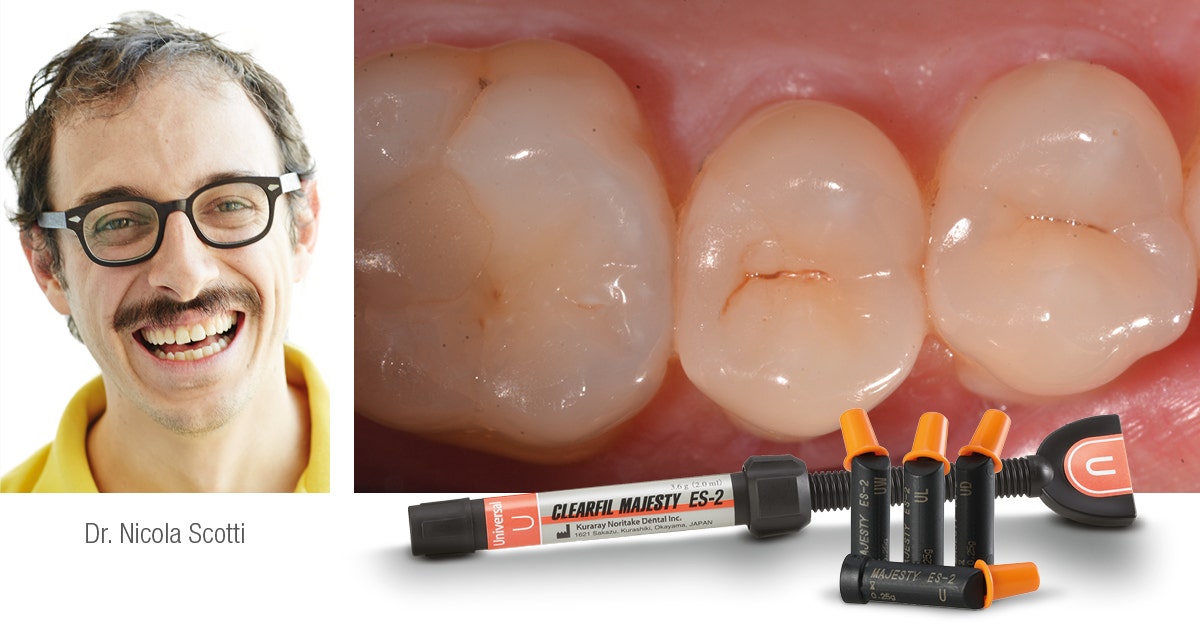
TRAITEMENT D‘UNE LÉSION CARIEUSE AVEC UN COMPOSITE POSTÉRIEUR D‘UNE SEULE COULEUR

CAS CLINIQUE AVEC LE
DR NICOLA SCOTTI


Pour restaurer des dents postérieures avec une résine composite, des aspects fonctionnels tels que des contacts proximaux serrés et corrects sur le plan anatomique, ainsi qu‘une surface occlusale de forme naturelle, résistante à l‘usure et favorable aux antagonistes sont plus importants même qu‘une intégration parfaite sur le plan visuel. C‘est pourquoi tout spécialiste dentaire devrait éviter de consacrer du temps à la sélection des couleurs dans ces cas et plutôt se concentrer sur les
facteurs qui ont un impact sur la fiabilité et longévité de la restauration. Dans ce contexte, CLEARFIL MAJESTY™ ES-2 Universal, une résine composite d‘une seule couleur universelle (U) pour la zone postérieure qui supprime l‘étape de la détermination et de la sélection de la couleur, est d‘une grande aide. Elle offre à la fois une bonne adaptation marginale, une faible rétraction et une grande résistance à l‘usure, toutes nécessaires pour de bons résultats à long terme.


Fig. 1. Situation initiale avec une vaste lésion carieuse primaire dans l‘aspect distal de la seconde prémolaire.


Fig. 2. Prémolaire après isolation du champ de travail avec une digue en caoutchouc, excavation des caries et préparation de la cavité.


Fig. 3. Positionnement d‘une matrice sectionnelle et d‘une cale pour optimiser la correspondance. Elles sont maintenues en position par un anneau de séparation qui agrandit l‘espace interproximal et assure donc des contacts proximaux serrés et corrects sur le plan anatomique.


Fig. 4. Construction de la cloison proximale avec CLEARFIL MAJESTY™ ES-2 Universal (couleur U) après mordançage sélectif de l‘émail à l‘acide phosphorique (seringue K-ETCHANT) et collage avec CLEARFIL™ SE Bond.


Fig. 5. Une fine couche de composite fluide (CLEARFIL MAJESTY™ ES FLOW High) est appliquée sur le plancher de la cavité pour agir comme un revêtement de résine.


Fig. 6. Restauration terminée avec CLEARFIL MAJESTY™ ES-2 Universal (couleur U). Alors que le composite de couleur universelle s‘intègre très bien à la structure dentaire environnante, l‘aspect naturel est perfectionné par l‘ajout d‘un tout petit peu de teinte brune au niveau de la fissure.


Fig. 7. Résultat du traitement immédiatement après retrait de la digue en caoutchouc. Le contact proximal est serré et l‘anatomie occlusale bien formée pour la dynamique masticatoire individuelle du patient. Le bord de la restauration est pratiquement invisible alors que la cuspide buccale paraît plus claire en raison de la déshydratation de la structure dentaire naturelle.


SITUATION FINALE


Fig. 8. Résultat du traitement après deux mois.


Conclusion

Le cas présenté ici démontre que le composite sélectionné convient bien à des procédures de restauration simplifiées dans la zone postérieure. Le matériau est maniable, offre les mêmes propriétés mécaniques que d‘autres matériaux de la série CLEARFIL MAJESTY™ ES-2 et s‘intègre harmonieusement aux structures environnantes sans être trop translucide. De cette manière, il est possible de se passer du processus de détermination de la couleur sans compromettre le résultat du
traitement. Le temps gagné dans ce contexte peut être consacré à des aspects fonctionnels - voire à un autre patient.


DR. NICOLA SCOTTI


BOND Volume 8 - Out now!

Innovation and workflow simplification made possible


In this edition of BOND, we're shining a spotlight on the innovation and workflow simplification made possible by high-quality products like our "KATANA™ Zirconia" range.


In an interview with Atsushi Matsumoto and Yuta Tajima about KATANA™ Zirconia YML these experts explain the benefits of this new material possessing different concentrations of yttria in a single blank, and highlight how its multi-layered nature allows practitioners to work with a nearly universal zirconia suitable for all cases.


Mathias Fernandez Lombardi has contributed an excellent article detailing the science behind "KATANA™ Zirconia", Kuraray Noritake Dental's brand new 4.4.1. kit is introduced and last, but certainly not least, Dr Stefano Daniele details his experiences with KATANA™ Cleaner.


Click here to read. Enjoy!


Start Reading: BOND | VOLUME 8 | 12/2021


Previous versions:

BOND | SPECIAL EDITION | 06/2021

BOND | VOLUME 7 | 10/2020


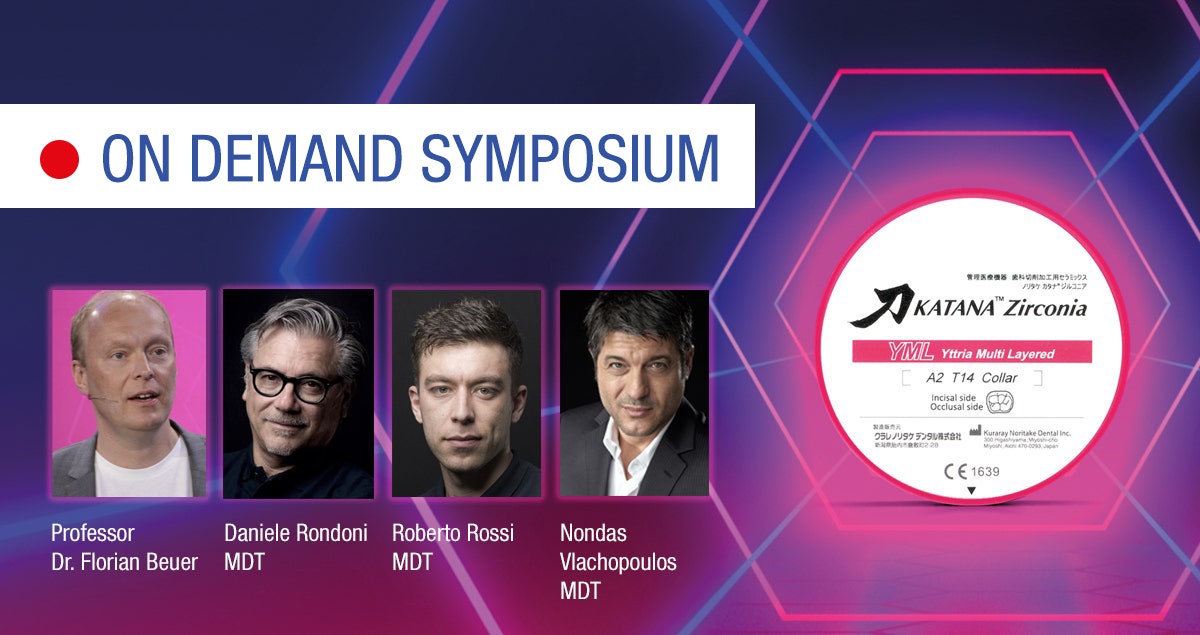
Recordings 03-07-2021 - YML Symposium Video Recordings

Virtual Kick-Off KATANA Zirconia Symposium


Lecture 1 of 3, Prof. Dr. Beuer
Watch how Prof. Dr. Beuer explains his experience with the new material. Two in one: Combining High Strength and High Translucent Zirconia.


Lecture 2 of 3, MDT Rondoni + MDT Rossi
Watch the recording of the KATANA Zirconia YML Online Symposium on July 3rd 2021, the second lecture plus hand-on which details the experience of MDT Rondoni and MDT Rossi with this new material.


Lecture 3 of 3 + Q&A, MDT Nondas Vlachopoulos
Mister Vlachopoulos deepdives in to a full procedure executed with the new material and demonstrates how liquid ceramics compliment the material establishing a very high-end aesthetic result.


LES SECRETS DE KATANA™ ZIRCONIA YML RÉVÉLÉS

La famille KATANA™ Zirconia de disques vierges CAD/CAM multicouches compte un nouveau membre : KATANA™ Zirconia YML (yttria multi-layered). Basé sur Kuraray Noritake Dental Inc. (KND), propriétaire de la technologie multicouche, ce nouveau matériau offre de multiples couches avec différents niveaux chromatiques et translucides PLUS différentes concentrations d’yttria dans un seul disque vierge. Nous avons parlé du nouveau produit et de ses spécificités
avec deux experts du département Recherche et développement de Kuraray Noritake Dental au Japon, Atsushi Matsumoto et Yuta Tajima.


Mr. Matsumoto, M. Tajima, KND offre déjà une vaste gamme de matériaux zircone qui couvre pratiquement chaque indication. Pourquoi alors avez-vous décidé de développer encore une autre zircone dentaire ?


En effet, la gamme KATANA™ Zirconia a reçu beaucoup de louages et d’excellents retours du marché. Les utilisateurs apprécient en particulier la résistance remarquablement élevée de HTML, le bel équilibre de propriétés esthétiques et de résistance de STML, ainsi que la haute translucidité d’UTML. Bien que le marché dentaire ait récemment connu une forte augmentation du nombre de matériaux zircone, de nombreux clients nous ont demandé un matériau plus
universel qui réunisse en un seul produit les excellentes propriétés de toutes les variantes de KATANA™ Zirconia. Ce produit leur permettra de fabriquer toutes sortes de restaurations à partir d’un seul disque, des simples couronnes aux bridges complets, tout en conservant une esthétique supérieure et des propriétés mécaniques tant pour les restaurations antérieures que postérieures. En tant que développeur de la gamme KATANA™ Zirconia, l’invention de KATANA™ Zirconia YML est notre réponse à ces désirs exprimés par nos clients.

 
Quelle est la principale différence entre KATANA™ Zirconia YML et les autres produits disponibles de la gamme KATANA™ Zirconia multicouche ?


Toutes les couches de KATANA™ Zirconia UTML, STML et HTML sont produites à partir de la même composition de poudre de base et offrent donc la même résistance sur l’intégralité du disque vierge. Selon les cas, les utilisateurs doivent pour répondre aux exigences spécifiques sélectionner le type de matériau le plus adapté, soit une zircone haute résistance ou une variante hautement translucide. KATANA™ Zirconia YML est une zircone « tout en un » convenant à tous les cas : Ce produit consiste dans une couche d’émail hautement translucide, une couche intermédiaire offrant un bel équilibre entre résistance, translucidité et couleur, ainsi qu’une couche de corps haute résistante. Les matériaux bruts utilisés ici sont développés et produits par KND en exclusivité pour YML. Il s’agit d’un
nouveau jalon dans le développement de produit avancé KATANA™ Zirconia.


Nous avons reçu de nombreuses demandes
de nos clients qui souhaitent un matériau
plus universel.


En général, les matériaux zircone actuellement disponibles avec une gradation de résistance intégrée ne sont pas très bien vus par de nombreux
techniciens et spécialistes dentaires parce qu’ils ne semblent pas suffisamment résistants dans la zone incisale. Cela peut conduire à des fractures s’agissant de restaurations longue portée, en particulier lorsqu’elles ne sont pas positionnées de manière adéquate sur le disque vierge. Dans quelle mesure KND s’est-elle penchée sur ces problèmes et comment a-t-on essayé de les résoudre pour se distinguer des concurrents ?


Les produits multicouches à base d’yttria actuellement sur le marché s’accompagnent de restrictions compliquées concernant la position du connecteur dans les cas de grandes dimensions comme les restaurations d’arcade complète car ils ne combinent pas idéalement esthétique et résistance. Pour relever ce défi, KND a développé des matériaux bruts bien équilibrés avec une haute résistance et une esthétique supérieure, ainsi qu’en les intégrant dans la couche intermédiaire située entre l’émail et les couches de corps. Résultat : même pour les restaurations de longue portée, il est très simple de positionner les connecteurs
grâce à cet équilibre parfaitement réussi entre résistance et esthétique. Ces propriétés uniques étant incorporées à notre nouveau produit, le risque de déformation et de cassure est évité.


Un autre problème est la ligne fréquemment visible entre les différentes couches avec différentes teneurs d’oxyde d’yttrium, ce que révèle une inspection plus détaillée après frittage. Comment avez-vous abordé cette question ?


Chez KND, nous avons réussi à obtenir les deux : une gradation adéquate de translucidité et une transition invisible, même pour les couches de zircone avec une teneur d’yttria différente. Nous nous sommes aidés de la technologie perfectionnée au fil de nombreuses années de fabrication de zircone multicouche,
qui comprend le mélange de la teneur adéquate pour la limite de chaque couche afin d’éviter délibérément les lignes de transition. En outre, l’intercouche nouvellement développée de matériaux bruts et un schéma de frittage récemment défini ont constitué la clé de la réussite.


Comment est-il possible d’avoir un protocole de frittage qui fonctionne pour différents composants zircone au sein du disque vierge KATANA™ Zirconia YML et autorise les temps de frittage les plus courts à ce jour ?


Le degré de rétrécissement pendant le frittage est déterminé par plusieurs facteurs, dont le nombre et la quantité d’additifs (yttria, alumine, etc.) contenus. Si le ratio de rétrécissement de chaque couche est différent, les lignes de transition apparaîtront probablement entre les couches ce qui peut créer des tensions dans la structure du matériau. Le matériau brut récemment développé pour KATANA™ Zirconia YML nous permet de contrôler et d’uniformiser le ratio de rétrécissement pour toutes les couches, même pour les matériaux bruts avec différentes teneurs en yttria.


L’utilisation de nos propres matériaux bruts produits en interne avec d’excellentes propriétés et convenant pour le frittage à grande vitesse était le principal pré-requis au développement du nouveau schéma de frittage grande vitesse de KND (54 min. pour les restaurations jusqu’aux bridges 3 unités), qui est disponible pour tous les produits de la gamme KATANA™ Zirconia multicouche. Cette option améliore l’efficacité du travail des techniciens dentaires et simplifie le flux de travail.


Enamel Layer
To provide high translucency that harmonizes with the anterior teeth.

Body Layer 1
To provide seamless color and translucency towards the Enamel Layer.

Body Layer 2, 3
To provide deep and vivid color while reducing whitening.


Y a-t-il des différences dans l’usinage et l’ajustement de KATANA™ Zirconia YML par rapport aux produits des concurrents ?


Tous les produits KATANA™ Zirconia de KND présentent une dureté appropriée avec moins d’ébréchures pendant l’usinage grâce aux matériaux bruts fabriqués et peaufinés en interne. En outre, après le processus de frittage, ils offrent un excellent niveau de résistance aux ébréchures, notamment lors des ajustements marginaux très complexes.


Y a-t-il autre chose qui distingue KATANA™ Zirconia YML d’autres produits intégrant une gradation de résistance ?


Oui, KATANA™ Zirconia YML présente une déformation réduite au frittage grâce aux matériaux bruts développés en interne sur la base de notre propre technologie de contrôle du taux de rétrécissement. Nous offrons de surcroît une vaste gamme de nuances (14), ce qui constitue un autre aspect important (outre les propriétés esthétiques bien équilibrées du matériau et l’absence de lignes de transition) pour la création de restaurations d’aspect naturel.
Enfin, trois des quatre couches répondant aux conditions d’une classification ISO classe 5, il y a peu de restrictions concernant la variation de conception de la prothèse.


Pourquoi un technicien dentaire devrait-il envisager d’utiliser KATANA™ Zirconia YML au lieu de n’importe quelle autre zircone dentaire (à votre avis) ?


Atsushi Matsumoto:

Il est désormais possible pour les techniciens dentaires de produire des restaurations solides et esthétiques avec seulement un matériau, KATANA™ Zirconia YML. Cela leur permet un stock réduit tout en réduisant significativement le temps de travail grâce à la possibilité du frittage grande vitesse.


Yuta Tajima:

Pour moi, les propriétés les plus convaincantes sont l’excellente précision de cuisson due au bon équilibre des caractéristiques de matériau dans toutes les couches, la vaste gamme de nuances disponibles et la formidable flexibilité de conception, même pour les bridges longue portée. Enfin, et ce ne sont pas des moindres, la qualité fiable de la marque KATANA™ et le label « Made in Japan » sont autant de raisons d’opter pour ce nouveau produit.


Tous les disques vierges de la gamme KATANA™ Zirconia se distinguent d’autres matériaux de zircone dentaire grâce à leur microstructure à grains particulièrement fins et de compression dense qui constitue la base pour une qualité supérieure de surface, la stabilité des bords et la précision en résultant en termes de correspondance. Quel est le secret qui se cache derrière cette qualité exceptionnelle du disque vierge ?


Comme nous ignorons la corrélation existant entre les propriétés de stabilité marginale (ébréchures, etc.) et les compositions de matériau, structures, etc., il est très difficile de répondre à cette question. Cela pourrait dépendre des structures des cristaux de zircone, du matériau brut lui-même, du niveau de résistance correct après pré-frittage ou de tout autre facteur mineur pendant le processus de fabrication du disque. Tous ces facteurs, conjointement, font la différence bien sûr.


Nous utilisons des pigments développés par KND qui présentent une
excellente stabilité de couleur, sans décoloration même après la
procédure de frittage finale.


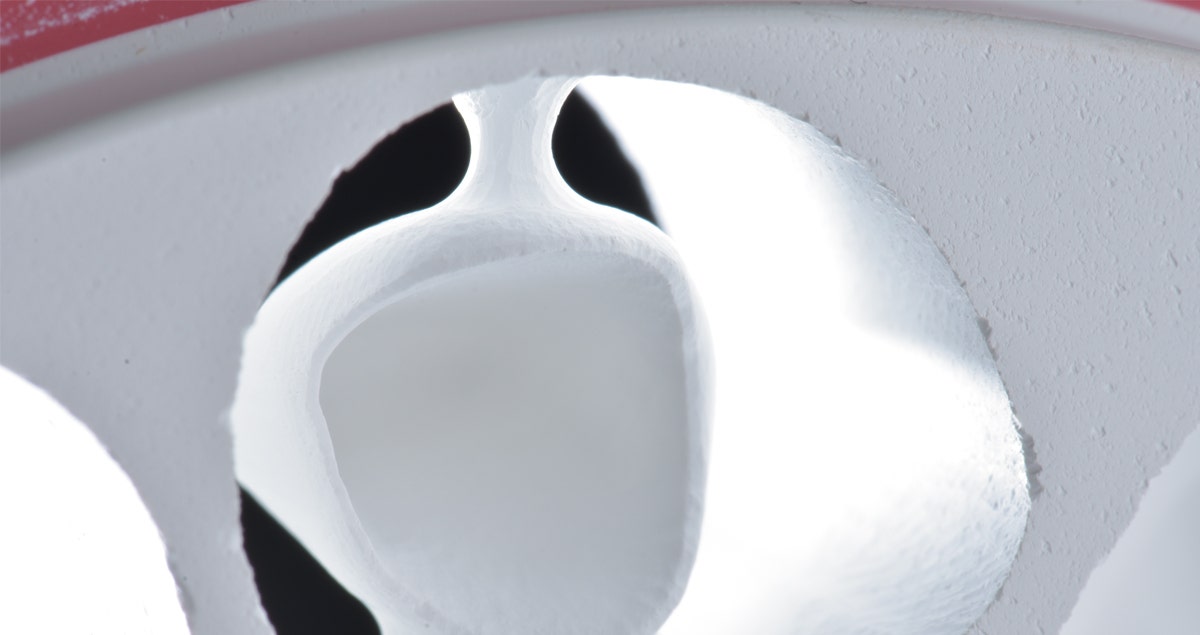
Even if the restoration margins have been milled to a very thin profile, they still show smooth margins without any chipping.


Un avantage évident de la gamme KATANA™ Zirconia, acclamé par des leaders d’opinion majeurs de KND, est sa stabilité de couleur et correspondance des nuances avec le nuancier « VITA classical shade guide ». Pouvez-vous expliquer l’importance de l’ajout mené
en interne d’additifs et pigments de couleur sous forme d’oxydes de métal pour satisfaire l’utilisateur et distinguer KATANA™ Zirconia des produits des concurrents ?


Nous utilisons des pigments développés par KND qui présentent une excellente stabilité de couleur, sans décoloration même après la procédure de frittage finale.
La taille des particules est contrôlée comme il se doit. En outre, notre équipe professionnelle de « mélange des couleurs », reflétant les opinions de techniciens dentaires avec de l’expérience clinique tant au sein qu’à l’extérieur de la société, a réalisé un mélange de pigments qui ne présente qu’une légère modification de nuance, même dans les cas d’épaisseurs différentes.


Comment voyez-vous l’avenir en termes de futurs développements pour la zircone dentaire ?


Depuis l’introduction de la zircone sur le marché dentaire, de nombreuses avancées significatives ont été accomplies par rapport au matériau.
Aujourd’hui, des matériaux zircone hautement résistants et de faible translucidité sont disponibles sur le marché. En outre, il existe aussi actuellement des matériaux zircone de forte translucidité et faible résistance dans des systèmes mixtes (gamme YML). Notre objectif premier est de développer dans l’avenir proche la zircone ultime, associant à la fois haute résistance et haute translucidité, à l’inverse des attentes générales supposant un compromis entre les deux dans les matériaux zircone.


Atsushi Matsumoto  Yuta Tajima


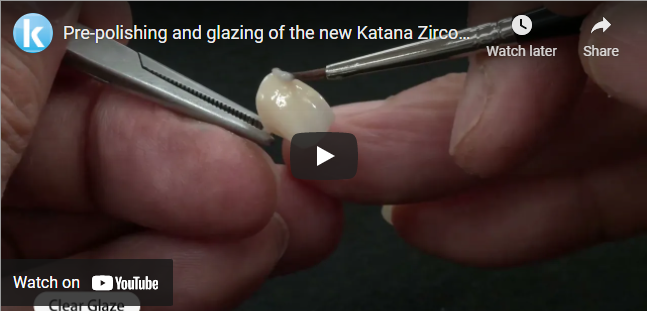
Video: Pré-polissage et vitrification du nouveau Katana Zirconia YML

Regardez le maître à l'œuvre : Kazunobu Yamada, prothésiste dentaire agréé, en train de prépolir et vitrifier une couronne faite avec le nouveau disque Katana Zirconia YML. Découvrez ses trucs et astuces pour obtenir les meilleurs résultats et une restauration hautement esthétique à l'aide des techniques de pré-polissage et vitrification simples.
 

Video: La dernière évolution dans le multi-couches, Katana Zirconia YML

Voici le dernier ajout à la famille Katana Zirconia : Katana Zirconia YML. Ce disque aux caractéristiques inédites offre un système multi-couches révolutionnaire qui améliore considérablement l'esthétique de vos restaurations. Découvrez comment ce produit de haute qualité peut constituer un avantage pour votre labo dentaire ! Voir la vidéo pour un bref résumé sur cet étonnant nouveau disque.


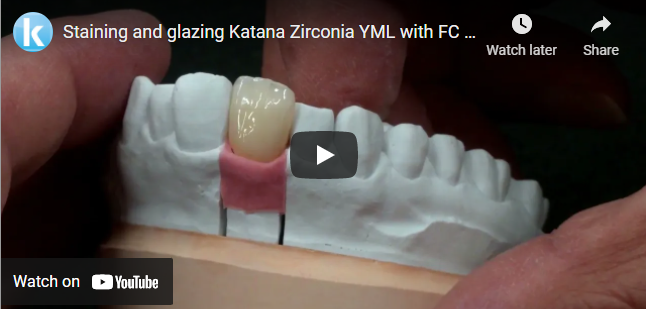
Video: Coloration et vitrification de Katana Zirconia YML avec FC Paste Stain

Dans cette vidéo, le prothésiste dentaire agréé Kazunobu Yamada montre son approche de la coloration et de la vitrification du nouveau Katana Zirconia YML. Regardez comment cette approche étape-par-étape permet d'obtenir un résultat hautement esthétique et naturel avec les différentes couleurs FC Paste Stain.


Educational videos - CERABIEN™ ZR (CZR)

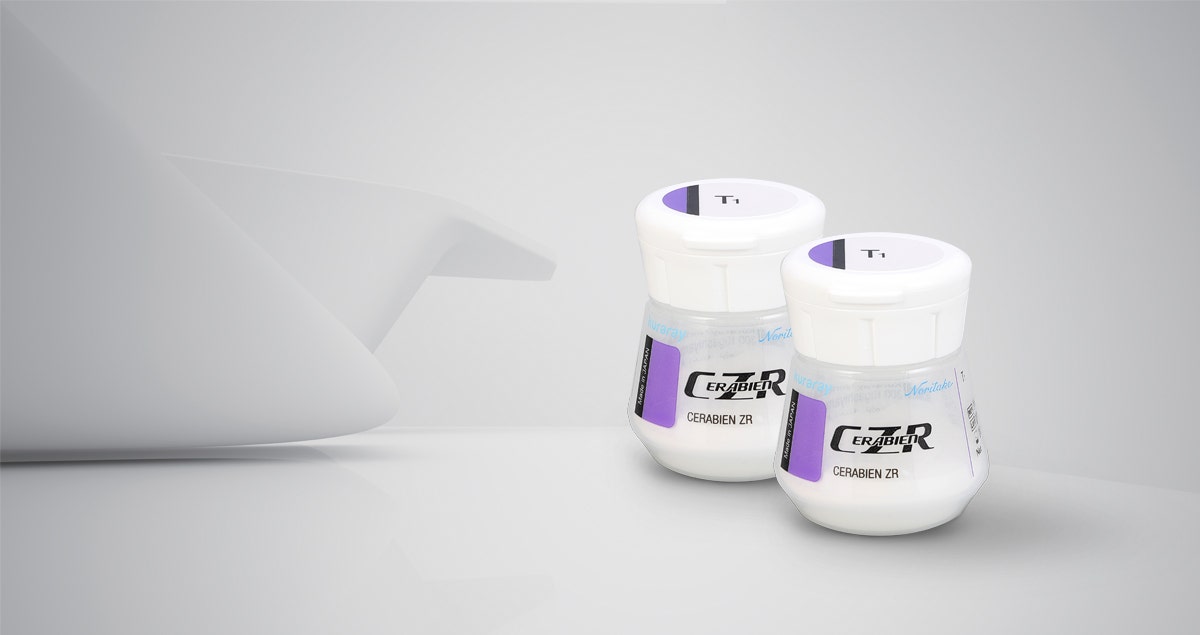
We are pleased to share with you short training videos for CERABIEN™ ZR (CZR) porcelain.


Check out the below working steps and learn more about how to achieve outstanding aesthetics using this tried and proven material.