No Author Selected

PANAVIA™ cements

Testimonial article by Dr. Troy Schmedding, USA


From PANAVIA™ EX to PANAVIA™ V5, Kuraray Noritake Dental Inc.‘s flagship product line of cements continues to evolve to offer reliable adhesion, enhanced ease of use, and superior esthetics.


Dentistry has certainly evolved in the years since Kuraray Noritake Dental Inc. developed the phosphate monomer MDP. But over the past 4 decades, it has rooted itself in restorative dentistry as the tried-and-true ingredient that clinicians rely on for strong adhesion to tooth structure as well as metals and zirconia. MDP is a key ingredient in the manufacturer’s flagship PANAVIA™ line of cements, which continues to evolve in line with a growing variety of indirect restorative materials from which to choose.


One example of this evolution is PANAVIA™ SA Cement Universal, one of the first true universal self-adhesive resin cements to hit the market. In addition to the original MDP monomer, it incorporates the LCSi monomer, a silane-based carbon chain in a dual-barrel system that forms a chemical bond with glass and ceramic materials.


“PANAVIA™ SA Cement Universal allows you to achieve a strong bond no matter which substrate is being used.”

- Troy Schmedding, DDS –


A STRONG BOND THAT’S SIMPLE TO CREATE


But all chemistry aside, what’s in it for the clinician? As dental educator and author Dr. Troy Schmedding points out, the key benefit of PANAVIA™ SA Cement Universal is eliminating the confusion over how to treat different substrates. This is because the material adheres to virtually every material without the need for a separate primer. “The plus side for the practitioner is that the confusion of ‚how do I condition zirconia‘ or ‚how do I condition glass ceramics‘ is no longer an issue because the paste formulation allows you to achieve a strong bond no matter which substrate is being used - whether it is the MDP monomer allowing strong adhesion to zirconia or the LCSi monomer forming a chemical bond with glass ceramics,” he shared.


DIALING UP THE AESTHETICS


Kuraray Noritake Dental Inc. considers PANAVIA™ V5 the most esthetic cement it has ever created. Available in 5 shades - White, Brown, Universal, Clear, and Opaque – it took researchers over 10 years to develop and features an anime-free catalyst that allows for superior colour stability and improved bond strength to dentin. And like its predecessors, PANAVIA™ V5 offers a simple cementation procedure that is compatible with all indications, from crown-and-bridge and implant abutments to ceramic inlays and laminate veneers.


“Kuraray Noritake Dental Inc. has an incredibly strong reputation in adhesive dentistry, so it should offer clinicians a lot of comfort and flexibility to partner with not only a reputable company, but one that continues to research and evolve their key products,” concluded Dr. Schmedding.


Dentist:

DR. TROY SCHMEDDING, DDS
USA


Article from Dental product shopper, vol. 14 No. 5


Et nyt design til PANAVIA Veneer LC-sprøjten

Opnå høj applikationskontrol med den nye sprøjte og spids!
Nem dispensering og høj applikationskontrol opnås takket være den specialdesignede sprøjte og applikationsspidsen på PANAVIA Veneer LC. Billedet nedenfor viser dig alle de nye funktioner.


Work flow PANAVIA Veneer LC with PANAVIA V5 Tooth primer

Minimally invasive procedures using highly aesthetic restorations is what patients expect when they seek restorative treatment. With the various types of restorations available today, it is possible to meet these expectations – provided that the right materials are used.


For the placement of veneers, a resin cement must be selected that supports long-lasting aesthetics, is easily applied, offers a working time sufficient for simultaneous cementation of multiple restorations and provides excellent bond strength. The new “PANAVIA™ Veneer LC” is precisely what you need.


What is the workflow you ask? Check out the video to see the full workflow using PANAVIA V5 Primer and CLEARFIL Ceramic Primer Plus.


Excess removal with PANAVIA Veneer LC

One of the key features when talking about cements is the ease of removal of excess cement. Our newest cement - PANAVIA™ Veneer LC - offers the ideal paste consistency, a low film thickness and long working time.


But how about excess removal? Do you wonder how do we compare to other similar products?


Check out this video demonstrating an excess removal comparison between PANAVIA Veneer LC and other brands.


Dr Jorge Espigares on PANAVIA Veneer LC

Webinar recording Panavia Veneer LC - Dr Jorge Espigares

PANAVIA™ Veneer LC

Great solution for challenging task

PANAVIA™ family just got bigger! We are introducing the new PANAVIA™ Veneer LC – the specialist cement that offers aesthetics, excellent paste viscosity, easy handling and 200 seconds(!) working time under ambient light (8000 lux.). Coming in four different shades with matching try-in pastes from PANAVIA™ V5 system, it allows users to take into account the individual shade requirements and deliver highly aesthetic outcomes when cementing veneers, inlays and overlays.

Join our free webinar now and be the first to learn all the details about this new and exciting product from Kuraray Noritake Dental Inc..


ABOUT DR JORGE ESPIGARES, DDS, PHD

Dr. Jorge Espigares received his DDS degree at the Faculty of Dentistry, University of Granada in Spain and obtained his PhD degree under the supervision of Prof. Tagami at Tokyo Medical and Dental University in Japan. Specialized in Cariology and Operative Dentistry, Dr. Jorge Espigares has clinical experience in Spain and UK, and has authored and coauthored full-length research publications with his colleagues at TMDU.


Clinical Report about PANAVIA Veneer LC

PRESENTATION OF A STUDY WITH ILLUSTRATIVE CASES

by Dr. Yohei Sato, DMD, PhD and Dr. Keisuke Ihara, CDT.


INTRODUCTION


In recent years, the application and advancement of digital technology in dentistry has made it possible to accomplish the fabrication of highly accurate prosthetic zirconia appliances that were difficult to mill using the previously available technology. In addition, thanks to advances in adhesive dentistry and the advent of cements that bond strongly to a diverse range of materials, cements have come into wide clinical use that can cope with the many types of materials used for the fabrication of prosthetic appliances.


At our hospital, we select the treatment method most suitable for each case by appropriately specifying various types of prosthetic appliance according to the status of each case. For example, we may specify zirconia prosthetic restorations fabricated by the CAD/CAM system, or silica-based ceramic prostheses, or those made of lithium disilicate glass, as the case dictates.


PANAVIA™ V5 is a resin cement system that bonds strongly to various types of prosthetic appliance, as well as to tooth structure. PANAVIA™ Veneer LC, a new resin cement system developed by Kuraray Noritake Dental Inc., has suitable characteristics for bonding laminate veneers, using two types of primer that can be used in common with PANAVIA™ V5. Here are some clinical examples of its advantages as a resin cement system used for laminate veneers restorations.


PANAVIA Veneer LC - HÆRDNINGSTEKNOLOGI

INNOVATIV HÆRDNINGSTEKNOLOGI
PANAVIA™ Veneer LC er en lyspolymeriserende cement, der kombinerer flere teknologier for at give dig den højest mulige bindingsstyrke.

FORSEGLING AF ADHÆSIONSFLADEN
Modificeret kontakthærdningsteknologi bruges til at opnå en længere arbejdstid, samtidig med at den høje bindingsstyrke, som PANAVIA™ er kendt for, bevares. PANAVIA™ Veneer LC kombineret med PANAVIA™ V5 Tooth Primer tilfører et vigtigt kemisk element til en lyspolymeriserende cement.

PANAVIA™ V5 Tooth Primer som er en selvætsende primer til tandstruktur (dentin og emalje), forsegler tandoverfladen sikkert, så snart PANAVIA™ Veneer LC kommer i kontakt med den. Denne ”milde” kontakthærdning initierer kun polymeriseringen ved adhæsionsfladen og skaber en øjeblikkelig stærk binding til emalje og dentin, men påvirker ikke cementens afbinding og dermed heller ikke arbejdstiden.


ARBEJDSTID
Under cementeringsprocedurer påvirker flere eksterne faktorer din arbejdstid. Teknologien bag PANAVIA™ Veneer LC tager højde for disse
faktorer. Kontakthærdningsteknologien giver mulighed for øjeblikkelig forsegling af adhæsionsfladen. Grundlaget for høje bindingsstyrker.
Lyspolymeriseringsteknologien giver dig en arbejdstid på 200 sekunder under omgivende lys*, før PANAVIA™ Veneer LC begynder at miste sin
ideelle formbarhed. I løbet af disse 200 sekunder kan du nemt placere og positionere op til flere facader. Den endelige polymerisering finder
sted under belysningen med hærdelampen og gør at cementen hærder fuldstændigt.
*Omgivende lys; ca. 8.000 lux


PANAVIA Veneer LC - KONSISTENS OG ÆSTETIK

NYE FYLDSTOFFER
PANAVIA™ Veneer LC’s fremragende håndtering forbedres yderligere af de nyudviklede sfæriske silikafillere (fillerindhold: 66 vægtprocent, 47 volumenprocent). Takket være cementens tiksotrope egenskaber kommer facaderne ikke til at glide eller løsne. PANAVIA™ Veneer LC giver en kontrolleret påføring, den bliver siddende, der hvor den påføres, men flyder godt under placering af facaden/facaderne. Takket være dens konsistens og lave filmtykkelse (≈ 8 μm) giver PANAVIA™ Veneer LC et tyndt, jævnt fordelt cementlag. Dette bidrager til nem placering uden forstyrrelser. Desuden gør anvendelsen af kun små, sfæriske fillere (partikelstørrelse; 0,05 μm - 8 μm) det muligt at opnå meget æstetiske og glatte kantområder og byder på forbedret polerbarhed og glansbestandighed.

SILIKAFILLERE
Nyligt udviklede sfæriske silikafillere i cementen sørger for, at den bliver siddende, hvor den påføres, men flyder godt under placering af facaden. Giver mulighed for nem placering, uden at facaden glider eller løsner. Ved applicering på facadens indre overflade klæber resincementen ikke til påføringsspidsen, en egenskab, der opnås ved tilsætning af sfæriske nanoklynge-fyldstoffer.

Disse nye fillertyper resulterer
i fremragende glatheds,
glansbevaring samt nem
håndtering.

VISKOSITET OG TIKSOTROPI
Viskositeten på en cement er vigtig og skal være tilstrækkelig lav for at forhindre protesen i at sprække under placeringen. Samtidig må
den ikke være så flydende, at den løber af under applicering og placering af restaureringen.
Da PANAVIA™ Veneer LC indeholder en optimeret fyldstof/resinblanding, kan dens viskositet ændres under tryk. Fænomenet kaldes
tiksotropi. Cementen bliver mere flydende under tryk under placeringen og positioneringen af facaden. Når trykket falder, øges
viskositeten igen. På grund af den tiksotrope egenskab ved PANAVIA™ Veneer LC, er cementen nem at dosere, og det kræver kun let
tryk at placere restaureringen, og det overskydende materiale er let at fjerne. Kort sagt: maksimal kontrol.


Materialer med samme viskositet har ikke nødvendigvis samme tiksotropi. Temperatur og tryk påvirker viskositeten. Graden og
hastigheden, hvormed et materiale vender tilbage til sin oprindelige viskositet, når trykket reduceres, afhænger af materialets tiksotropi.

Direct cuspal coverage with resin composite

Case by Dr. Aleksandra Łyżwińska, Warsaw, Poland


ABSTRACT


Indirect overlays are the contemporary restoration standard for posterior teeth with extensive hard tissue loss. They provide for cuspal coverage, which decreases the likeliness of coronal and/or root fracture. At the same time and in contrast to crowns, overlay preparations minimize the removal of sound tooth structure especially in the cervical region, which is a critical factor.1 Modern dental resin composites allow for direct cuspal coverage in a single-visit appointment. The results of in-vitro studies suggest that these direct overlays are a suitable alternative to their indirect counterparts in specific situations.2-6 The following case report is used to describe the direct restoration procedure by means of a maxillary right molar with an extensive, deep MOD lesion.


INTRODUCTION


In the context of treating a tooth with an extensive carious lesion, a biomechanical risk assessment should be performed. The primary method of reducing the likeliness of tooth fracture is treatment with a restoration that provides cuspal coverage. The contemporary gold standard for biomechanically compromised teeth are adhesively cemented overlays as an alternative to crowns.1 Another option that does not involve labwork is a direct overlay restoration.2-6 The direct approach is especially suitable for long-term temporization, which may be required during orthodontic treatment, for example.


CLINICAL CASE


The 40-year-old male patient was referred to my office before an orthodontic and prosthetic treatment. Intraoral examination (Figs. 1 and 2) revealed:

  • Tetracycline discolouration,
  • Multiple extensive composite restorations with marginal leakage,
  • Primary and secondary carious lesions, and
  • Significant mechanical weakness7,8 (mesio-occluso-distal (MOD) cavities, cusp loss, cracks).


Fig. 1. Initial situation – extensive MOD composite resin restoration.


Fig. 2. Initial situation – unacceptable contact points, palatal wall crack line.


Based on a clinical and radiological examination (Fig. 3), it was decided to restore the maxillary right first molar with a direct overlay, which should serve as a long-term temporary for the duration of orthodontic treatment. Once the local anaesthetic had been administered, rubber dam was placed in the first quadrant and the cusps of the affected first molar were reduced. For subgingival tooth preparation, a rubber dam sheet was temporarily moved behind the second upper molar (Fig. 4). In order to obtain a good emergence profile of the restoration and a tight fit of the sectional matrix, the gingivectomy was performed with an electric surgical knife (Surtron 50D, LED SPA) (Fig. 5). The main advantages of a diathermal cut are instant tissue coagulation and hemostasis9.


Fig. 3. Bite-wing radiograph: Maxillary fist molar with an overhang and negative profile of the distal wall.


Fig. 4. Initial preparation with reduction of the cusps and exposure of gingiva.


Fig. 5. Gingivectomy performed using a surgical electric knife.


In accordance with the European Society of Endodontology’s guidelines on the management of deep caries10, the deepest part of the cavity was cleaned in full rubber dam isolation (Nic Tone Dental Dam, MDC Dental) (Fig. 6). Carious-tissue excavation was carried out using round burs, then the enamel and dentin were air-abraded with 50-μm aluminum oxide (Microetcher IIa, Danville). Multiple cracks, penetrating through the enamel and partially the dentin, occurred within the mesial and palatal walls. The presence of cracks crossing the dentin-enamel junction is an absolute indication to cuspal coverage8,11.


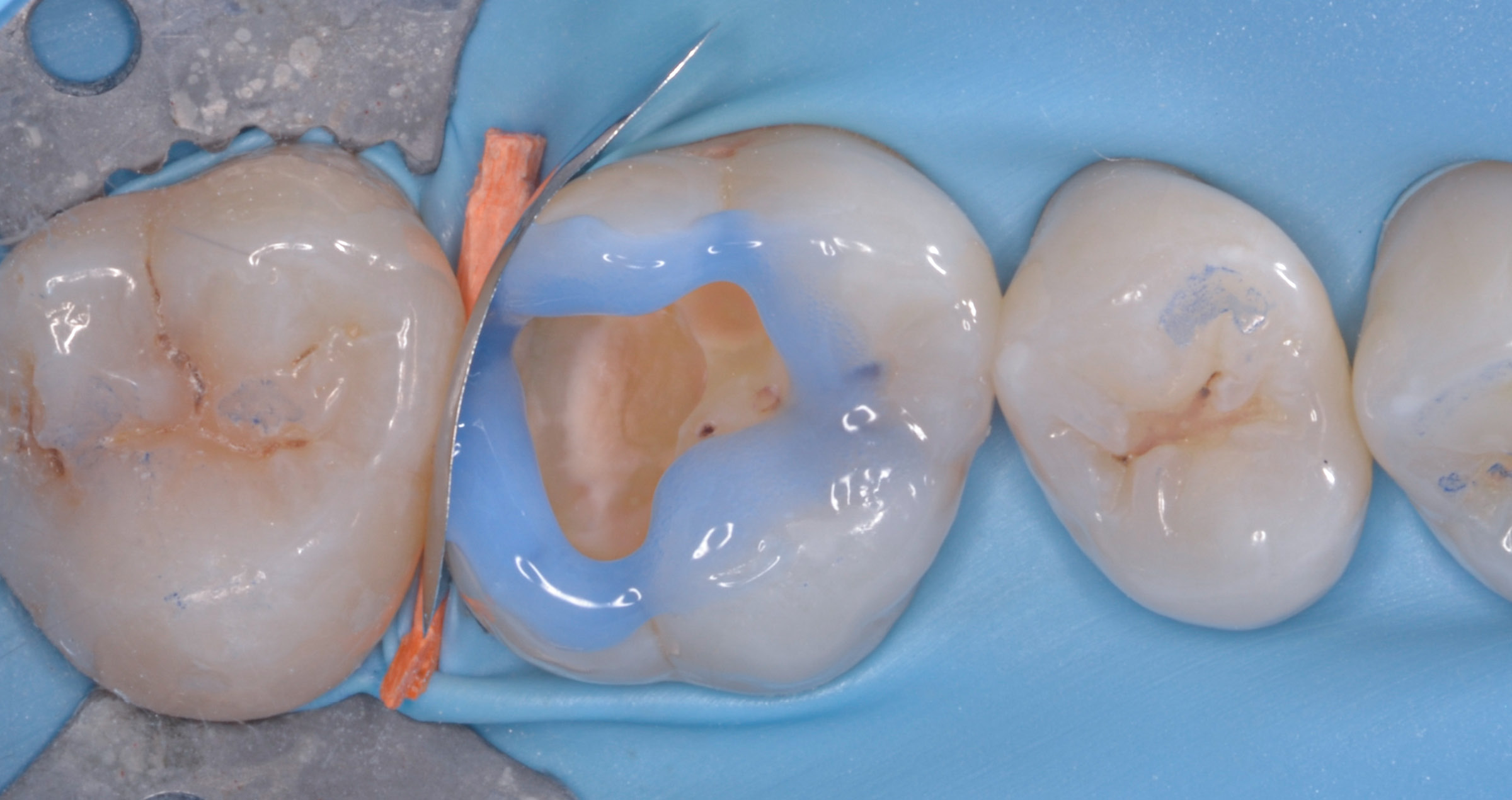
An appropriate rubber dam isolation is essential in adhesive dentistry. Beyond the obvious advantage of a clean operation field uncontaminated by saliva and moisture, the rubber dam contributes to keeping periodontal tissues at a distance form a tooth. In order to ensure both, maximum retraction and sufficient space to work, the rubber dam was inverted (introduced to the gingival sulcus) and stabilized using PTFE tape (Fig. 7). The mesial wall was restored using a blue 3D Composite-Tight 3D Fusion matrix ring (Garrison) and a medium standard Sectional Contoured Metal Matrix (TOR VM, Fig. 8). Due to its extensiveness and shape, restoration of the distal wall was more difficult to perform.


Fig. 6. Rubber dam newly placed in the interproximal area. Full isolation is essential for the excavation of the infected dentin in the deepest part of the cavity.


Fig. 7. PTFE tape placement for improving isolation in the gingival area. Al2O3 sandblasting.


Fig. 8. Mesial matrix fit.


The first attempt to adapt an elongated Sectional Contoured Metal Matrix and the green 3D Composite-Tight 3D Fusion (Garrison) ended with failure (Fig. 9). The matrix was changed for a longer and more curved one (Fig. 10). The ring was replaced by a smaller Palodent V3 Ring (Dentsply Sirona, Fig. 11). Due to the depth of the carious lesion, an antibacterial adhesive system was used (CLEARFIL™ SE Protect, Kuraray Noritake Dental Inc.). It contains the MDPB monomer, which offers an antibacterial effect that lasts even after hybrid layer formation12-14. Furthermore, the fluoride included in the bond liquid intensifies the cariostatic mechanism of CLEARFIL™ SE Protect and supports the so-called “Super Dentin” formation15.


Fig. 9. Insufficient fit of the distal matrix.


Fig. 10. New, longer and more curved matrix in place.


Fig. 11. Different matrix ring placed in the distal area.


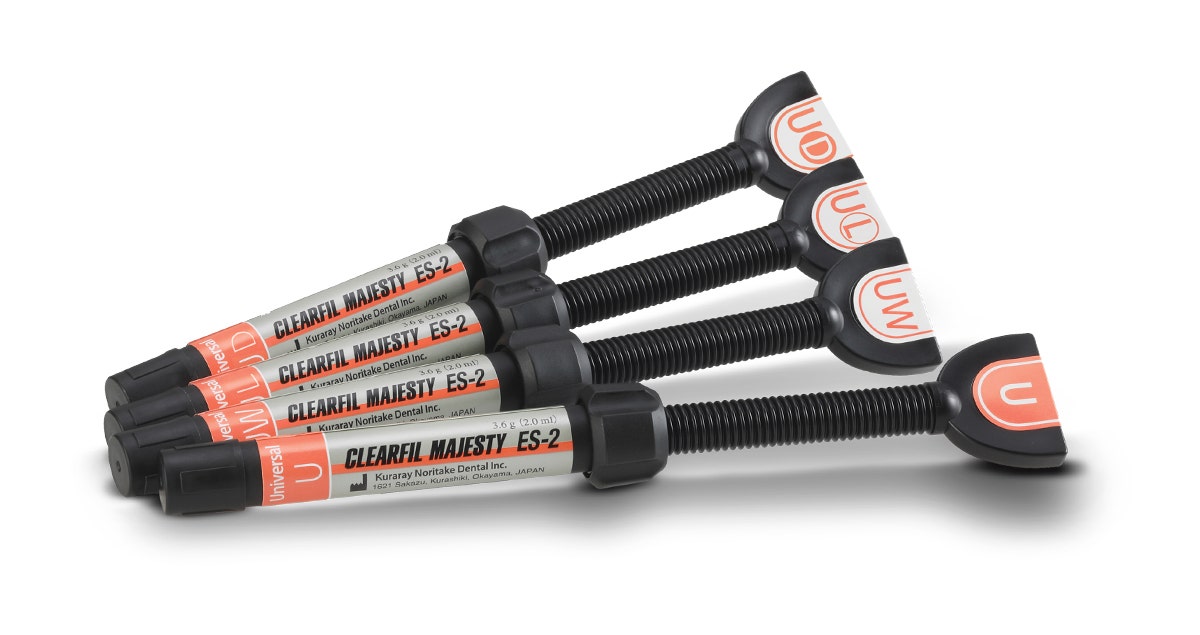
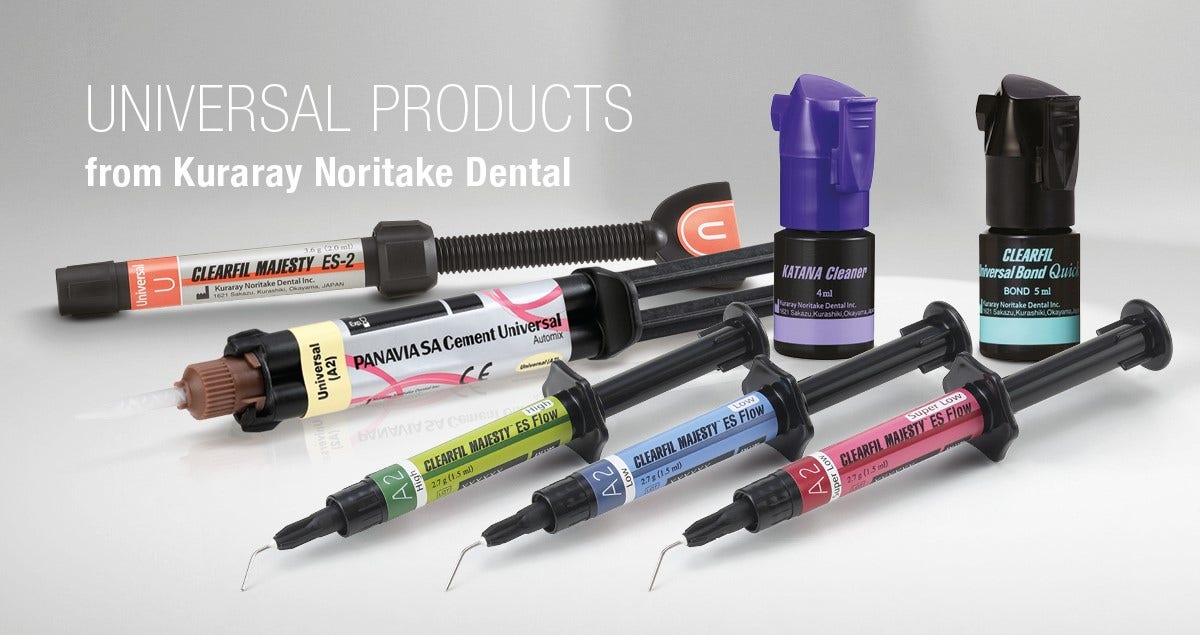
After polymerization of the bonding agent, the nanohybrid flowable composite resin (CLEARFIL MAJESTY™ ES Flow High, Kuraray Noritake Dental Inc.) was applied in a thin layer. The proximal wall was restored using both packable (CLEARFIL MAJESTY™ ES-2 Universal, Kuraray Noritake Dental Inc.) and flowable composite resin (CLEARFIL MAJESTY™ ES Flow Super Low, Kuraray Noritake Dental Inc.) (Figs. 12 and 13). Core build-up was performed with bulk-fill type composite. The cusps were reconstructed free-hand with the previously used CLEARFIL MAJESTY™ ES-2 Universal (Figs. 14 and 15). The universality of this product provides for a good optical integration and blending with the adjusted tissue, regardless of the colour of the underlying tooth structure. The fissures were gently highlighted using brown tints.


Fig. 12. Thin layer of flowable composite resin CLEARFIL MAJESTY™ ES Flow High (A2) applied on the cavity floor. The proximal walls are built up with build-up by CLEARFIL MAJESTY™ ES-2 Universal and CLEARFIL MAJESTY™ ES Flow Super Low (A2).


Fig. 13. Proximal walls build-up – palatal view.


Fig. 14. Core build-up. Free-hand cusp coverage with CLEARFIL MAJESTY™ ES-2 Universal, palatal view.


Fig. 15. Cusp coverage – occlusal view.


The initial polishing was performed with the rubber dam still in place. The excesses of composite resin were removed with the aid of abrasive discs, diamond burs and a “Brownie” polisher (BAL, Nevadent). Pre-polishing and high-shine polishing were executed with TWIST™ DIA for Composite (Kuraray Europe GmbH.) supported by a goat hair brush (Micerium) (Figs. 16 to 17).


Fig. 16. Occlusal surface after surface modeling with CLEARFIL MAJESTY™ ES-2 Universal and initial polishing.


Fig. 17. Occlusal surface after modeling with CLEARFIL MAJESTY™ ES-2 Universal and initial polishing – palatal view.


After removal of the rubber dam, the occlusal contact points of the direct overlay were adjusted (Figs. 18 and 19). Every spot touched by the burr was subsequently repolished according to the previously described protocol (Figs. 20 and 21).


Fig. 18. Occlusal adjustment. Contact points recorded with articulation paper (100 μm).


Fig. 19. Occlusal adjustment. Contact points recorded with articulation paper (100 μm= and articulation foil (16 μm).


Fig. 20. Final effect after polishing with TWIST™ DIA for Composite.


FINAL SITUATION


Fig. 21. Final effect – palatal view.


CONCLUSION


As a result of decades of improvements mainly with regard to the filler density and polishability, modern dental composites offer a great gloss retention and favourable wear properties. In addition, polymerization shrinkage has been decreased due to the integration of nanohybrid filler technology. Those features allow us to restore biomechanically compromised teeth using a direct restoration technique.


Direct overlays are a suitable alternative for a conventional indirect restoration in many situations.18,19 According to researchers, the advantages of direct restorations with cuspal coverage include minimal tooth preparation, vital pulp-oriented treatment, the possibility to treat patients in a single appointment and a potentially lower cost of the treatment.18-20 However, it should be emphasized that the presented technique requires advanced restorative skills that need to be acquired first before starting to implement it.


Dentist:

DR. ALEKSANDRA ŁYŻWIŃSKA
Warsaw, Poland


Dr. Aleksandra Łyżwińska is a restorative dentist. She graduated from the Warsaw Medical University in 2017, where she was an assistant professor at the Department of Conservative Dentisyty and Endodontics. Her focus lies in modern adhesive techniques, resin composites and biomaterials.


REFERENCES


1. Dietschi D, Duc O, Krejci I, Sadan A. Biomechanical considerations for the restoration of endodontically treated teeth: a systematic review of the literature--Part 1. Composition and micro- and macrostructure alterations. Quintessence Int. 2007 Oct;38(9):733-43.
2. van Dijken JW. Direct resin composite inlays/onlays: an 11 year follow-up. J Dent. 2000 Jul;28(5):299-306. doi: 10.1016/s0300-5712(00)00010-5. PMID: 10785294.
3. Mondelli RF, Ishikiriama SK, de Oliveira Filho O, Mondelli J. Fracture resistance of weakened teeth restored with condensable resin with and without cusp coverage. J Appl Oral Sci. 2009 May-Jun;17(3):161-5.
4. Deliperi S, Bardwell DN. Multiple cuspal-coverage direct composite restorations: functional and esthetic guidelines. J Esthet Restor Dent. 2008;20(5):300-8; discussion 309-12.
5. Deliperi S, Bardwell DN. Clinical evaluation of direct cuspal coverage with posterior composite resin restorations. J Esthet Restor Dent. 2006;18(5):256-65; discussion 266-7.
6. Mincik J, Urban D, Timkova S, Urban R. Fracture Resistance of Endodontically Treated Maxillary Premolars Restored by Various Direct Filling Materials: An In Vitro Study. Int J Biomater. 2016;2016:9138945.
7. Reeh ES, Messer HH, Douglas WH. Reduction in tooth stiffness as a result of endodontic and restorative procedures. J Endod. 1989 Nov;15(11):512-6.
8. Banerji S, Mehta SB, Millar BJ. The management of cracked tooth syndrome in dental practice. Br Dent J. 2017 May 12;222(9):659-666.
9. Bashetty K, Nadig G, Kapoor S. Electrosurgery in aesthetic and restorative dentistry: A literature review and case reports. J Conserv Dent. 2009 Oct;12(4):139-44.
10. European Society of Endodontology (ESE) developed by:, Duncan HF, Galler KM, Tomson PL, Simon S, El-Karim I, Kundzina R, Krastl G, Dammaschke T, Fransson H, Markvart M, Zehnder M, Bjørndal L. European Society of Endodontology position statement: Management of deep caries and the exposed pulp. Int Endod J. 2019 Jul;52(7):923-934.
11. Lynch CD, McConnell RJ. The cracked tooth syndrome. J Can Dent Assoc. 2002 Sep;68(8):470-5.
12. Hashimoto M, Hirose N, Kitagawa H, Yamaguchi S, Imazato S. Improving the durability of resindentin bonds with an antibacterial monomer MDPB. Dent Mater J. 2018 Jul 29;37(4):620-627.
13. Imazato S, Kinomoto Y, Tarumi H, Torii M, Russell RR, McCabe JF. Incorporation of antibacterial monomer MDPB into dentin primer. J Dent Res. 1997 Mar;76(3):768-72.
14. Imazato S, Kinomoto Y, Tarumi H, Ebisu S, Tay FR. Antibacterial activity and bonding characteristics of an adhesive resin containing antibacterial monomer MDPB. Dent Mater. 2003 Jun;19(4):313-9.
15. Nakajima M, Okuda M, Ogata M, Pereira PN, Tagami J, Pashley DH. The durability of a fluoride-releasing resin adhesive system to dentin. Oper Dent. 2003 Mar-Apr;28(2):186-92.
16. Bore Gowda V, Sreenivasa Murthy BV, Hegde S, Venkataramanaswamy SD, Pai VS, Krishna R. Evaluation of Gingival Microleakage in Class II Composite Restorations with Different Lining Techniques: An In Vitro Study. Scientifica (Cairo). 2015;2015:896507.
17. Oficjalne informacje producenta Kuraray Noritake Dental https://www.kuraraynoritake.eu/pl/clearfil-majesty-es-flow (dostęp 08.02.2022).
18. Angeletaki F, Gkogkos A, Papazoglou E, Kloukos D. Direct versus indirect inlay/onlay composite restorations in posterior teeth. A systematic review and meta-analysis. J Dent. 2016 Oct;53:12-21.
19. Dhadwal AS, Hurst D. No difference in the long-term clinical performance of direct and indirect inlay/onlay composite restorations in posterior teeth. Evid Based Dent. 2017 Dec 22;18(4):121-122.
20. Banerji S, Mehta SB, Millar BJ. Cracked tooth syndrome. Part 2: restorative options for the management of cracked tooth syndrome. Br Dent J. 2010 Jun;208(11):503-14.
21. Opdam NJ, Roeters JJ, Loomans BA, Bronkhorst EM. Seven-year clinical evaluation of painful cracked teeth restored with a direct composite restoration. J Endod. 2008 Jul;34(7):808-11.
22. van Dijken JW. Direct resin composite inlays/onlays: an 11 year follow-up. J Dent. 2000 Jul;28(5):299-306.


What did you miss this summer?

The vacation period is over and we all are slowly returning back to our everyday routines and work. With all the travel and holidays in the last months you might have missed this great article in the LabLine Summer edition: Graftless solutions and implant-supported monolithic zirconia fixed prostheses.


It is an extensive, beautiful and detailed case report created and documented by team of well known and respected KOLs: Fortunato Alfonsi, Antonio Barone, Marco Stoppaccioli, Romeggio Stefano and Vincenzo Marchio.


Check it out by clicking here.


“Worthy addition to the PANAVIA dynasty of cements”

REALITY NOW rates brand-new PAVANIA™ Veneer LC

Just launched and already tested: REALITY RATINGS & REVIEWS has published a FirstLook evaluation of the brand-new PANAVIA™ Veneer LC, a purely light-cured resin cement for the permanent cementation of veneers and thin inlays and onlays. Based on laboratory testing, they conclude that “PANAVIA Veneer LC appears to be a worthy addition to the PANAVIA dynasty of cements.” The PANAVIA™ Veneer LC kit available in Europe consists of PANAVIA™ Veneer LC Paste, PANAVIA™ V5 Tooth Primer and CLEARFIL™ CERAMIC PRIMER PLUS.


During testing, the product features that are verifiable in a laboratory setting delivered no surprise: PANAVIA™ Veneer LC Paste is very well polishable with the polishing systems used, and the working time turned out to be exactly as long as specified by Kuraray Noritake Dental Inc. According to the evaluators, this working time is more than sufficient. While other possibly beneficial features – wear resistance and colour stability – were not put to a test, the evaluators were enthusiastic about the product’s handling properties. Their opinion: “The material itself has very nice handling properties, allowing easy seating of veneers with virtually no rebound. It is also not runny (flow is 5), but at the same time, it is not overly thick that you risk fracturing an ultrathin veneer. In addition, its consistency facilitates loading a veneer and cleaning the excess with minimal to no stickiness.”


Equipped with these favourable features, PANAVIA Veneer LC clearly has the potential to make your life easier during veneer cementation. Try-in pastes are available, the shade offering (four shades) is more than adequate and its close relatedness with PANAVIA™ V5 (which share technologies and system components) lets you use the product with confidence right from the start.


To view the full evaluation visit www.realityratings.com