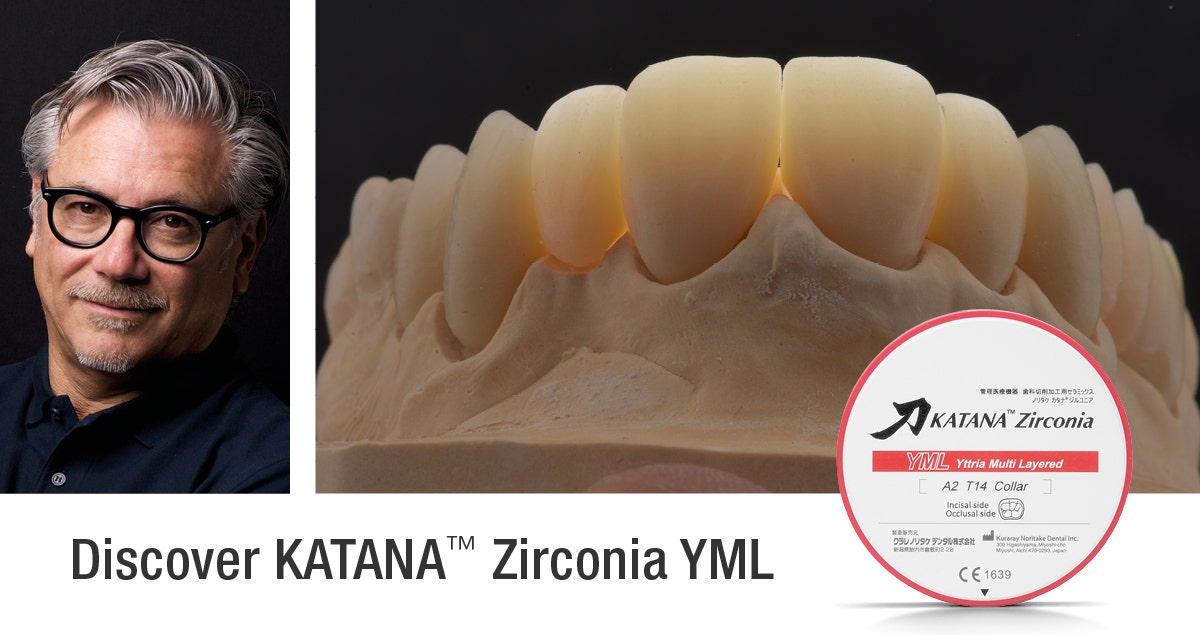
“KATANA™ Zirconia”-familjen med multi-layered CAD/CAM-ämnen har en ny medlem: “KATANA™ Zirconia” YML (yttrium multi-layered). Baserad på Kuraray
Noritake Dental Inc’s (KND) egna multi-layer-teknologi, erbjuder detta nya material flera skikt med olika nivåer av chroma och translucens PLUS olika koncentrationer av yttrium i ett enda ämne. Vi har talat med två experter från Kuraray Noritake Dentals Forskning & Utveckling i Japan, Atsushi Matsumoto och Yuta Tajima, om den nya produkten och dess specifika egenskaper.
Mr. Matsumoto, Mr. Tajima, KND erbjuder redan ett brett sortiment med zirkoniamaterial som täcker i princip alla indikationer. Varför bestämde ni er för att börja utveckla ännu en dental zirkonia?
”KATANA™ Zirconia”-serien har verkligen fått mycket beröm och fantastisk feedback från marknaden. Användare uppskattar särskilt den påfallande höga styrkan hos HTML, balansen mellan estetik och styrka hos STML, och även den höga translucensen hos UTML. Även om antalet zirkoniamaterial på dentalmarknaden har ökat kraftigt på senare tid, har vi fått många önskemål från våra kunder om ett mer universellt material, som kan erbjuda alla de utmärkta egenskaperna från alla varianter av ”KATANA™ Zirconia” i en enda produkt. En produkt som skulle göra det möjligt att framställa alla typer av restaurationer ur en enda disk, från singelkronor till fullbroar, med bibehållen hög estetik och mekaniska egenskaper för både anteriora och posteriora restaurationer. Som utvecklare av ”KATANA™
Zirconia”-serien, är vårt svar på dessa önskemål från våra kunder, uppfinningen av ”KATANA™ Zirconia” YML.
iVad är den främsta skillnaden mellan ”KATANA™ Zirconia” YML och de andra tillgängliga produkterna i serien ”KATANA™ Zirconia” Multi-Layered?
Alla skikt i ”KATANA™ Zirconia” UTML, STML och HTML produceras från samma grundsammansättning av pulver och erbjuder därför samma styrka genom hela disken. Beroende på kraven i det specifika fallen, behöver användarna välja den mest lämpliga typen av material, antingen en zirkonia med hög styrka eller en högtranslucent variant. ”KATANA™ Zirconia” YML är en allt-i-ett zirkonia, lämplig för alla fall: den består av ett högtranslucent emaljskikt, ett mellanskikt
med välbalanserad styrka, translucens och färg, och ett body-skikt med hög styrka. Råmaterialen som används för denna produkt är utvecklade och producerade av KND exklusivt för YML. Detta är ännu en milstolpe i avancerad produktutveckling för ”KATANA™ Zirconia”.
Vi har fått många önskemål från våra
kunder om ett mer universellt material.
Generellt så har de zirkoniamaterial med integrerad styrkegradient som funnits, inte haft en speciellt positiv bild i ögonen på många tandtekniker och specialister, på grund av att dessa material inte haft tillräcklig styrka i det incisala området. Detta kan leda till frakturer när det handlar om långa restaurationer, speciellt om de inte är adekvat placerade i disken. Hur noggrannt har KND fokuserat på dessa problem och hur har de försökt lösa dem för att skilja ut sig från konkurrenterna?
De nuvarande yttriumbaserade muliti-layer-produkterna på marknaden dras med komplicerade begränsningar för connectorplaceringen vid stora fall, som fullbroar, på grund av att de inte har en idealisk kombination av estetik och styrka. För att klara denna utmaning, har KND utvecklat välbalanserade råmaterial med hög styrka och hög estetik, och genom att inkludera dessa råmaterial i skiktet mellan emalj- och body-skikten. Resultatet är att även för långa
restaurationer, är det väldigt lätt att placera connectorna tack vare den ypperliga balansen mellan hög styrka och högestetiska egenskaper. Tack vare dessa unika attribut som inkluderats i vår nya produkt, undviker man risken för deformation och frakturer.
Mellan de olika skikten som innehåller olika mängder yttriumoxid, vilket kan ses vid en noggrann inspektion efter sintring. Hur har ni löst detta problem?
På KND, har vi uppnått både adekvat translucensgradient och osynliga övergångslinjer, även för zirkoniaskikt med olika innehåll av yttriumoxid. Detta har uppnåtts tack vare vår multi-layer tillverkningsteknologi som förfinats över många år, vilket inkluderar en blandning av rätt mängd vid varje skikts
gräns med avsikt att undvika övergångslinjer. Dessutom har de nyligen utvecklade råmaterialen för skiktövergångarna och ett nydesignat sintringsschema varit nycklarna till framgången.
Hur är det möjligt att ha ett sintringsprotokoll som fungerar för de olika zirkoniakomponenterna i ”KATANA™ Zirconia” YML-disken och som tillåter de kortaste sintringstiderna någonsin?
Graden av krympning under sintringen bestäms av olika faktorer, som antalet och mängden av tillsatser (yttriumoxid, aluminiumoxid etc.) det innehåller. Om krympningsgraden för varje skikt är olika, kommer troligen övergångslinjer att uppstå mellan skikten, vilket kan skapa spänningar i materialstrukturen. De nyutvecklade råmaterialen för ”KATANA™ Zirconia” YML gör det möjligt för oss att kontrollera och förena krympningsgraden för alla lager, även för råmaterial
med olika innehåll av yttriumoxid.
Användningen av våra egenproducerade råmaterial med enastående egenskaper lämpliga för snabbsintring var
grundförutsättningen som gav möjlighet till utvecklingen av KND:s snabbsintringsschema (54 min för restaurationer upp till 3-ledsbroar), som är tillgängligt för alla produkter i ”KATANA™ Zirconia” multi-layered serien. Denna möjlighet ökar effektiviteten i tandteknikerns arbete och förenklar arbetsflödet.
|
|
Enamel Layer
To provide high translucency that harmonizes with the anterior teeth.
Body Layer 1
To provide seamless color and translucency towards the Enamel Layer.
Body Layer 2, 3
To provide deep and vivid color while reducing whitening.
|
Finns det några skillnader i fräsning och justering för ”KATANA™ Zirconia” YML jämfört med konkurrerande produkter?
Alla ”KATANA™ Zirconia” produkter från KND har en lämplig hårdhet med mindre chipping under fräsningen tack vare råmaterialen som tillverkas och förädlas på plats hos oss. De får dessutom ett utmärkt motstånd mot chipping efter sintringen, speciellt vid mycket utmanande justeringar av marginalen.
Är det något annat som särskiljer ”KATANA™ Zirconia” YML från andra produkter med integrerad styrkegradient?
Ja, ”KATANA™ Zirconia” YML ger mindre deformation vid sintringen, tack vare de egna råmaterialen, baserade på egen teknologi för att kontrollera krympningsgraden. Dessutom har vi ett brett utbud av färger (14), vilket är en annan viktig aspekt (förutom materialets välbalanserade estetiska egenskaper och frånvaro av övergångslinjer) för att skapa naturliga restaurationer. Slutligen, eftersom tre av fyra skikt uppfyller kraven för klassificering i ISO klass 5, finns
det få begränsningar för variation av designen på protetiken.
Varför ska en tandtekniker välja ”KATANA™ Zirconia” YML istället för någon annan dental zirkonia (enligt er åsikt)?
Atsushi Matsumoto:
Nu är det möjligt för tandtekniker att framställa starka och estetiska restaurationer med ett enda material, ”KATANA™ Zirconia” YML. Det leder till reducerat lager, samtidigt som arbetstiden förkortas signifikant tack vare möjligheten till snabbsintring.
Yuta Tajima:
För mig, är de mest övertygande egenskaperna den utomordentliga precisionen vid sintringen tack vare de välbalanserade materialegenskaperna genom alla skikt, det breda urvalet av färger och den stora flexibiliteten även vid design av långa broar. Sist men inte minst, är den beprövade kvaliteten hos KATANA™ och märkningen “Made in Japan” goda skäl att välja denna nya produkt.
Alla ämnen från ”KATANA™ Zirconia” serien skiljer sig från andra dentala zirkoniamaterial med sin speciellt finkorniga, tätt pressade mikrostruktur, vilket är grunden till en överlägsen ytkvalitet, kantstabilitet och resultatets noggrannhet och precision. Vad är hemligheten bakom denna exceptionellt höga kvalitet på ämnena?
Eftersom vi inte vet korrelationen mellan egenskaperna för kantstabilitet (chipping, etc.) och materialkomposition, struktur etc., är det väldigt svårt att besvara den frågan. Det kan bero på strukturen hos zirkoniakristallerna, råmaterialet i sig, den korrekta styrkenivån efter försintring eller någon annan mindre faktor under framställningen av disken. Alla dessa faktorer tillsammans, är självklart viktiga.
Vi använder pigment utvecklade av KND, som har en
utomordentlig färgstabilitet som inte avtar, även efter
den slutliga sintringen.
Även om restaurationens marginaler har frästs till en väldigt tunn profil, uppvisar de ändå släta kanter utan någon chipping.
En klar fördel för ”KATANA™ Zirconia” serien, mycket uppskattad av KND:s Key Opinion Leaders, är färgstabiliteten och färgmatchningen till ”VITA classical shade guide”. Kan ni förklara vikten av att själva på fabriken hantera tillsatsen av additiv och färgpigment i form av metalloxider för att hjälpa användaren och särskilja ”KATANA™ Zirconia” från konkurrerande produkter?
Vi använder pigment utvecklade av KND, som har en utomordentlig färgstabilitet som inte avtar, även efter den slutliga sintringen. Partikelstorleken är noggrannt kontrollerad. Dessutom har vår professionella ”färgblandningspersonal”, med erfarenhet som kliniskt verksamma tandtekniker både inom och utanför företaget, uppnått en pigmentblandning som uppvisar en endast minimal förandring av färgen även i fall med olika tjocklekar.
Vad är er vision med tanke på framtida utveckling av dental zirkonia?
Sedan introduktionen av zirkonia på dentalmarknaden, har många signifikanta framsteg för materialet uppnåtts. Idag finns zirkoniamaterial, från de med hög styrka och låg translucens, till de med hög translucens och låg styrka tillgängliga på marknaden. Dessutom finns nu även högtranslucenta material med lägre styrka i blandade system (YML serien) tillgängliga. Vårt främsta mål är att utveckla en ultimat zirkonia i en nära framtid, som kombinerar både hög styrka och hög translucens , vilket bryter med den allmänna förväntningen om en kompromiss mellan styrka och translucens för zirkoniamaterial.
|
|
| Atsushi Matsumoto |
Yuta Tajima |