Blog

Universeel composietcement: Heeft u ooit nagedacht over een derde applicatiemethode?

Artikel van prof. Lorenzo Breschi


Minder flesjes, méér keuzes; dat is waarschijnlijk de kortste omschrijving van de categorie universele composietcementen. Aangezien deze duaal uithardende cementen op harsbasis zelfhechtend zijn, is een 1-component workflow in veel klinische situaties mogelijk, zonder de noodzaak van aparte tand- of restauratieprimers. Binnen een breed indicatiespectrum is de op deze manier gerealiseerde hechtsterkte meestal voldoende voor een stabiele bevestiging tussen tand en restauratie. De hechtsterkte is niettemin iets lager dan de sterkte die wordt bereikt met conventionele composietcementsystemen die uit verschillende componenten bestaan (meestal tandprimer, composietcement en restauratieprimer).


Naast de zelfhechtende applicatiemethode kunnen composietcementen worden gecombineerd met aanvullende systeemcomponenten om de hechtsterkte aan de tandstructuur, respectievelijk het restauratieve materiaal te vergroten. Dit baant de weg voor nieuwe gebruiksmogelijkheden van het product; afhankelijk van de vereiste of gewenste kwaliteit van de bevestiging kan het composietcement alleen worden toegepast, of in combinatie met een tand- of restauratieprimer, of met beide componenten. Bovendien komen hybride concepten binnen handbereik en deze worden toegelicht in dit artikel, waarin bij wijze van voorbeeld wordt ingegaan op PANAVIA™ SA Cement Universal (Kuraray Noritake Dental Inc.).


Zelfhechtende bevestiging; voor diverse indicaties

PANAVIA™ SA Cement Universal is a dual-cure universal resin cement that is indicated for a wide range of applications when used in the self-adhesive mode. The bond established to restorative substrates (including silicate ceramics) is high without the use of a separate primer or silane1-4. This is due to two different adhesive monomers contained in the formulation – the Original MDP Monomer and the LCSi Monomer (a long carbon-chain silane coupling agent responsible for a strong chemical bond to silicate ceramics). Hence, it is possible to use the resin cement without any additional component applied on the side of the restoration – even in cases with a lack of retention and consequently high bond-strength requirements.


Bij de zelfhechtende modus wordt tevens een sterke bevestiging aan glazuur en dentine gerealiseerd. In bepaalde situaties kan het echter nuttig zijn om de hechtsterkte aan de tandstructuur verder te vergroten met behulp van een tandprimer.


Adhesieve bevestiging; voor lastige situaties

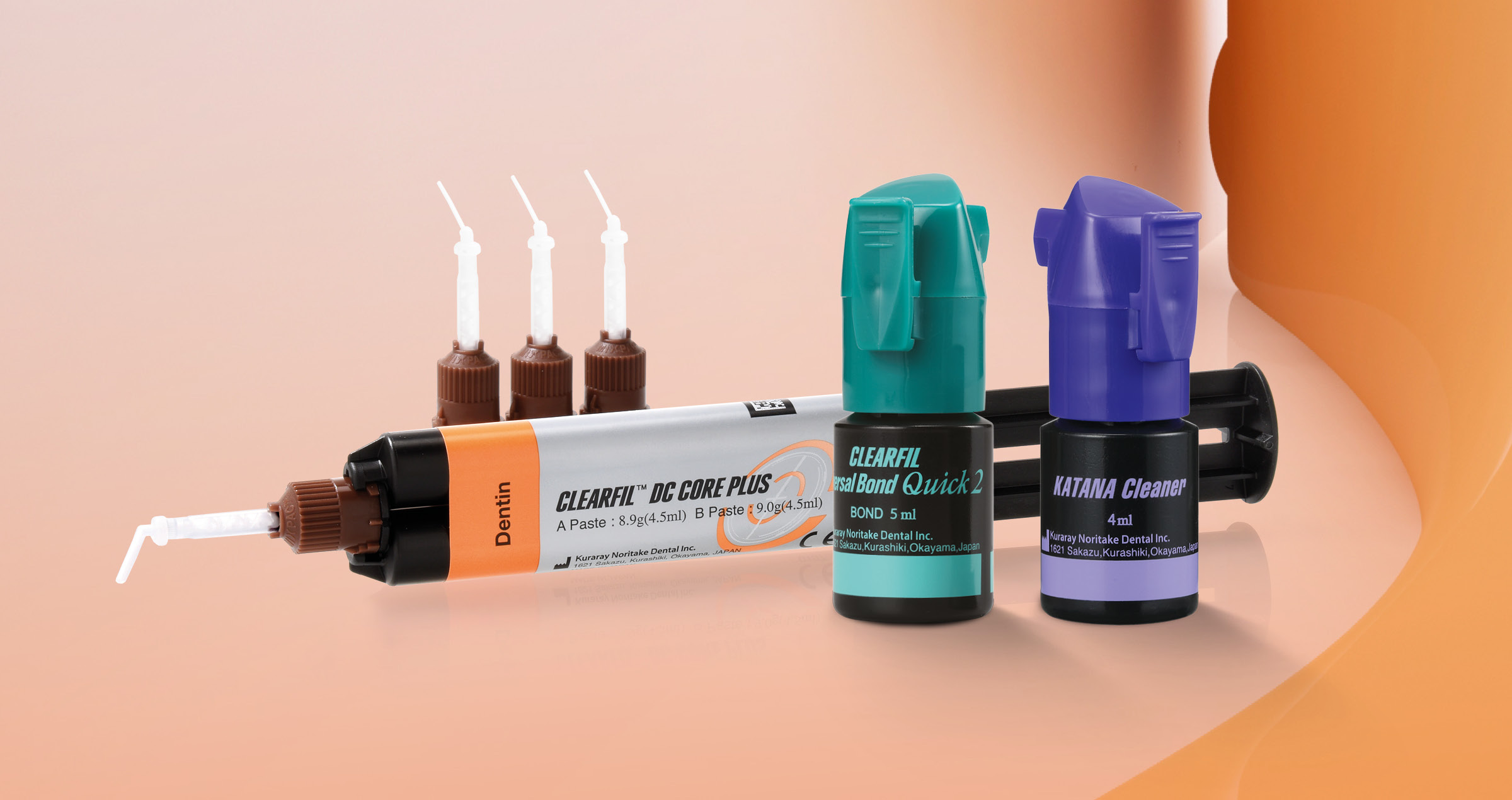
Voor PANAVIA™ SA Cement Universal wordt de tandprimer CLEARFIL™ Universal Bond Quick (Kuraray Noritake Dental Inc.) aanbevolen. Gebruik van dit product wordt aanbevolen als een gebruiker meent dat de behandeling zou worden bevorderd door een uitzonderlijk sterke en duurzame chemische bonding, dus in uitzonderlijk veeleisende situaties met een onvoldoende mechanische retentie. De effectiviteit van die maatregel is bevestigd door een in Japan uitgevoerd in-vitro-onderzoek, waarbij de micro-treksterkte aan dentine gedurende 24 uur significant werd verhoogd door toepassing van het universele adhesief5. Bij gebruik van een apart adhesief neemt het belang van een volledig droog werkgebied echter toe. Reden hiervan is dat de vochttolerantie van composietcementen meestal hoger is dan die van adhesieven. Het gebruik van een rubberdam wordt dan ook sterk aangeraden.


Selectieve adhesieve bevestiging; voor korte abutments en subgingivale randen

Voor situaties waarin een effectieve isolatie van het werkgebied met een rubberdam lastig is, bestaat er nog een derde toepassingsoptie, die wordt voorgesteld door een groep Italiaanse onderzoekers: selectieve adhesieve bevestiging. In dat geval wordt CLEARFIL™ Universal Bond Quick alleen aangebracht op die delen van de geprepareerde tand waarvan de vochtigheid goed kan worden geregeld; voor de gedeelten waarbij het lastig is om het gewenste droge werkgebied te realiseren kan worden vertrouwd op de zelfhechtende functionaliteit van PANAVIA™ SA Cement Universal. Situaties waarvoor deze techniek zich goed leent, zijn abutmenttanden met een subgingivale preparatierand en bijzonder korte abutmenttanden (die de plaatsing van een rubberdam in de weg staan).


De effectiviteit van de selectieve adhesieve bondingtechniek wordt bevestigd door een in-vitro-onderzoek, waarbij de drie adhesieve strategieën - zelfhechtende bevestiging, volledige adhesieve bevestiging en selectieve adhesieve bevestiging - werden vergeleken door middel van afschuifsterktetests6. Uit de testresultaten blijkt dat gebruikers de hechtsterkte van PANAVIA™ SA Cement Universal aan dentine en glazuur kunnen vergroten door het adhesief uitsluitend op een deel van het tandoppervlak te appliceren. Voor het cementeersysteem bestaande uit PANAVIA™ SA Cement Universal en CLEARFIL™ Universal Bond Quick leidden de volledige adhesieve en selectieve adhesieve benadering tot soortgelijke resultaten.


Voor situaties waarin een effectieve isolatie van het werkgebied met een rubberdam lastig is, bestaat er nog een derde toepassingsoptie, die wordt voorgesteld door een groep Italiaanse onderzoekers: selectieve adhesieve bevestiging.


AANBEVOLEN STAPPEN VOOR SELECTIEVE ADHESIEVE BONDING

Afb. 1: Preparatie van de tand


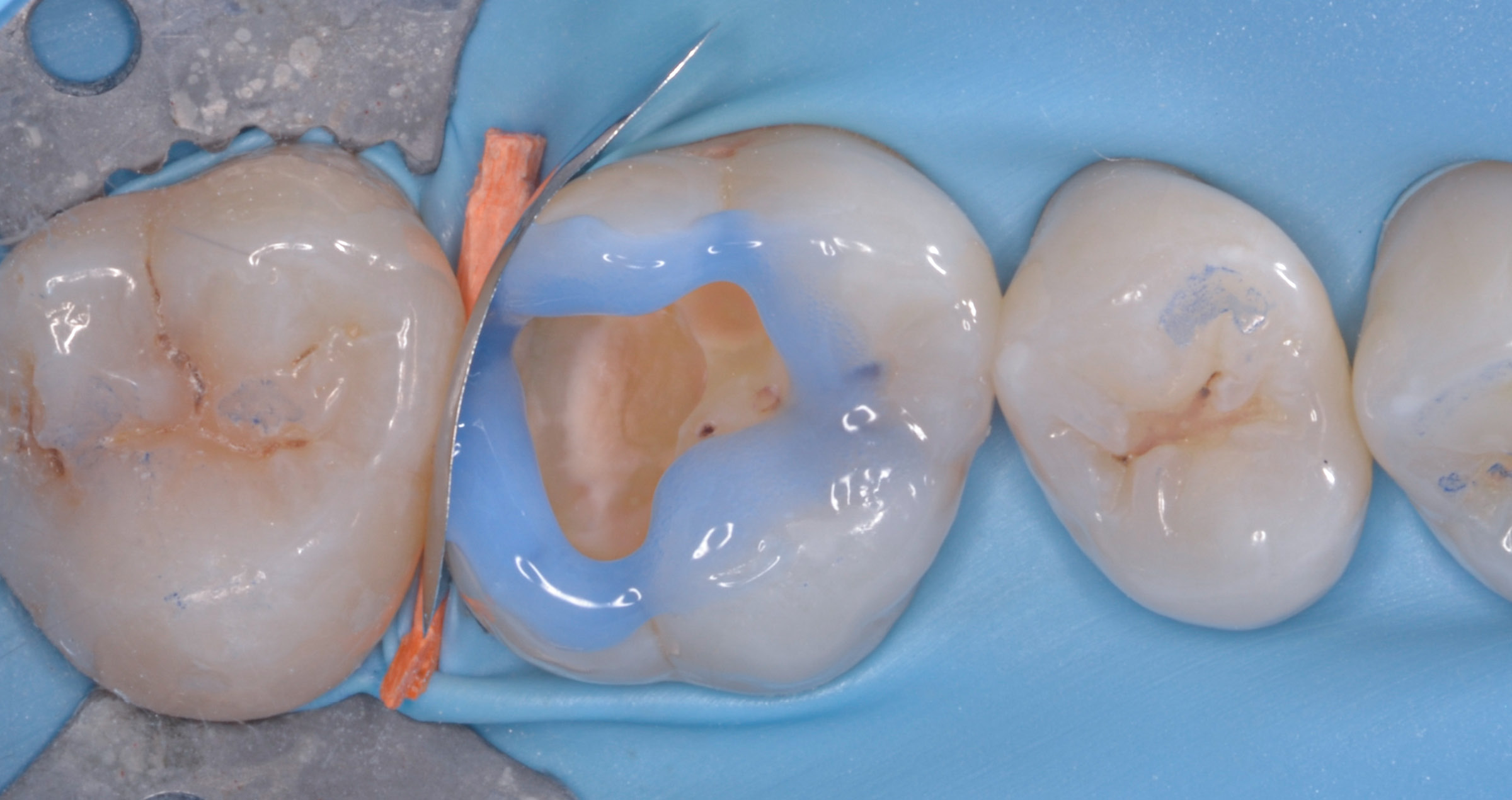
Afb. 2: Selectief etsen van het glazuur met een fosforzuurmiddel.


Afb. 3: Appliceren van het universele adhesief + droogblazen


Afb. 4. Plaatsing van de kroon na aanbrengen van het composietcement in de kroon.


Afb. 5. Tack-curing


Afb. 6. Verwijdering van overmaat en definitieve lichtuitharding


Afb. 7. Behandelresultaat bij controlebezoek na een jaar.


Voordelen van selectieve adhesieve bevestiging

Naast de gewenste vergroting (op lange termijn) van de hechtsterkte door het - geheel of gedeeltelijk - aanbrengen van een afzonderlijk adhesief op het geprepareerde tandoppervlak biedt deze techniek nog meer voordelen. In vergelijking met meerstaps cementeersystemen is het protocol vereenvoudigd, aangezien een aparte restauratieprimer niet nodig is. Lichtuitharding van het adhesief is niet nodig, mits de gebruiker binnen het aanbevolen systeem blijft. In tegenstelling tot de volledige adhesieve benadering, waarbij een rubberdam moet worden geplaatst, kan die stap worden overgeslagen bij de selectieve adhesieve methode. Op die manier duurt de behandeling korter en is deze comfortabeler voor de patiënt.


Conclusie

Afhankelijk van de indicatie, klinische variabelen en individuele voorkeuren kunnen gebruikers van universele composietcementen zoals PANAVIA™ SA Cement Universal de techniek kiezen die naar verwachting de beste klinische resultaten zal opleveren. Dankzij deze flexibiliteit en het brede scala van toepassingen is deze innovatieve productcategorie zonder meer universeel. Universele materialen - met gebruik van minder componenten - bevorderen de stroomlijning en standaardisatie van klinische procedures; er zijn minder flesjes nodig, dus bestellingen en voorraadbeheer worden ook overzichtelijker voor de praktijkmedewerkers.


Tandarts:

LORENZO BRESCHI


Prof. Lorenzo Breschi is hoogleraar Restauratieve Tandheelkunde en Tandheelkundige Materialen bij de Universiteit van Bologna. Hij is actief betrokken bij onderzoek naar de ultrastructurele aspecten van glazuur en dentine. Hij is voormalig voorzitter van de Academy of Dental Materials (ADM), gekozen voorzitter van de European Federation of Conservative Dentistry (EFCD), gekozen voorzitter van de Dental Materials Group IADR, gekozen voorzitter van de Italian Academy of Conservative Dentistry (AIC) en gekozen voorzitter van de International Academy of Adhesive Dentistry (IAAD).


Referentielijst

  1. Cowen M, Cunha S, Powers JM. Novel Cement Bond Strength to Multiple Substrates. DENTAL ADVISOR Biomaterials Research Center, Biomaterials Research Report, Number 132 – June 16, 2020. 2. Patel N, Anadioti E, Conejo J, Ozer F, Mante F, Blatz M. Bond Strength of Different Self-Adhesive Resin Cements to Zirconia” (2021). Dental Theses. 62. https://repository.upenn.edu/dental_theses /62 3. Yoshihara K, Nagaoka N, Maruo Y, Nishigawa G, Yoshida Y, Van Meerbeek B. Silane-coupling effect of a silane-containing self-adhesive composite cement. Dent Mater. 2020 Jul;36(7):914-926.  4. Irie M, Tokunaga E, Maruo Y, Nishigawa G, Yoshihara K, Nagaoka N, Minagi S, Matsumoto T. Shear bond strength of a resin cement to CAD/CAM Blocks for molars. P-2, 37th Annual Meeting of the Japanese Society of Adhesive Dentistry 2018.  5. Ohara N. Bonding strength of resin cement containing silane coupling agent to dentin or core resin. Results presented at the 150th meeting of the Japanese Society of Conservative Dentistry.  6. Breschi L, Josic U, Maravic T, et al. Selective adhesive luting: A novel technique for improving adhesion achieved by universal resin cements. J Esthet Restor Dent. 2023;1-9. doi:10.1111/jerd.13037


KATANA™ Zirconia Troubleshooting Handbook

Available Now!


Have you ever produced a zirconia restoration without obtaining the outcome you expected? Most dental technicians probably have. The bad thing is that aesthetic flaws such as colour deviations or white spots and technical issues like cracks can occur and require remakes. The good thing is, however, that those problems are usually avoidable. Do you know how?


We would like to show you – in the new KATANA™ Zirconia Troubleshooting Handbook we just completed. On 30 pages, this handbook summarized the most important facts about modern zirconia-based restorative materials, their selection, the KATANA™ Zirconia line-up and, finally, possible aesthetic or technical problems, their origin and solutions to overcome them.


Let us assume that the beauty of your restorations is limited due to a lack of translucency. By looking up the problem “lack of translucency”, you will find a compact, well-structured overview of possible causes and adequate solutions. The recommendations include selecting dry instead of wet milling, abstaining from sandblasting the restoration surface and checking of the sintering parameters, quality of the sintering beads and position of the restoration in the furnace. For more details, problems and solutions, download the handbook!


DOWNLOAD NOW


Universal resin cement: did you ever think about a third application mode?

Article by Prof. Lorenzo Breschi


Fewer bottles, more choices – this is possibly the shortest way to describe the category of universal resin cements. Being self-adhesive, these dual-cure resin-based cements allow for a single-component workflow without the need for separate tooth or restoration primers in many clinical situations. The bond strength obtained in this way is usually high enough to provide for a stable bond between the tooth and the restoration in a wide range of indications. However, it is slightly lower than that achieved with conventional resin cement systems consisting of several components (typically tooth primer, resin cement and restoration primer).


Apart from the self-adhesive application mode, universal resin cements may be combined with additional system components to increase the bond strength to tooth structure or the restorative material, respectively. This opens up new possibilities with regard to the product’s use: depending on the required or desired bonding performance, the universal resin cement may be applied alone or in combination with a tooth primer, a restoration primer or both components. In addition, hybrid concepts become feasible, as explained in this article that focuses on PANAVIA™ SA Cement Universal (Kuraray Noritake Dental Inc.) as an example.


Self-adhesive luting: for many indications

PANAVIA™ SA Cement Universal is a dual-cure universal resin cement that is indicated for a wide range of applications when used in the self-adhesive mode. The bond established to restorative substrates (including silicate ceramics) is high without the use of a separate primer or silane1-4. This is due to two different adhesive monomers contained in the formulation – the Original MDP Monomer and the LCSi Monomer (a long carbon-chain silane coupling agent responsible for a strong chemical bond to silicate ceramics). Hence, it is possible to use the resin cement without any additional component applied on the side of the restoration – even in cases with a lack of retention and consequently high bond-strength requirements.


A strong bond to enamel and dentin is also obtained in the self-adhesive mode. In certain situations, however, it may be useful to further increase the bond strength to tooth structure with the aid of a tooth primer.


Adhesive luting: for challenging situations

The tooth primer recommended for PANAVIA™ SA Cement Universal is CLEARFIL™ Universal Bond Quick (Kuraray Noritake Dental Inc.). Its application is recommended whenever a user feels that the treatment would benefit from an extraordinarily strong and durable chemical bond, i.e. in particularly challenging situations with insufficient mechanical retention. The effectiveness of this measure has been confirmed in an in-vitro study conducted in Japan, in which the 24-hour micro-tensile bond strength to dentin was increased significantly by the application of the universal adhesive5. When a separate adhesive is used, however, the importance of a completely dry working field increases. The reason is that the moisture tolerance of resin cements is usually higher than that of adhesives. Consequently, the application of a rubber dam is highly recommended.


Selective adhesive luting: for short abutments and subgingival margins

For situations in which proper isolation of the working field with a rubber dam is difficult, a third application option is available and proposed by a group of Italian researchers: Selective Adhesive Luting. In this case, CLEARFIL™ Universal Bond Quick is applied solely to those parts of the prepared tooth that allow for proper moisture control, while relying on the self-adhesive functionality of PANAVIA™ SA Cement Universal in areas where it is challenging to obtain the desired dry working field. Situations which are predestined for this technique are abutment teeth with a subgingival preparation margin and particularly short abutment teeth (that hinder the placement of a rubber dam).


The effectiveness of the selective adhesive luting technique has been verified in an in-vitro study that compared the three adhesive strategies – self-adhesive luting, full adhesive luting and selective adhesive luting – with the aid of shear bond strength testing6. The results of the tests show that users are able to enhance the bond strength of PANAVIA™ SA Cement Universal to dentin and enamel by applying the adhesive to a part of the tooth surface only. For the cementation system consisting of PANAVIA™ SA Cement Universal and CLEARFIL™ Universal Bond Quick, the full adhesive and the selective adhesive approach led to similar outcomes.


For situations in which proper isolation of the working field with a rubber dam is difficult, a third application option is available and proposed by a group of Italian researchers: Selective Adhesive Luting.


RECOMMENDED STEPS FOR SELECTIVE ADHESIVE LUTING

Fig. 1. Tooth preparation.


Fig. 2. Selective etching of the enamel with phosphoric acid etchant.


Fig. 3. Application of the universal adhesive + air-drying.


Fig. 4. Crown placement after application of the resin cement into the crown.


Fig. 5. Tack-curing.


Fig. 6. Excess removal and final light curing.


Fig. 7. Treatment outcome at a recall after one year.


Benefits of selective adhesive luting

Apart from the desired (long-term) increase in bond strength achieved by applying a separate adhesive to a part of the or the whole prepared tooth surface, the technique offers additional benefits. Compared to multi-step cementation systems, the protocol is simplified as no separate restoration primer is needed. Light-curing of the adhesive is not required as long as the user stays within the recommended system. And in contrast to the full adhesive approach requiring rubber dam placement, the need for this step is eliminated in the selective adhesive approach. In this way, the chair-time is reduced and patient comfort increased.


Conclusion

Depending on the indication, clinical variables and individual preferences, users of universal resin cements like PANAVIA™ SA Cement Universal may select the technique that is likely to deliver the best clinical outcomes. It is this flexibility and the generally wide range of applications that makes the innovative product category truly universal. With fewer components to be used, universal materials facilitate the streamlining and standardization of clinical procedures, while with fewer bottles to be stored, they help staff gain control over order and storage management as well.


Dentist:

LORENZO BRESCHI


Prof. Lorenzo Breschi is Professor of Restorative Dentistry and Dental Materials at the University of Bologna. He is actively involved in research on the ultrastructural aspects of enamel and dentin. He is Past-President of the Academy of Dental Materials (ADM), President-Elect of the European Federation of Conservative Dentistry (EFCD), President-Elect of the Dental Materials Group IADR, President-Elect of the Italian Academy of Conservative Dentistry (AIC), President-Elect of the International Academy of Adhesive Dentistry (IAAD).


References

1. Cowen M, Cunha S, Powers JM. Novel Cement Bond Strength to Multiple Substrates. DENTAL ADVISOR Biomaterials Research Center, Biomaterials Research Report, Number 132 – June 16, 2020.
2. Patel N, Anadioti E, Conejo J, Ozer F, Mante F, Blatz M. Bond Strength of Different Self-Adhesive Resin Cements to Zirconia” (2021). Dental Theses. 62. https://repository.upenn.edu/dental_theses/62.
3. Yoshihara K, Nagaoka N, Maruo Y, Nishigawa G, Yoshida Y, Van Meerbeek B. Silane-coupling effect of a silane-containing self-adhesive composite cement. Dent Mater. 2020 Jul;36(7):914-926.
4. Irie M, Tokunaga E, Maruo Y, Nishigawa G, Yoshihara K, Nagaoka N, Minagi S, Matsumoto T. Shear bond strength of a resin cement to CAD/CAM Blocks for molars. P-2, 37th Annual Meeting of the Japanese Society of Adhesive Dentistry 2018.
5. Ohara N. Bonding strength of resin cement containing silane coupling agent to dentin or core resin. Results presented at the 150th meeting of the Japanese Society of Conservative Dentistry.
6. Breschi L, Josic U, Maravic T, et al. Selective adhesive luting: A novel technique for improving adhesion achieved by universal resin cements. J Esthet Restor Dent. 2023;1-9. doi:10.1111/jerd.13037.


Klinische cases Dr. Devigus - Enkele kroon op 11

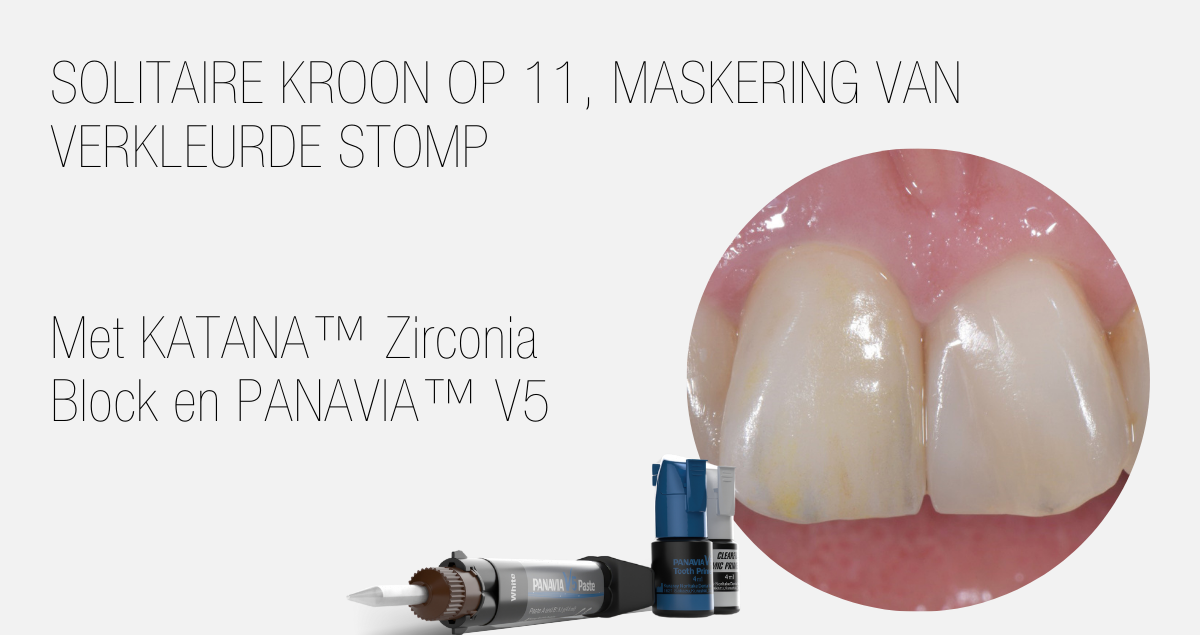
SOLITAIRE KROON OP 11, MASKERING VAN VERKLEURDE STOMP

met KATANA™ Zirconia Block en PANAVIA™ V5


DR. ALESSANDRO DEVIGUS

KATANA™ ZIRCONIA STML A1 – CEREC - Speedfire – PANAVIA™ V5 opaque

AANVANKELIJKE SITUATIE


Aanvankelijke situatie

2. Close-up van insufficiënte kroon op element

3. Na verwijdering van oude kroon; verkleurde stomp (endodontische behandeling).

4. Passing van de kroon na sinteren -  geen intrinsieke fluorescentie.

5. Passing van de kroon na glazen.

6. Passing van de kroon na glazen onder kruislings gepolariseerd licht om de kleurmatch te controleren.

7. Passing van de kroon na inkleuren onder kruislings gepolariseerd licht om de kleurmatch te controleren.

8. Retractiedraad voorafgaande aan adhesief cementeren met PANAVIA™ V5.

9. Adhesieve cementering met PANAVIA™ V5 Opaque om donkere stomp te maskeren.

10. Resultaat direct na plaatsing

11. Controle na 1 week

12. Controle na 1 week - toetsing van kleur met kruislings gepolariseerd licht.

13. Controle na 1 week - toetsing van fluorescentie.

EINDRESULTAAT


ALESSANDRO DEVIGUS

Dr. Alessandro Devigus is in 1987 afgestudeerd aan de Universiteit van Zürich, Zwitserland.

Vanaf 1990 werkt hij in zijn privépraktijk, waar hij zich toelegt op CAD/CAM en digitale tandheelkunde. Tevens is hij CEREC-instructeur op de Zurich Dental School.

Dr. Alessandro Devigus is een actief lid van de European Academy of Esthetic Dentistry (EAED), oprichter van de Swiss Society of Computerized Dentistry, lid van de Neue Gruppe, ITI fellow en gastspreker.

Dr. Devigus is hoofdredacteur van het International Journal of Esthetic Dentistry, auteur van diverse publicaties en tevens internationaal docent.

International webinar with Dr. Wiktor Pietraszewski

May 15th, 2024 at 21:00 CET


From margin elevation to restoration

Did you ever wonder how to optimize teamwork, efficiency, and patient satisfaction in the context of a combined endodontic and restorative treatment? As a general or restorative dentist, you can easily contribute to streamlined procedures and better outcomes for your patients. The measures to be taken are in the center of this webinar by experienced and knowledgeable Dr. Wiktor Pietraszewski.


Endodontic treamtment and pre-refferal strategies

In the first part of his lecture, Dr. Pietraszewski reveals how to proceed before referring the patient to the endodontic specialist to improve the overall prognosis of the treatment on the one hand, and the patient experience on the other. Materials and techniques, such as deep margin elevation, caries removal, and tooth build-up, will be described and examined. But most importantly, many practical tips will be shared with the audience.


Post-endodontic restoration options for long term success

In the second part, the speaker will focus on post-endodontic treatment. He will describe the available materials and types of post-endodontic restorations. Dr. Pietraszewski will shed light on the most important factors guiding the most crucial treatment decisions and will elaborate on the factors influencing long-term success.


Go to the Facebook Event of the webinar and click „Livevideo”!


We look forward to seeing you!


About the speaker


Dr. Pietraszewski is a general and restorative dentist working in private practice in London. He utilizes biomimetic adhesive protocols in his restorative cases and uses gold standard materials to emulate the natural appearance, bio-mechanical function, and internal structure of teeth when restoring them.


He has a special interest in direct and indirect restorations in the posterior dentition, and his dentistry is fueled by his passion for dental photography.


From The Medical University in Lodz (Poland) to private clinics in Malta and London, his dental journey reflects dedication to excellence.


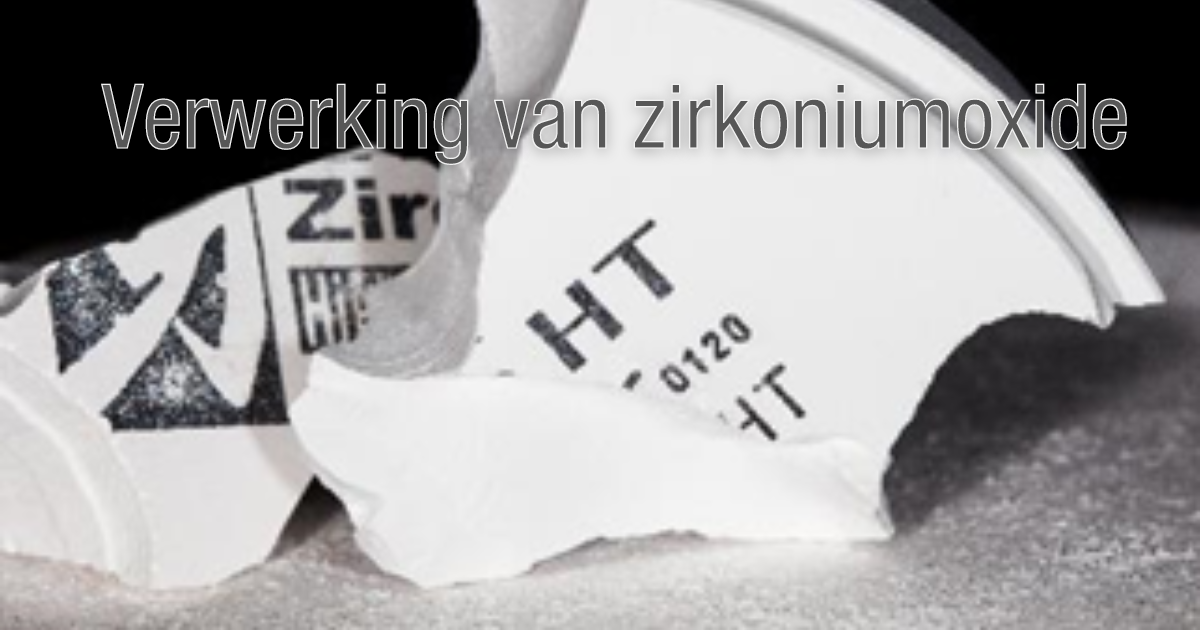
Verwerking van zirkoniumoxide door Bas Leempoel

Zirkoniumoxide heeft zijn plek in de tandheelkunde als sterk, esthetisch en bio-inert keramisch materiaal verworven.1 Elk materiaal kent zijn eigen verwerkingsvereisten. Zo ook zirkoniumoxide. In dit artikel gaan we in op meerdere essentiële zaken om tot de beste resultaten te komen. We geven onder andere antwoord op vragen als: Hoe voorkom je witte vlekken? Waarom de sinterkamer niet te overvullen?  En waarom is het zo belangrijk dat de oven de juiste temperatuur bereikt?

Ruim veertig jaar al staat zirkoniumoxide als keramisch biomateriaal in de belangstelling binnen de tandheelkunde. In eerste instantie als vervanging van metaal en nu steeds meer als een monolithische oplossing. Zirkoniumoxide kenmerkt zich door zijn uitstekende chemische en dimensionale stabiliteit, evenals door indrukwekkende mechanische sterkte en breuktaaiheid. Bovendien ligt de Young's modulus in dezelfde orde van grootte als die van metaallegeringen.

Met de komst van meer translucent en multi-layered zirkoniumoxide werd het ook in de esthetische zone uitstekend toepasbaar. Zirkonium biedt tegenwoordig niet alleen veel mogelijkheden in het laboratorium, maar ook direct aan de stoel (chairside). Dit is met name te danken aan de optie om met verkorte sintertijden te werken. Zirkoniumoxide heeft een strikt verwerkingsprotocol, omdat soms kleine afwijkingen in de verwerkingsprocedure al leiden tot een esthetisch ongewenst eindresultaat.
Hoe verwerk je zirkoniumoxide op de juiste wijze?

FREZEN
Kies je voor nat of droog frezen? Beide opties hebben voor- en nadelen, maar droog frezen is eerste keus en geeft de mooiste resultaten. Verschillende freesstrategieën hebben een significant ander effect op de optische eigenschappen van hoogtranslucent zirkoniumoxide. Droog frezen geeft de hoogste translucentie, terwijl een natte freesstrategie een lagere translucentie geeft.[1] Maar let wel, schoon werken is in alle gevallen essentieel. Bovendien, gebruik voor elk materiaal een specifieke set frezen of boren en ander toebehoren.


Nat
Modern, translucent zirkonium is uitstekend monolithisch inzetbaar. Toch wordt er nog regelmatig geklaagd over de te witte kleur en de te hoge opaciteit van gesinterde werkstukken. De oorzaak daarvan ligt vaak in het nat slijpen van de restauraties. In de voorgesinterde fase, ook wel krijtfase of green-state genoemd, dringt koelwater en tegelijkertijd eventuele verontreiniging, gemakkelijk in het materiaal.

Na het nat frezen is voordrogen vóór het sinteren belangrijk. Toch bestaat er een reële kans dat nat geslepen zirkoniumoxide ook na voordrogen nog te opaak is. Wanneer in de slijpeenheid meerdere, verschillende materialen verwerkt worden, zullen de slijpresten van eerder gefreesde werkstukken het werkstuk vervuilen. Met name silica, uit lithiumdisilicaat en veldspaat, zorgt voor een ongewenst resultaat.3 Voor de mooiste eindresultaten is droog slijpen het beste! Niet alle (chairside) freesapparaten beschikken over de mogelijkheid om droog te slijpen. Ook bieden ze niet allemaal de optie om te worden omgebouwd naar ‘nat/droog’.

Reinig en droog na elke slijpcyclus de slijpkamer met een zachte doek en reinig ook het filter. Gebruik een separate watertank gevuld met (gedemineraliseerd) water zonder Dentatec of een ander smeermiddel en een schoon filter om de freeseenheid te spoelen. Zelfs bij gebruik van zirkoniumsoorten met onderling afwijkende merken en/of samenstelling, 3-, 4-, of 5y, is het sterk aan te raden om na het slijpen de watertank en het filter uit te spoelen.

[1] P. Mourouzis and K. Tolidis, Effects of milling method and artificial ageing on optical properties of high translucent zirconia for chairside restorations, Dental Materials, https://doi.org/10.1016/j.dental.2021.10.015 


GEFREESDE WERKSTUKKEN

Bewerken
Na het frezen is het belangrijk om zorgvuldig met het nu nog erg kwetsbare materiaal om te gaan. Draag altijd schone handschoenen bij de verwerking van ongesinterd zirkonium. Huidvet is een belangrijke contaminatiebron. Verwijder de sprue voorzichtig met een geschikte hardstalen frees of een hoge kwaliteit diamantboor. Gebruik instrumenten die nergens anders voor gebruikt worden dan voor het gebruikte soort zirkoniumoxide.

Slijpstof kan je het best verwijderen met een zachte borstel. Vermijd overmatige druk en gebruik geschikte en scherpe instrumenten. Wees voorzichtig met perslucht. Hoge druk of mogelijke verontreiniging, zoals olie, kan schade aan het werkstuk toebrengen en/of leiden tot een minder mooi resultaat.


SINTEREN

Ovenkeuze
Bij het sinteren gebruik je een sinterprogramma dat op het specifieke zirkoniumoxidetype is afgestemd. Verschillende materialen vereisen vaak verschillende sintercycli met een specifieke minimum- en hold-temperatuur. Wanneer er nat geslepen is, dient uiteraard eerst een voordroog- (pre-dry) programma geselecteerd te worden. Het gebruik van de juiste, voorgeschreven duur en de hoogte van de opwarm-, hold- en afkoeltemperatuur is belangrijk om de gewenste sterkte en translucentie te bereiken. Lang (over-night) sinteren resulteert vaak in een iets translucenter eindresultaat, Houd bij de aanschaf van een sinteroven rekening met de maximaal haalbare temperatuur en de mogelijke snelheid van de temperatuurop- en afbouw. Bedenk ook dat bij verschillende merken en types ook de grootte van de sinterkamer vaak verschilt. De grootte van de restauratie(s) en het aantal restauraties dat tegelijk gesinterd wordt, is medebepalend voor de keuze van een geschikte oven.
Sinter echter nooit te veel restauraties tegelijkertijd. Bij een te volle sinterkamer kan de sintertemperatuur plaatselijk kritisch afwijken. Zo wordt de minimaal noodzakelijke temperatuur niet (overal) bereikt. Dat geeft een minder mooi resultaat. Overvul de sinterkamer daarom nooit.

Effect van temperatuurverschillen tijdens het sinteren op restauraties gemaakt van KATANA™ Zirconia UTML: De restauraties werden bij dezelfde nominale temperaturen in drie verschillende ovens gesinterd!


Ovenkalibratie
Om te controleren of de oven ook daadwerkelijk de temperatuur bereikt die hij aangeeft is het zaak hem periodiek te controleren en eventueel te kalibreren. Dit doet u of zelf, wat bij de meeste ovens kan, of gebeurt wanneer de oven zijn krijgt. Tijdens de kalibratie doorloopt de oven een kalibratiecyclus met een geschikte, zogeheten kalibratie-ring. Deze ring wordt na het sinterproces met een digitale schuifmaat op meerdere punten nagemeten om de volumeverandering van het materiaal te bepalen. De gemeten diameter is een maat voor de bereikte temperatuur waarmee vervolgens de oven geijkt wordt.


Onderhoud van de oven
Vervuiling kan ervoor zorgen dat de oven de noodzakelijke temperatuur niet bereikt – en het werkstuk dus niet het gewenste resultaat bereikt. Daarom is niet alleen een periodieke kalibratie, maar ook een frequente reiniging van de sinteroven van groot belang. Daarnaast moeten de verwarmingselementen regelmatig worden gecontroleerd en indien nodig vervangen, want deze zijn uiteraard aan gebruiksslijtage onderhevig.

1Een molybdeendisilicide-verwarmingselement met een aangetaste beschermlaag. Het schoonhouden van de oven en het vermijden of beperken van gebruik van zure materialen heeft een positieve invloed op de levensduur van de verwarmingselementen


Tijdens de reinigingscyclus worden de verwarmingselementen schoongebrand. Het is aan te bevelen om een paar stukjes ongesinterd, ongekleurd zirkoniumoxide (bijvoorbeeld KATANA Zirconia HT 10) mee te sinteren tijdens het doorlopen van deze cyclus. Vervuiling die vrijkomt tijdens het reinigen wordt door het ongepigmenteerde zirkoniumoxide opgenomen. Door periodiek, met een vast interval, te reinigen (afhankelijk van het gebruik circa 1x per maand), is de mate van verontreiniging eenvoudig vast te stellen door het gesinterde stuk witte zirkoniumoxide op kleur te vergelijken met die van een vorige cyclus. Als de oven lang niet gereinigd is, is het handig om deze cyclus eenmalig een aantal maal achter elkaar te doorlopen.
Borstel stof en vuil dagelijks uit de brandkamer met een zachte die uitsluitend voor dit werk gebruikt wordt. Dit voorkomt verontreiniging en kruisvervuiling bij het gebruik van verschillende zirkoniumoxidesoorten en -merken.


Vervuilingsbron
Wordt de sinteroven ook gebruikt om stain en glaze te kristalliseren, of wordt er gebruik gemaakt van inkleurvloeistoffen, dan raakt de oven sneller vervuild. Metalen uit de pigmenten in stains maar ook uit inkleurvloeistoffen slaan tijdens het kristalliseren neer op de verwarmingselementen. Vermijd het gebruik van inkleurvloeistoffen. Hierdoor boet de oven langzaamaan in op nauwkeurigheid. Deze vervuiling heeft ook invloed op de uiteindelijke kwaliteit van de zirkoniumrestauratie. Doffe en te donkere restauraties zijn het gevolg. Wanneer er gekozen wordt om een inkleurvloeistof te gebruiken, gebruik er dan een op waterbasis, zoals ESTHETIC COLORANT.

Het is de overweging waard om naast een sinteroven een porseleinoven aan te schaffen om stains en glazes te bakken en zo het kritische sinterproces niet te compromitteren. Bijkomend voordeel van een extra oven: bij verwerking van verschillende materialen kan sneller worden doorgewerkt.


GESINTERDE WERKSTUKKEN

Afwerken
Nadat de restauratie gesinterd is, wordt hij gepolijst en indien gewenst, in een extra cyclus gekleurd en/of geglazed. Vóór het kleuren en glazen moet het oppervlak onder lage druk gezandstraald worden. Het oppervlak wordt hierdoor opgeruwd en tegelijkertijd de oppervlakte-energie en daarmee de bevochtigingscapaciteit verhoogd. Zo wordt de hechting van de inkleur- en glaze-porselein geoptimaliseerd. Polijst ten slotte de contactvlakken met de antagonist.


KATANA™ Zirconia Block

Met zijn excellente mechanische eigenschappen en hoge esthetische kwaliteit, levert KATANA™ Zirconia Block het beste van twee werelden. KATANA™ Zirconia Block biedt oplossingen voor een verscheidenheid aan klinische uitdagingen.
Met Dentsply Sirona’s CEREC system incl. de CEREC speedfire oven is het mogelijk om in iets meer dan een half uur een volzirkoniumrestauratie te vervaardigen, inclusief de sintertijd van slechts 18 minuten.

Verkleuringen

Mogelijke ongewenste resultaten zijn onder meer blauwgrijze verkleuringen en een lage chroma, groengele verkleuringen en witte vlekken gepaard gaand met variaties in kleur en translucentie. Waar ontstaan deze door?

  • Een grijsachtige gloed van de restauraties en een lage chroma

Blauwgrijze verkleuring en een lage chroma ontstaan vaak door de aanwezigheid van minerale resten in de sinterkamer afkomstig van tijdens het frezen gebruikte vloeistoffen.

  • Groene, gele, blauwe of grijze sporen in de restauraties

Dit komt meestal door verouderde, aangetaste verwarmingselementen. Reinig de oven periodiek door gebruik te maken van een reinigingsprogramma.

Restauraties met groenachtige pigmentatie (links).

  • Witte vlekken op het oppervlak en variaties in kleur en translucentie

Dit is meestal het gevolg van vervuilde sinterparels. Vervang dan ook met regelmaat de aluminiumoxide of zirkoniumoxide sinterparels. Achtergebleven slijpstof op de gefreesde restauratie is ook een potentiële bron voor de vorming van witte vlekken.

Sinterparels moeten regelmatig vervangen worden, om de vorming van witte vlekken op het werkstuk te voorkomen.




Dental Zirconia and why dentists should get involved in prosthetic material decisions

Importance of high-quality prosthodontic treatment

High-quality treatment is probably the most important element on the road to patient satisfaction. During every single appointment, the patient wants to feel well cared for by a skilled professional, while chair time and the number of appointments should be reduced to the necessary minimum. This implies that, in the context of prosthodontic treatment, a restoration needs to fit perfectly straight away and be stable over time to avoid remakes and extra appointments.


But how is it possible to deliver perfectly fitting, high-quality restorations every time? Among the potential sources of problems with the quality of indirect restorations are common mistakes made in the dental office or laboratory, communication issues and – often overlooked – the use of low-quality dental zirconia.


Zirconia restorations – contemporary and aesthetic dental solution

More than 20 years ago, zirconia entered the dental market as a substitute to metal used for the production of crowns and bridges. Both materials – zirconia and metal – were usually combined with a layer of porcelain, forming porcelain-fused-to-metal or porcelain-fused-to-zirconia restorations. In the years to come, several leading manufacturers of dental zirconia (like Kuraray Noritake Dental Inc.) focused on material improvements. These improvements gradually transformed the original white-opaque framework material into a ceramic material with tooth-like optical and excellent mechanical properties. The latest zirconia variants, available with different levels of translucency and strength, are regarded as the best-possible treatment option in a wide variety of patients and indications by many dental professionals around the world. One reason is that they require just a small or no layer of porcelain. Another is that, with low minimum wall thicknesses, they allow for conservative tooth preparations, while they offer a favourable long-term behaviour – that is, if a high-quality material is used.


Quality differences of dental zirconia

Zirconia product quality may vary depending on various factors such as the purity of the raw materials (not only zirconia, but also alumina and yttria as well as colour additives etc.), the exact chemical composition, the grain size and particle distribution. Every step in the blank production process – from powder compilation to blank pressing and pre-sintering – has an impact on the final quality, i.e., the mechanical and optical properties of the zirconia, too.


Common issues resulting from low-quality zirconia

Whenever there is something wrong with the optical properties of a restoration – with its translucency, its overall colour or the transition from one layer to the next in blanks with a multi-layered colour structure – the problem will become apparent after the final sintering procedure in the laboratory. A remake might be necessary and eventually, the blemish might be identified during try-in, which will most likely have a negative impact on patient satisfaction. The same is true for cases with an improper fit resulting from inhomogeneities in the material structure, for example. What is even worse is an inferior biocompatibility, surface quality, edge stability, flexural strength or fracture toughness. These issues are identifiable only with testing equipment that is very expensive and usually not available in dental laboratories. This means that flaws of this kind usually remain undetected until a real clinical problem – like gingival recession, increased plaque accumulation, higher wear or an early failure that might cause pain and discomfort – occurs.


Overview of potential problems and clinical consequences for patients

Potential problem of substandard zirconia

Potential clinical consequence for patients

Limited biocompatibility

Gingival recession / inflammation

Inhomogeneities in the material structure

Improper fit of the restoration
Surface cracks
Aesthetic issues (translucency, colour) > remakes

Inferior surface quality: porous surface

Increased plaque accumulation > periodontal problems, caries

Inferior surface quality: rougher surface texture

Harder to smoothen and polish > high antagonist wear

Low edge stability

Marginal cracks and fractures > early repair or replacement

Low flexural strength

Decreased longevity > early replacement

Limited fracture toughness

Fractures / limited longevity > early replacement


Certification and standardization of dental zirconia

That is why specialists have developed an ISO standard (ISO 6872:2015), which describes in-vitro tests every manufacturer of dental zirconia used in Europe or the United States needs to conduct in order to pass FDA approval and receive the CE mark. The described tests are used to measure the flexural strength and fracture toughness, the two probably most important properties determining the long-term behaviour of restorations produced from the material. Every material used in Europe or the United States needs to have passed these tests.


How to avoid placing low-quality dental zirconia restorations in your patients’ mouths

Hence, everyone using this certified dental zirconia should be safe and able to minimize material-related risks. However, the increasing popularity of dental zirconia has attracted the attention of companies trying to have their share of the cake without undergoing the necessary efforts needed to safeguard a high product quality and pass certification. Non-certified products that lack CE marking have one thing in common: they definitely put your business and patient at risk.


So how is it possible to safeguard zirconia product quality from the dental office? The good news is that there are some simple rules available. By following them, you are able to avoid placing counterfeit or low-quality dental zirconia restorations in your patients’ mouths.


Avoid placing counterfeit or low-quality dental zirconia restorations in your patients’ mouths.


Three golden rules to provide your patients with high-quality zirconia restorations:

  • Only order restorations that are produced domestically or in a region with the same standards as your own: restorations produced in dental laboratories in China, for example, need to fulfil lower standards (thus lacking CE mark) and might not live up to your expectations.
  • Talk to your (domestic) laboratory partner about the source of their zirconia: make sure they are purchasing zirconia from leading manufacturers (e.g. Kuraray Noritake Dental Inc.) via authorized distributors or sellers they really know.
  • Avoid deals that are too good to be true: low prices may be tempting, but the final cost of a treatment may be even higher than usual when complications occur.


Long-term impact for patients when using certified zirconia restorations

Making certain that the zirconia placed in your dental office fulfils the highest possible quality standards is an important contribution to long-term patient satisfaction. Even if the initial cost of high-quality zirconia restorations is somewhat higher than that of inferior-quality work, the overall investment may be lower when the restorations last longer and remakes are eliminated. Your happy patients are likely to be more engaged and compliant with oral hygiene regimens as well as loyal, with a positive impact on your reputation and patient base.


Research zirconia options and choose for products from certified manufacturers

If you would like to go one step further, you can even compare certified zirconia variants from several manufacturers and detect differences. Kuraray Noritake Dental Inc., for example, is one of very few manufacturers of dental zirconia carrying out the whole manufacturing process including raw material production in-house. In this way, the company is able to control every step in the procedure and provide for an outstanding product quality – no matter which material variant is selected. With the available portfolio consisting of KATANA™ Zirconia UTML (ultra translucent multi-layered), KATANA™ Zirconia STML (superior translucent multi-layered) and the high-translucent multi-layered HTML PLUS as well as YML (with additional strength and translucency gradation), it is possible to cover virtually every indication.


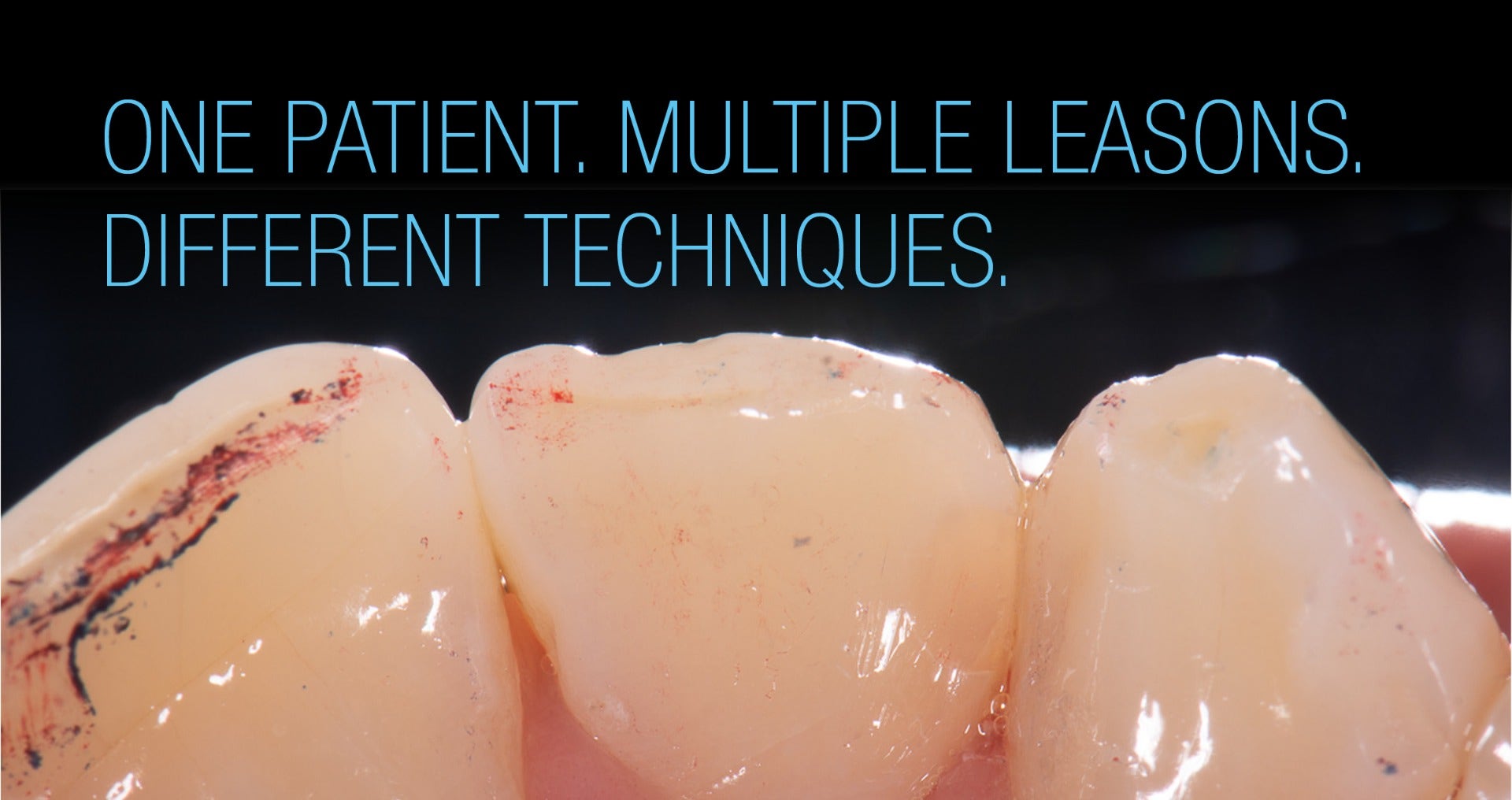
Different direct restoration techniques in one patient case

Case by Dr. Ioannis Memis


Single-shade or two-shade approach? Using modern resin composites, it is possible to treat virtually every patient in need of a direct restoration in an aesthetic way using one of those two techniques. If the defect is rather small, a single shade of composite restorative in a body opacity may be sufficient – especially when the tooth to be restored is in the posterior region. Larger defects and those located in the aesthetic zone may require a combination of two different shades – one as a dentin replacement and one as translucent as enamel – to closely imitate the optical characteristics of the natural tooth.


With CLEARFIL MAJESTY™ ES-2, Kuraray Noritake Dental Inc. offers a complete composite system designed to simplify procedures in bot, the single-shade and the two-shade approach. CLEARFIL MAJESTY™ ES-2 Classic is a typical composite for the single-shade technique consisting of 18 shades offered in a single universal opacity. Shade determination is brightness-based, meaning that the brightness is selected first and the hue and colour saturation in a second step (using the VITA Classical A1 – D4 shade guide). For those who want to skip shade determination completely, CLEARFIL MAJESTY™ ES-2 Universal has been introduced. It consists of only two shades for the anterior and one shade for the posterior region, selectable without using shade tabs. For the two-shade technique, CLEARFIL MAJESTY™ ES-2 Premium is the solution: It allows users to copy natural enamel and dentin layers with a total of seven enamel, seven dentin and four translucent shades. Its exceptional feature: pre-defined colour combinations with one Premium shade combination covering three VITA Classical shades. A natural blending into the environment is achieved with the Light Diffusion Technology in the formulation.


All three versions of CLEARFIL MAJESTY™ ES-2 are compatible with each other and offer the same favourable handling properties. The use of different techniques, shades and opacities is demonstrated using the following patient case.


YOUNG PATIENT WITH MULTIPLE CARIOUS LESIONS

A 24-year-old female patient was referred from undergraduate clinic of Operative Dentistry of the Aristotle’s University of Thessaloniki - School of Dentistry (Greece). Patient presented multiple interproximal carious lesions in need of restorative treatment. In the clinical and radiographic examination, the following defects were identified:


Quadrant 1 (maxillary right):

- Distal lesion on the lateral incisor (Class III)

- Mesial and distal lesions on the first premolar (Class II)

- Mesial and distal lesions on the second premolar (Class II)

- Mesial lesion on the first molar (Class II)


Quadrant 2 (maxillary left):

- Distal lesion on the lateral incisor (Class III)

- Mesial lesion on the first premolar (Class II)

- Mesial and distal lesions on the second premolar (both Class II)

- Mesial lesion on the first molar (Class II)


Quadrant 3 (mandibular left):

- Distal lesion on the first molar (Class II)

- Mesial lesion on the second molar (Class II)


In a stepwise procedure, the teeth were restored with CLEARFIL MAJESTY™ ES-2 either in a single-shade or in a two-shade approach depending on the size of the lesions.


INITIAL SITUATION

Fig. 1. Initial situation: Frontal view.


Fig. 2. Occlusal view of the maxilla.


Fig. 3. Occlusal view of the mandible.


RESTORING THE TEETH IN QUADRANT 1

The six carious lesions in this quadrant were restored in three steps. At first, the focus was on the first molar and second premolar. Opening the larger cavity mesially of the first molar provided access to the smaller lesion on the premolar’s distal surface. After caries excavation and cavity preparation, rubber dam was placed and fixed with a clamp on the second molar. The enamel in the cavities was treated with phosphoric acid etchant for 15 seconds before CLEARFIL™ Universal Bond Quick (Kuraray Noritake Dental Inc.) was applied according to the manufacturer’s instructions. For a morphologically correct designing of the proximal contact point and area, the use of a sectional matrix system with rings was utilized. Both cavities were restored with CLEARFIL MAJESTY™ ES-2 Premium in the shades A3D and A2E. Finishing and polishing of the occlusal surface accomplished with silicon cups and Twist Dia disks on a slow speed handpiece.


In the second step, the distal lesion on the first and mesial lesion on the second premolar were restored in an identical procedure with CLEARFIL MAJESTY™ ES-2 Premium in the shade A3D and CLEARFIL MAJESTY™ ES-2 Classic in the shade A3. A different approach was selected in step 3 for the lesions on the distal part of the lateral incisor and the mesial part of the first premolar. Due to the small size and the all-but-prominent position of the lesions, a single-shade technique using CLEARFIL MAJESTY™ ES-2 Classic in the shade A3 was selected. Between the lateral incisor and canine, a posterior sectional matrix was placed in an upright position and fixed with a wedge to support a proper restoration of the contact point, while both elements were used in the usual way between the canine and first premolar.


Fig. 4. Simultaneous restoration of the mesial lesion on the first molar and the distal lesion on the second premolar with CLEARFIL MAJESTY™ ES-2 Premium.


Fig. 5. Restoration of the distal lesion on the lateral incisor and the mesial lesion on the first premolar with CLEARFIL MAJESTY™ ES-2 Classic.


RESTORING THE TEETH IN QUADRANT 2

For the small disto-palatal lesion on the maxillary left lateral incisor, a single-shade technique with CLEARFIL MAJESTY™ ES-2 Classic in the shade A3 also produced aesthetic outcomes. The four lesions at the posterior region of the quadrant were restored in two steps – one for each pair of proximal lesions – with a combination of CLEARFIL MAJESTY™ ES-2 Premium in the shade A3D and CLEARFIL MAJESTY™ ES-2 Classic in the shade A1.


Fig. 6. A single-shade technique is sufficient to aesthetically restore this small lesion on the left lateral incisor.


Fig. 7. Simultaneous restoration of the mesial lesion on the second premolar and the distal lesion on the first premolar.


Fig. 8. Simultaneous restoration of the mesial lesion on the first molar and distal lesion on the second premolar.


RESTORING THE TEETH IN QUADRANT 3

In this quadrant, only a single pair of proximal lesions needed treatment. A simultaneous restoration procedure was selected once again due to the favourable space conditions. Although the size of the lesion was like those in the posterior region of the maxilla, a single-shade restoration was selected with the use of CLEARFIL MAJESTY™ ES-2 Classic (shade A3).


Fig. 9. Treatment of the lesions in quadrant 3.


CONCLUSION

In the present patient case, several different shades, opacities, and combinations of CLEARFIL MAJESTY™ ES-2 were utilized either in a single- or in a two-shade approach. All combinations and techniques produced good outcomes. As shown in Figure 4, the enamel opacity of CLEARFIL MAJESTY™ ES-2 Premium is visibly more translucent than the universal opacity of CLEARFIL MAJESTY™ ES-2 Classic. Experience shows that enamel shades translucency is highly valuable for aesthetic anterior restorations, while in posterior restorations, the universal shade approach is aesthetically adequate, particularly for medium-sized restorations, as shown in Figure 9. This is clearly an evidence of Light Diffusion Technology which is blending hue and colour saturation to the surrounding tooth structure.


Handling of all selected composite pastes is comfortable: non-sticky, adaptable to cavity walls and allowing precise occlusal sculpting. Polishing with Silicone Cups and TWIST DIA for Composite is easy, quick and leaves a natural gloss on the surface.Dentist:

DR. IOANNIS MEMIS

Postgraduate Student, Operative Dentistry Dept., School of Dentistry
Aristotle University of Thessaloniki, Greece


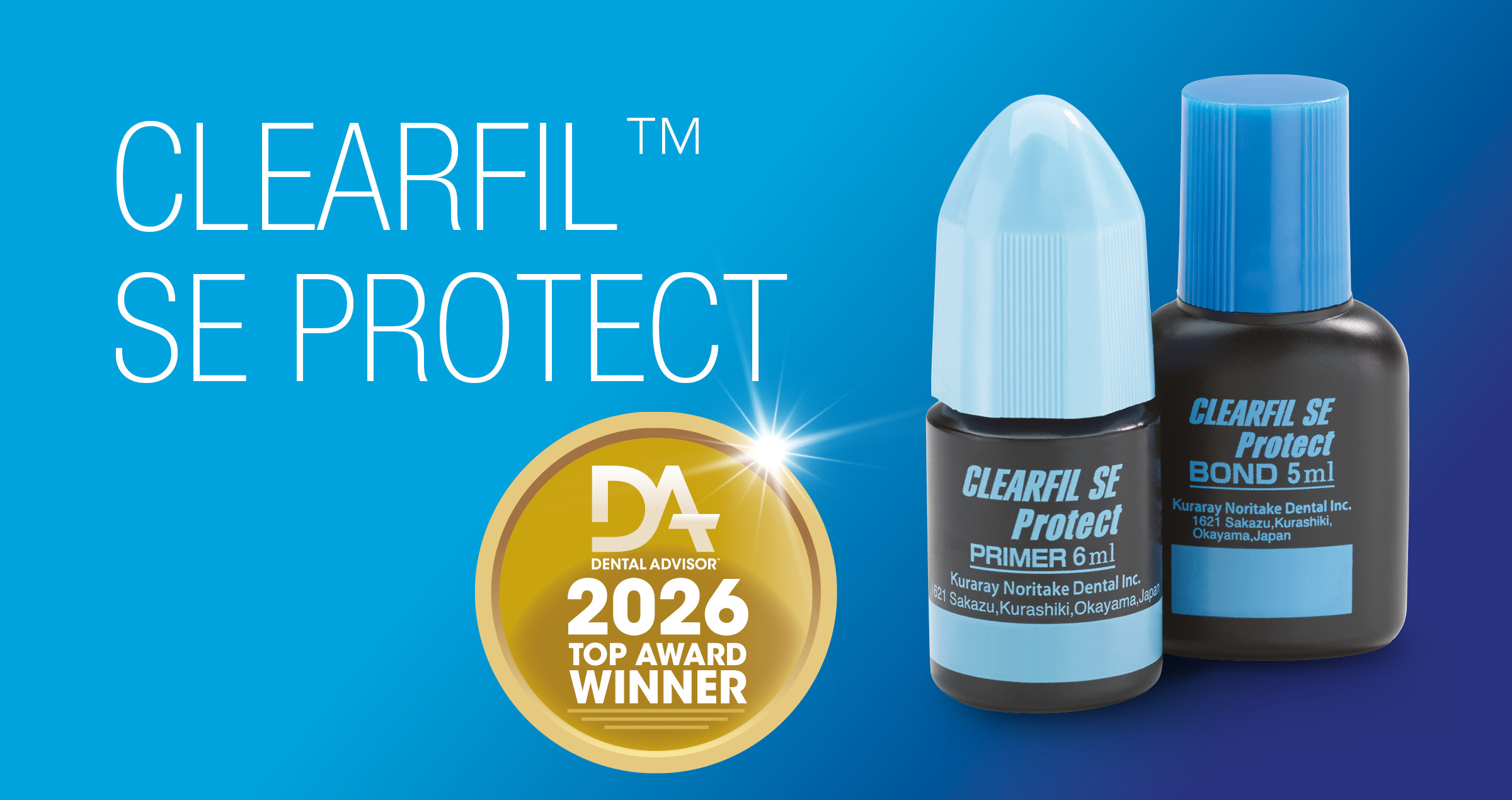
Self-etch adhesive with antibacterial properties

AWARD WINNING PRODUCT

For the 10th time, the self-etch adhesive CLEARFIL™ SE Protect has been named a Top Product by DENTAL ADVISOR, which announced its choices for dental materials and equipment found by its evaluators to deliver the best practice-based performance in its JAN/FEB 2024 issue.


The publication included CLEARFIL™ SE Protect among honorees in the Bonding Agent Self-Etch category, noting attributes that go far beyond providing a reliable bond.


ABOUT THE PRODUCT

This outstanding toolbox staple is built on the same system of the gold-standard adhesive CLEARFIL™ SE BOND, so it offers excellent bond strength for enamel and dentin. Its MMP inhibiting effect protects the bond from degradation over time and hence supports bond durability. Beyond that reliable bond, it provides an antibacterial cavity-cleansing effect that eliminates the need for the use of a separate cavity cleanser, thanks to the proprietary MDPB monomer it contains.


In short, CLEARFIL™ SE Protect offers you following benefits:

  • Fast and simple procedure with low technique sensitivity
  • Excellent bond strength for enamel and dentin
  • Long-lasting bond strength
  • Antibacterial cavity-cleansing effect
  • Virtually no post-operative sensitivity


It is also a highly versatile adhesive system that can be used in the context of:

  • Placing direct restorations
  • As a cavity sealant
  • For the treatment of hypersensitive or exposed root surfaces


Among the extended indications are cementation with composite resin cement or core build-up with self- or dual-cured resin materials in combination with CLEARFIL™ DC Activator.


EVALUATION

Its attributes are reflected in the study findings and comments of DENTAL ADVISOR’s editors and consultants, who assessed it over a six-week period during which over 150 restorations were placed. It received a 98% clinical rating by consultants using a 1-5 rating scale.


The practitioners evaluating the product found no post-operative sensitivity. Among their observations mentioned in the online DA report were the fact that the primer and bond wet the tooth evenly. They also considered the antibacterial and fluoride releasing qualities “an added benefit”. On the topic of sensitivity, they mentioned that “CLEARFIL SE Protect is effective in the reduction of sensitivity when placed on areas of recession or similar areas of sensitive tooth structure.”.


ABOUT DENTAL ADVISOR

The Top Product or Preferred Product Awards conferred by US-based DENTAL ADVISOR were initially introduced to help busy practitioners make sense of the numerous new solutions indicated for less invasive techniques, standardised or simplified procedures, ultimately to achieve better outcomes regularly.


DENTAL ADVISOR conducts its practice-based clinical evaluations and product performance tests shortly after product launch, and publishes results annually online to help potential users identify high-quality new dental materials and determine which among them are best suited to fulfill their individual requirements.


For more information visit the website of DENTAL ADVISOR: www.dentaladvisor.com


EENVOUDIG, VOORSPELBAAR EN HERHAALBAAR

Interview met Dr. Michał Jaczewski


Kan je de techniek kort beschrijven?


De Flowable Injection Technique biedt een eenvoudige, voorspelbare en reproduceerbare manier om restauraties uit te voeren met vloeibaar composiet. Het is gebaseerd op een wax-up, waarvan een siliconenindex wordt geproduceerd. Deze index dient vervolgens als mal voor het injecteren van de vloeibare composiet. Hierna wordt door de transparante siliconenmal, het composiet met licht uitgehard. Het belangrijkste voordeel is dat deze techniek werkt zonder, of in sommige gevallen met zeer minimale, weefselopoffering. Het is een populaire techniek voor zowel beginnende als ervaren tandartsen. Met behulp van een composiet met een uitgebalanceerde dekking, gebruikt in een dikte van ca. 0,3 mm en een speciaal polijstprotocol, creëer je een uitstekende morfologie en bereik je prachtige optische resultaten.


Wanneer ben je begonnen met het gebruik van de Flowable Injection Technique en wat zijn de belangrijkste indicaties?


Ik begon de techniek in 2018 te gebruiken. Oorspronkelijk was die ontwikkeld voor anterieure restauraties, maar tegenwoordig is hij ook succesvol toe te passen in het posterieure gebied. Ik vind het voornamelijk handig wanneer de vorm van meerdere tanden moet worden gecorrigeerd om de glimlach van een patiënt te verbeteren, ongeacht jong of oud. Dit is vaak het geval na een orthodontische behandeling. Na de regulering restaureer je op eenvoudige wijze en creëer je de perfecte vorm en esthetiek met behulp van deze niet-invasieve methode. Ik gebruik de Flowable Injection Technique ook voor een smile-make-over, om slijtage defecten te herstellen en de occlusiehoogte aan te passen in het geval van een volledige reconstructie. In het laatste geval is de restauratie mogelijk tijdelijk en wordt gebruikt voor een “proefrit” op middellange tot lange termijn. Maar ook vaak als definitieve restauratie.


Hoe begin je met de Flowable Injection Technique?


De belangrijkste fase die het succes van deze techniek sterk beinvloedt is de planningsfase. Die bestaat uit het maken van het behandelplan waaronder het vervaardigen van afdrukken, een wax-up en een mock-up, evenals de productie van de siliconenindex. Je kunt uiteraard op de traditionele manier werken met een siliconenafdruk en conventionele wax-up, maar het gebruik van digitale technieken verbetert de workflow aanzienlijk. Ik begin meestal met foto- en videodocumentatie en een digitale impressie. Registratie van de centrale relatie en occlusie zijn ook nodig. Vervolgens wordt een virtuele wax-up gemaakt met behulp van Digital Smile Design software (DSD). Bij deze stap is het belangrijk om rekening te houden met de gezichtskenmerken van de patiënt, bijvoorbeeld via het face-flow-concept. Gebaseerd op het resulterende ontwerp presenteer je een virtueel behandelresultaat en bespreek je deze met de patiënt. Eenmaal goedgekeurd wordt het model via de wax-up in verschillende versies vervaardigd: een volledige fuctionele wax-up en een alternerend, zogenaamd “interlip model”. Deze modellen gebruik je om de siliconen indexen te (laten) vervaardigen.


Digital Smile Design: Patiënt met ernstige slijtage.


Virtuele wax-up weergegeven in de mond van de patiënt.


Modellen afgedrukt op basis van de virtuele mock-up.


Siliconenindex geproduceerd op de alternerende (interlip) wax-up


Wanneer maak je meer dan één siliconenindex, en waarom?


Het is vooral nuttig om te werken met zowel de volledige als de alternerende siliconenindex wanneer alle tanden in de bovenkaak worden gerestaureerd. Met de alternerende index verkrijg je extra stabiliteit en leg je, vooral ten aanzien van de beoogde occlusale hoogte, de basis voor een trefzeker resultaat. In de onderkaak is het werken met de index en composiet lastiger vanwege de aanwezigheid van speeksel en beweeglijk zacht weefsel. Ik raad altijd aan om daar het werkgebied te verdelen in drie secties - één anterieure en twee posterieure - en die apart te bewerken.


Hoe bereid je de elementen voor en injecteer je het vloeibare composiet?


In de meeste gevallen is het enige wat je moet doen, het opruwen van het glazuuroppervlak voor de hechtingsprocedure. Ik zandstraal meestal met aluminiumoxide (50 μm op lage druk). Vervolgens ets ik het glazuur met fosforzuur en breng een universele bonding aan. De siliconenindex is voorzien van een injectieopening ter plaatse van de incisale rand. Hierin wordt gemakkelijk de naaldpunt van de vloeibarecomposietspuit naar binnen gebracht. Het is raadzaam om posterieur een harder materiaal voor de index te gebruiken en ter hoogte van de knobbels twee afzonderlijke gaten te maken voor elk element – één voor de injectie en één voor de ‘ontluchting’. Bij gebruik van een harde index is een diamantboor nodig om de gaatjes mee te maken. Ik plaats de index, injecteer de vloeibaar composiet van onderaf, hard het materiaal kort uit en verwijder de index. De finale polymerisatie voer ik uit na het verwijderen van de index onder een laagje glycerinegel. Zodra de overmaat aan composiet is verwijderd en het proximale deel van de restauratie geperfectioneerd is, wordt de procedure bij de andere elementen herhaald waarna de restauraties gepolijst worden.


Heb je favoriete producten voor de techniek?


Voor de siliconenindex gebruik ik Exaclear (GC), omdat dit de meest transparante silicone is die op de markt verkrijgbaar is. Maar er zijn meer fabrikanten die doorzichtig materiaal van goede kwaliteit leveren die uitstekend geschikt zijn voor het beoogde doel. Mijn favoriete composiet voor de Flowable Injection Technique is  CLEARFIL MAJESTY™ ES Flow  Low (Kuraray Noritake Dental Inc.). In mijn praktijk en tijdens mijn cursussen heb ik de kans om veel verschillende producten te testen. In deze context ontdekte ik dat het materiaal van Kuraray Noritake Dental een aantal voordelen biedt boven andere fabrikaten. Het is een modern nanocomposiet met een breed scala aan indicaties en een groot kleuraanbod. Met zijn drie vloeibaarheden biedt het flexibiliteit en is het in te zetten tijdens veel verschillende klinische situaties. Ik begon het vijf jaar geleden te gebruiken voor de Flowable Injection Technique. De variant met de middelste viscositeit (Low) is mijn eerste keuze, omdat deze de meest universele is, geschikt voor zowel anterieur als posterieur. De meest doorslaggevende voordelen die van invloed waren op mijn beslissing zijn de natuurlijke esthetiek en superieure polijstbaarheid. Je bereikt een spectaculair effect zonder extreme vaardigheden aan te moeten leren. Mijn voorkeursbonding is CLEARFIL™ Universal Bond Quick, dit onder andere om mijn workflow nog eenvoudiger, sneller en voorspelbaarder te maken. Voor het polijsten heb ik mijn eigen protocol ontwikkeld.


Hoe werk je restauraties af en polijst je ze?

Ik begin in het proximale gebied met polijststrips en soms een proximale zaag. Voor vormaanpassingen gebruik ik drieverschillende diamant- en hardmetalen boren die hun waarde hebben bewezen. Vervolgens ga ik over tot fijn of extrafijn afwerken met schuurschijfjes en hierna polijst ik met de flexibele polijstrubbers, TWIST DIA™(Kuraray Noritake Dental), die al een mooi, natuurlijk, glanzend oppervlak creëren. Hierna gebruik ik een wielvormige borstel van geitenhaar met diamantpolijstpasta en ten slotte een katoenen borstel met een aluminiumoxide-polijstpasta. Op deze manier creëer je een prachtige natuurlijke hoogglans.


Etsen van het glazuur met fosforzuur.


Volledige siliconenindex op zijn plaats.


Aanbrengen van CLEARFIL™ Universal Bond Quick.


Situatie onmiddellijk na de injectie van CLEARFIL MAJESTY™ES Flow (Low), lichtuitharding en verwijdering van de siliconenindex.


Proximale aanpassingen met roterende instrumenten.


Wat zijn de grootste voordelen van de Flowable Injection Technique?


Voor patiënten en tandartsen zijn de grootste voordelen besparing in tijd en geld. Veel patiënten zijn heel blij met dit kwalitatief hoogwaardig alternatief voor keramische veneers. De procedure vereist geen voorbereiding. Indien gewenst zijn aanpassingen in vorm en kleur eenvoudig te realiseren. Het is een behandelingsoptie met slechts een beperkt risico. Als tandarts kan je vaak al beginnen met het behandelen van patiënten na het volgen van één goede cursus. Wetende dat oefening leidt naar perfectie, zijn de eerste resultaten toch vaak al behoorlijk indrukwekkend, zodat er geen sprake is van enorm investeringen voor beginners – noch in tijd, noch in nieuwe materialen. Natuurlijk kun je veel tijd investeren in de afwerkings- en polijstprocedure, maar ik weet zeker dat u de juiste balans tussen inspanning en resultaat zult vinden.

Michal's instrumentenset voor gebruik bij de Flowable Injection Technique


Heb je een aanbeveling hoe de techniek te gebruiken?


Allereerst wil ik iedereen aanmoedigen om de comfortzone te verlaten, probeer regelmatig iets nieuws. Voor mij is het werken met de Flowable Injection Technique echt een gamechanger gebleken en ik zou nooit meer zonder willen. Voordat je de techniek toepast in de praktijk, adviseer ik zeker een cursus te volgen die je alles leert. In ieder geval de theoretische kennis die nodig is voor een succesvolle eerste behandeling en misschien zelfs een praktische workshop. Ik bied beide soorten regelmatig aan met mijn lezingen en hands-on cursussen.


Michał Jaczewski tijdens zijn presentatie op de Kuraray Noritake Dental-stand in Keulen (IDS 2023).


Abonneer u op onze nieuwsbrief
Sluit u aan bij duizenden tandheelkundige professionals en ontvang gratis advies dat u en uw carrière kan helpen. We zullen uw e-mailadres niet spammen of delen.